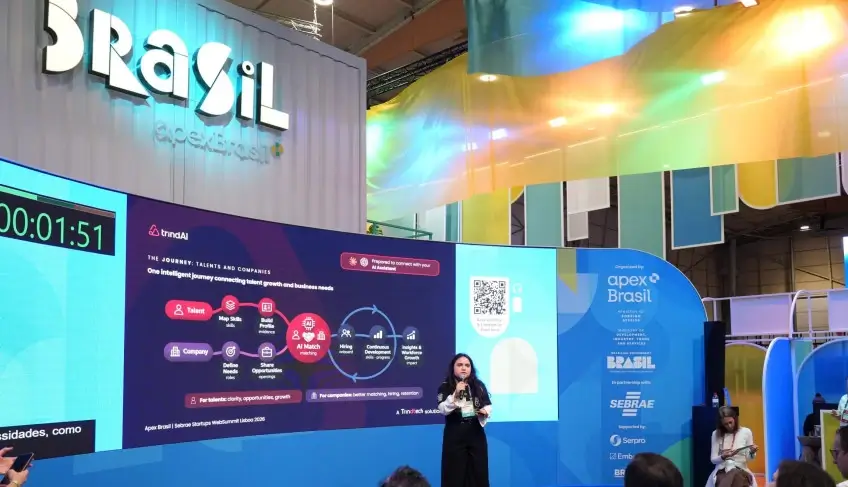
Solutions for food waste and clean energy are highlighted at the Brazil Pavilion in Lisbon.
Nine startups supported by Sebrae and ApexBrasil presented their technologies to international investors at Web Summit 2026 in the Portuguese capital.
A technology that offers food close to its expiration date, a system that automates the management of renewable energy credits, and a platform that connects family farmers to companies interested in environmental compensation. Nine Brazilian startups presented their businesses to international investors at the Brazil Pavilion at Web Summit Lisbon 2026, on Thursday morning (12). Considered one of the largest global technology and innovation events, WSL expects to receive 70,000 people at this edition.
The pitch session coordinated by Sebrae and ApexBrasil brought together representatives from LatamTech Hub, Cueva Group, OW Ventures, COREangels, and the UK’s Office for Investment. For the startups, it was an opportunity to showcase results already achieved, seek investment, and establish contact with potential partners abroad.
Vinicius Lages, manager of the International Advisory Department at Sebrae, explains that the institution helps these businesses take the next step. “It’s great to see the confidence of Brazilian entrepreneurs here in Lisbon. While COP31 renews its commitment to decarbonization, Sebrae supports small businesses in the energy transition and bioeconomy. These are two areas where innovation is possible and where contributions can be made to reducing emissions,” says Lages.
From supermarkets to renewable energy plants
Gander has developed an artificial intelligence tool that integrates with supermarket management systems, identifies products nearing their expiration date, calculates discounts, and promotes offers through delivery apps and digital channels. This allows retailers to sell merchandise in time, and consumers have access to lower prices. The solution already serves 5,000 stores across 25 retail chains in 10 countries.
Gander’s CEO, Ricardo Salazar Farias, says that the support from Sebrae and ApexBrasil was crucial in overcoming regulatory obstacles and finding a partner in Europe. “In our case, it saved our company. A company that, until a month ago, we were thinking of closing, we managed to find a partner and expand in Europe. Sebrae and Apex were fundamental to our growth.”
Brazilian mining company Digital Grid brought to Lisbon a platform that automates the management of energy credits from renewable energy plants with a capacity of up to 5 megawatts. The tool cross-references generation and consumption data, distributes credits among clients, and issues invoices. According to the company, the solution serves more than 250 clients and 5,000 consumers in Brazil. In Lisbon, the startup seeks to raise US$1 million to expand its operations.
“Renewable energy plants are growing rapidly, but they face many technological challenges. They don’t know how to manage energy, they don’t know how to send invoices at scale, and they lose a lot of money every month,” said Renan Souza, founder and CEO of Digital Grid, during the presentation.
Agroforestry systems create opportunities for family farmers.
Agroforestree, a company from Santa Catarina, connects companies interested in environmental compensation with family farmers who maintain agroforestry systems. The model combines the planting of native species with food production and the recovery of degraded soils. The startup uses artificial intelligence, blockchain records, and geospatial data to track planted trees. Presented in Lisbon by Marcelo Shama, the company received an investment of R$ 340,000 from FDC Angels in 2025 and is seeking partners in Europe.
“When we support agroforestry systems, we are also restoring the soil, stimulating biodiversity, producing food, and creating economic opportunities for small farmers,” said Gabriel Neto, founder of Agroforestree.
Also part of the mission, the São Paulo-based company Carbono Zero brought Reciclinho to Lisbon, a platform that uses AI to identify what industry workers already know about environmental practices and offer personalized training. The tool addresses topics such as selective collection, disposal of batteries and waste management. According to Nathália Duque, a representative of the company, the platform updates an educational character created by her father in 1995: “More than 30 years later, the opportunity arose to give new life to this idea, combining environmental education, technology and artificial intelligence.”
From inventory control to your first job.
Among the startups that took the stage at the Brazil Pavilion were also:
- Checkbits: introduced an application that digitizes audits, maintenance routines, and food safety controls. According to the company, the tool helped reduce audit costs by 77% across the 21 stores of the Hickmann Supermarkets chain.
- Cloud Storm demonstrated how it uses AI to detect and correct flaws in cloud systems. In one of the cases presented, incident resolution time at Manet dropped from seven and a half hours to five minutes, according to the startup.
- TrindAI presented a platform that maps the skills of young people seeking their first job and connects them with job openings and professional development opportunities. According to the company, the tool has mapped more than 2,000 young people in six months of operation. IseTool, Na Porta, and PlurieBR also participated in the session.
Biotechnology and global scale in the afternoon program.
The Brazilian Pavilion’s program at Web Summit Lisboa 2026 continues this Thursday (12) at 2:30 pm, Lisbon time, with a debate on the international expansion of startups. Participants include Vinicius Lages (Sebrae), Paula Akitaya (ApexBrasil), Daniel Papa Garcia (Ministry of Entrepreneurship) and Márcio Steffani (Finep). At 3 pm, the Sebrae Startups Talk presents Brazilian solutions in biotechnology and health, focusing on well-being and precision medicine.
Source: www.agenciasebrae.com.br
Source link