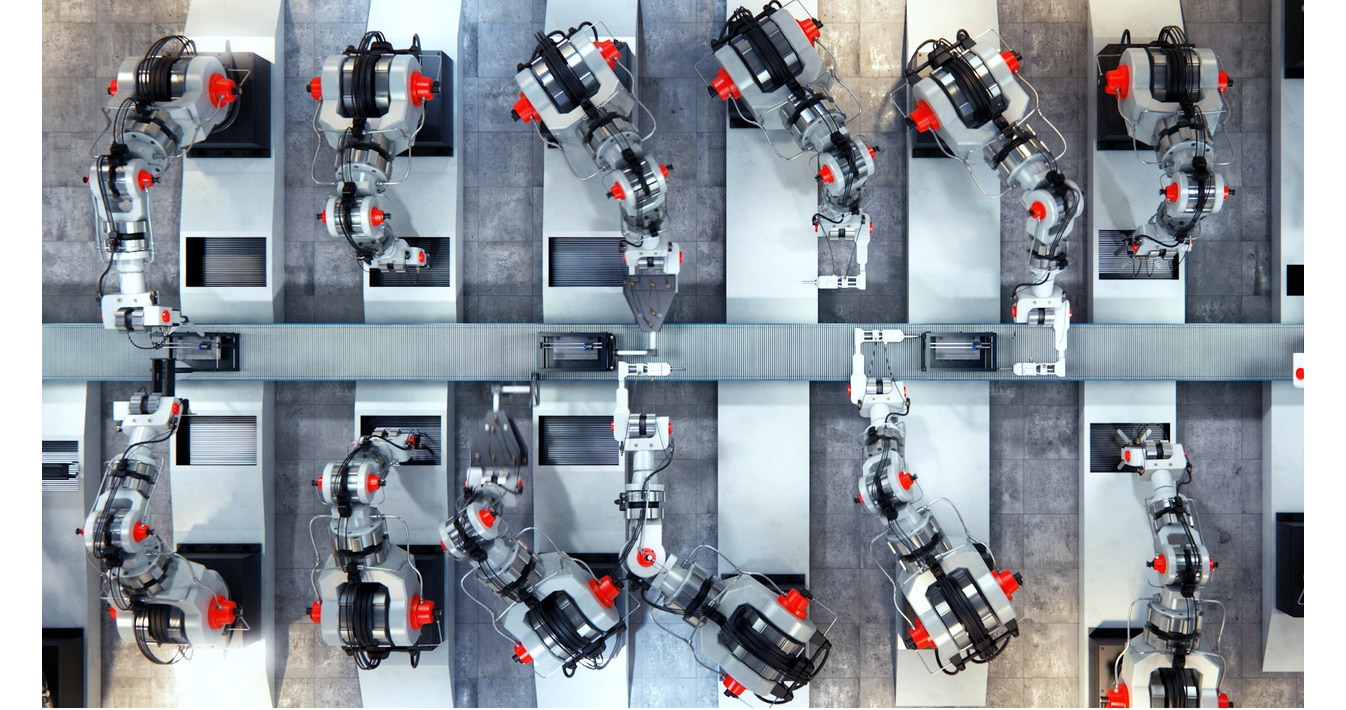
For decades, industrial robots have been extraordinarily good at doing exactly what they were told. Move this. Grip that. Repeat. The moment something unexpected happened — an object slightly out of place, a different lighting condition, a task that wasn’t in the script — the robot stopped, or worse, failed silently.
That era is ending.
At SC’26, Dell is demonstrating a humanoid robot that doesn’t just execute instructions — it perceives its environment, plans a response, acts and adapts based on what actually happens. The difference isn’t cosmetic. It represents a fundamental shift in how robots are built, trained and deployed.
From hard-wired to aware: perceive, plan, act, adapt
Walk through a manufacturing facility today and you’ll see robots performing highly repeatable tasks — moving a component from point A to point B thousands of times, following a predefined trajectory with predetermined gripper positions and motor settings. That repeatability is valuable. But it shouldn’t be confused with awareness.
Physical AI introduces something different. Instead of programming every movement, you give the robot a goal and let it interpret that goal in the context of its surroundings and physical capabilities. Vision-language-action models connect visual perception and language instructions with embodied control — helping a robot relate an instruction to the physical world in real time.
Ask the robot to move a disk drive from one location to another, and rather than following a fixed series of coordinates, it must understand the request, identify the object, determine how to handle it and adjust as the task unfolds. Perceive. Plan. Act. Adapt. Continuously, in a loop.
The pipeline problem nobody talks about
A capable model is necessary but not sufficient. The harder challenge is building the infrastructure that takes a robot from raw task demonstrations to reliable physical action — and keeps improving it over time.
Dell Applied Research built and validated exactly that: a connected pipeline organized across three distinct compute environments; each matched to its workload.
Training compute: Dell PowerEdge infrastructure with NVIDIA GB300 GPUs — handles data preparation, model fine-tuning and checkpoint evaluation. For this work, approximately 250 teleoperated demonstration episodes were collected across varied operator positions, then used to adapt NVIDIA’s GR00T vision-language-action model to the specific robot, task and workspace.
Simulation and validation compute: a PowerEdge R770 with NVIDIA RTX PRO 6000 GPUs running NVIDIA Isaac Sim — represents the robot, end effector, sensors, objects and workspace before anything touches the physical system. Critically, the team ran hardware-in-the-loop validation before deployment: the GR00T model running on the actual edge hardware (NVIDIA IGX) controlled the simulated robot, surfacing integration and timing issues in simulation rather than on the physical robot.
Deployment compute: NVIDIA IGX for real-time perception, manipulation inference and low-latency control. Dell Pro Max with GB10 for speech, planning, orchestration and non-time-critical workloads — connects the validated model to cameras, actuators and control interfaces at the edge.
The architecture matters because training, simulation and deployment have fundamentally different compute requirements. Trying to run the entire pipeline on the robot, or on a single class of infrastructure, creates bottlenecks at every stage. Separating the environments while keeping them tightly connected is what allows data, models and validation results to flow continuously from demonstration to physical action — and back again.
The feedback loop is the point
What distinguishes this pipeline from a one-time deployment exercise is what happens after the robot acts. Runtime observations from the physical system feed back into simulation and training in real time. The digital twin gets refined. The model improves. The next action benefits immediately from what just happened.
This is what now makes Physical AI a continuous process rather than a project with a finish line.
The SC’26 demonstration — a humanoid identifying, picking and placing a disk drive on demand — is a bounded task by design. It isn’t a claim of unrestricted autonomy or a production-ready solution. It’s proof that the full pipeline works: from demonstration data through training, simulation, hardware-in-the-loop validation and physical execution, with observations flowing back in real time to close the loop.
For teams building or deploying robots, that’s the result that matters. Not just a robot that can do a task, but a validated path for getting any robot to do any task — and getting better at it continuously.
Dell reported this
Source: www.dell.com
Source link