Unification of Relativity and Quantum Mechanics
Quantum entanglement—the connection that forms between two particles, causing one to instantly influence the other regardless of the distance separating them—is the basis of most quantum technologies, including quantum computers.
Meanwhile, in the more general world of physics, there is a heated debate about whether the force of gravity is quantum or not. Knowing this is crucial to eliminating inconsistencies between Quantum Mechanics itself, which explains things at the molecular and atomic level and below, and the Theory of Relativity, which explains things at cosmic levels.
There are several ideas for unifying Relativity and Quantum Mechanics, the most common being the proposal that gravity acts through particles, hypothetically called gravitons. If this is the case, it would prove that the force of gravity is quantum.
Theories and hypotheses accept almost anything, but the problem is experimentally proving the existence of gravity particles – nobody knows how to do it, and most agree that, if it is possible, we don’t yet have the technology for it.
Ryotaro Fukuzumi and colleagues at Kyushu University in Japan then had a brilliant idea: To test whether gravity interacts with quantum entanglement. Or, put another way, to generate gravity-induced quantum entanglement, in which two objects that interact only through gravity become intrinsically linked. If this “gravitationally induced entanglement” emerges, then the quantum nature of gravity will be proven.
[Image: Kazuhiro Yamamoto/Kyushu University]
Gravity-induced quantum entanglement
The problems start early: Gravity-sensitive objects are too large for quantum entanglement, and gravity is too weak for very small objects.
That’s where the innovation comes in: We just need to amplify the effects to the point where we can measure them.
Let’s go back to the beginning: One way to make the hypothetical quantum effects generated by gravity observable is to carefully control relatively large objects so that they enter the quantum regime. This can be done by cooling the large objects to near their lowest energy state, called the ground state, which can be achieved through cryogenic cooling.
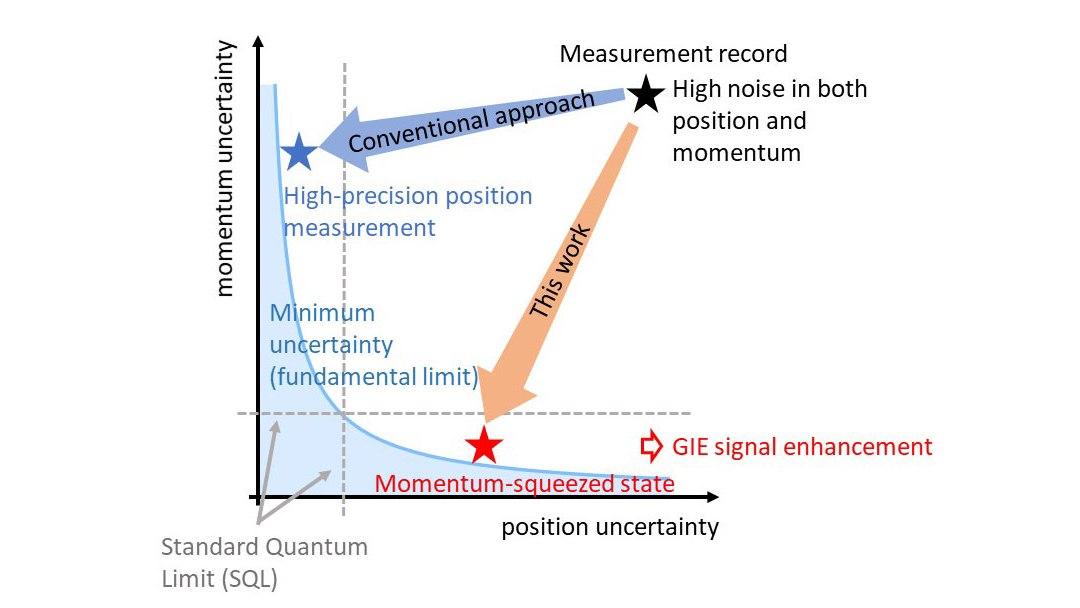
At this point, random thermal motion is minimized. In this state, quantum behavior becomes easier to detect. The object’s position and momentum are then governed by Heisenberg’s uncertainty principle, which states that none of these properties can be known with perfect precision.
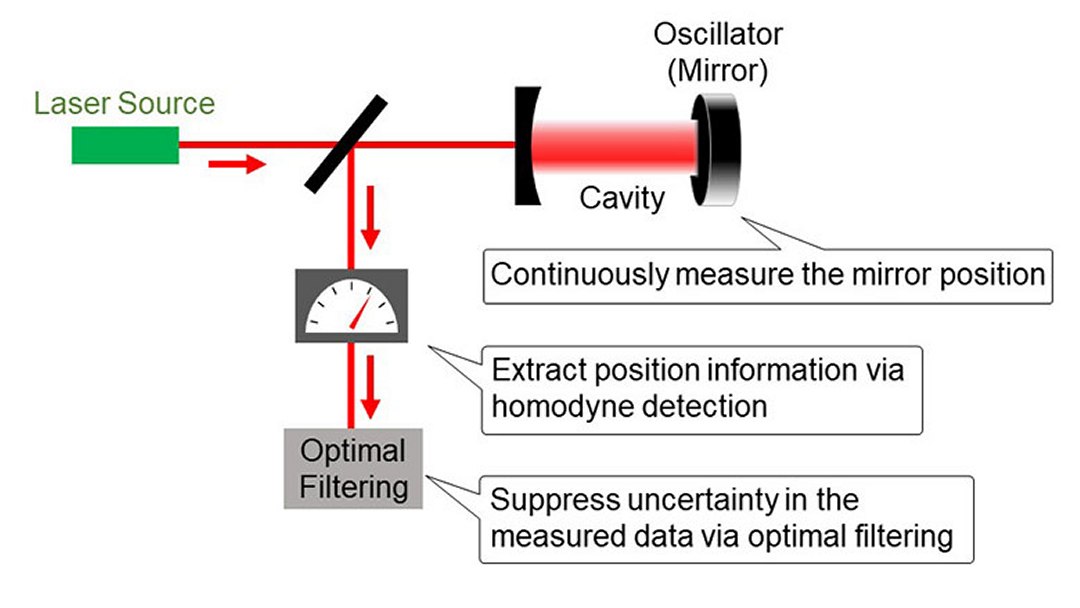
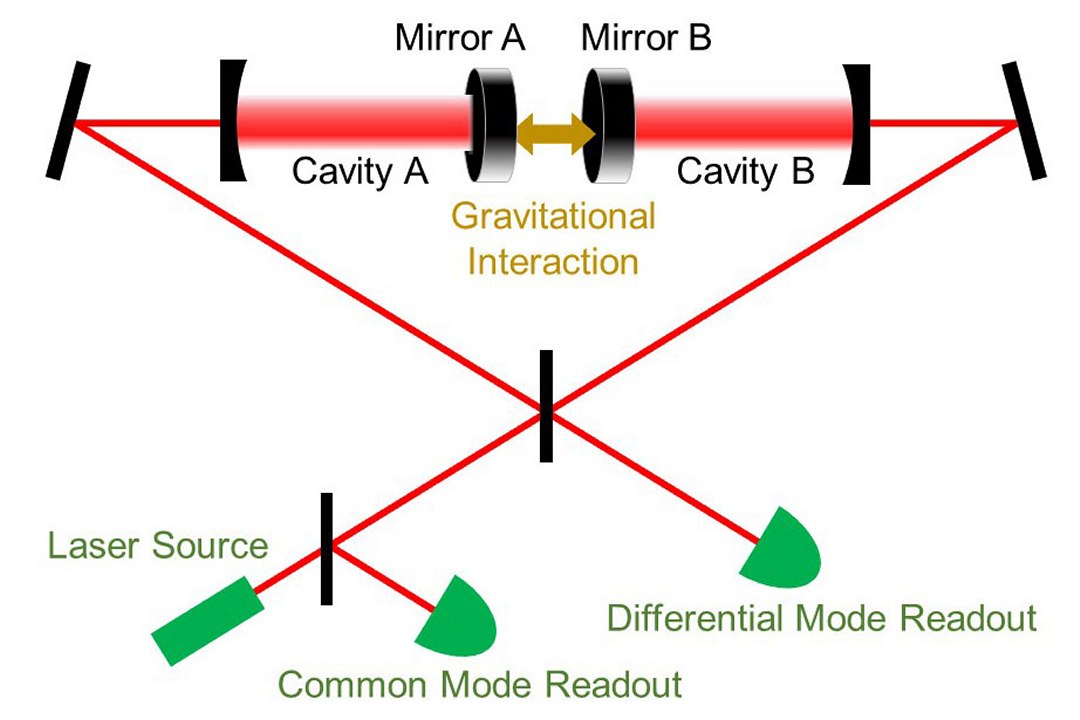
The idea is to test quantum entanglement between two mirrors large enough to interact through gravity. But the platform needs to do more than that: It needs to handle the momentum and position of the mirrors, essentially “amplifying” one of these properties so that it can be measured with the necessary precision.
[Image: Kazuhiro Yamamoto/Kyushu University]
Compressing the moment
The proposal involves using moving mirrors to create what researchers call “compressed momentum.” In quantum mechanics, compression reduces uncertainty in one property, such as momentum, while increasing uncertainty in another, in this case position.
In the compressed momentum state envisioned by the researchers, the mirror’s momentum becomes very precise, while its position becomes more diffuse. As a result, the mirror exists in a quantum superposition over a larger region of space.
“We have demonstrated that using this compressed momentum state significantly amplifies the quantum superposition of the mirror’s position, thus considerably amplifying the quantum entanglement signal generated by gravity. This represents a new strategy that will be advantageous for future experiments verifying the quantum nature of gravity,” explained Professor Kazuhiro Yamamoto.
The proposed device – for now only a project – consists of an optomechanical cavity system, in which the movement of a mirror can be controlled with high precision using laser light trapped in an optical cavity. With the two mirrors close enough, the quantum entanglement signals will become stronger through their gravitational interaction. As the momentum becomes more precise, the mirror’s position becomes less certain and spreads over a larger area. This greater dispersion strengthens the measurable signature of the quantum effects of gravity, making quantum entanglement easier to detect.
By continuously measuring the emitted light and carefully processing the signal to reduce thermal noise (an optical quantum filtering), the compressed momentum state can emerge, making the long-awaited experiment feasible. And the team believes that the conditions necessary to create the compressed momentum state are within reach of current technology. “In particular, it is believed that the possibility of generating and detecting gravity-induced entanglement will be further enhanced with the use of low-noise environments, such as extremely low temperatures and high vacuum or outer space,” said Yamamoto.
Source: www.inovacaotecnologica.com.br
Source link