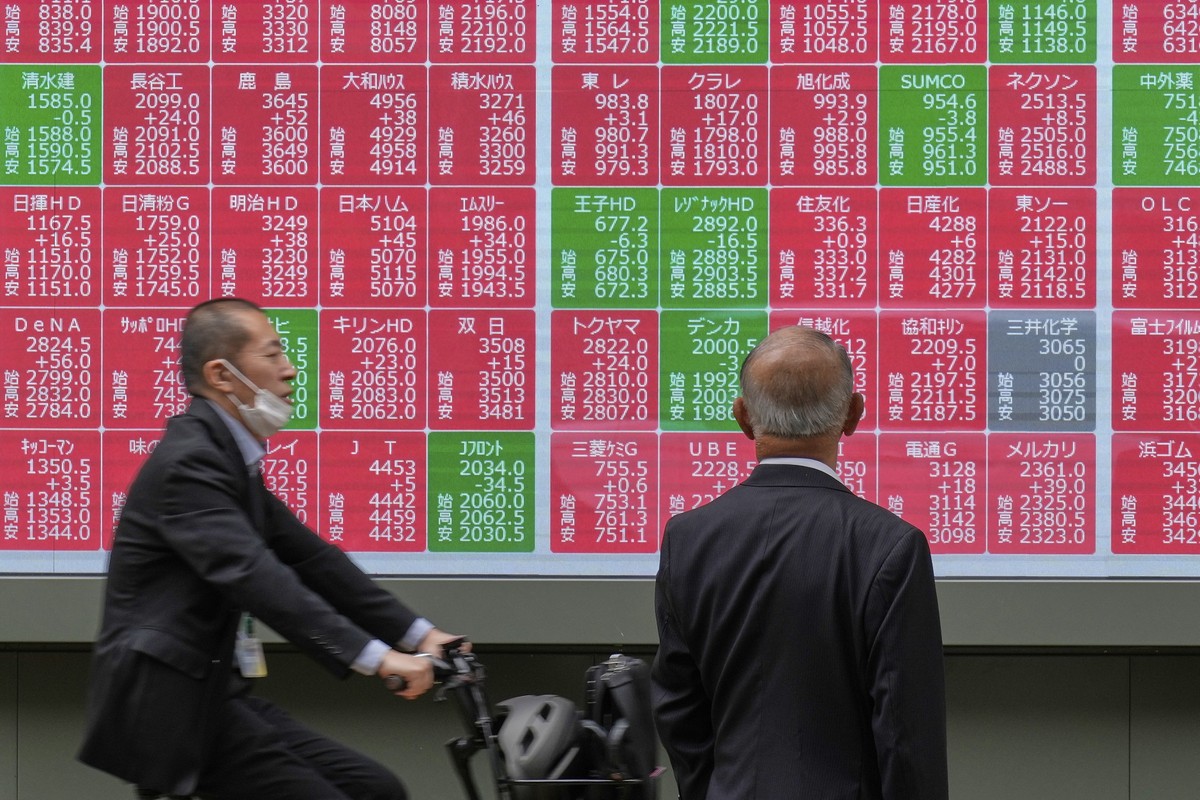
Stock markets in Asia closed sharply lower this Monday, with the increase in hostilities in the Middle East pushing up oil prices and with investors dumping the most promising shares linked to artificial intelligence (AI), fearing that the appreciation had gone too far and too fast.
The Nikkei 225 index, in Tokyo, closed down 3.85%, at 64,024.60 points and the Kospi index, in Seoul, dropped 8.2%, at 7,484.41 points. In Hong Kong, the Hang Seng fell 1.22%, to 24,657.06 points, and, in mainland China, the Shanghai Composite index decreased 1.70%, to 3,959.33 points.
The two main factors triggering the decline in technology stocks were chipmaker Broadcom’s disappointing outlook last week and a surprisingly strong U.S. jobs report on Friday, which led investors to price in an interest rate hike by the Federal Reserve later this year.
The escalation of the conflict in the Middle East also affected market sentiment, after Israel said it had attacked military targets in western and central Iran, which boosted Brent crude futures by 5%. “The market has come a long way without a correction,” said Lars Skovgaard, senior investment strategist at Danske Bank. “The big surprise is not that there was a wave of sales, but that it didn’t happen sooner.”
The Seoul stock market index, with a strong presence of companies in the semiconductor sector and the best performance in the world this year, led the losses with a drop of more than 8%, which represents a devaluation of more than 16% in relation to last week’s historic high. The Nikkei fell nearly 4%, with market favorites across the computer chip production supply chain suffering the biggest declines.
“The move looks more like a positioning adjustment and unwinding of momentum than a reassessment of the long-term story of AI,” said Marc Velan, head of investments at Lucerne Asset Management in Singapore. “South Korean technology companies were among the best performers globally and were widely traded, so when interest rate expectations changed following the jobs report, they became a natural source of liquidity.”
The Shanghai Composite registered its lowest level since April 8 and the Hang Seng registered its lowest level since the end of March. The experience of this year’s March sell-off at the start of the war with Iran is giving some market participants confidence in their ability to weather short-term volatility.
“From a short-term perspective, there is a bubble in China’s AI stocks,” said Charles Wang, president of Shenzhen Dragon Pacific Capital Management Co. “But on a long-term horizon, the market is still healthy.”
The Shanghai Composite index reversed all year-to-date gains after rising more than 7% at its peak. The Chinese stock market remains in a short-term correction phase, but the pace of the pullback is expected to slow considerably from now on, said Li Qiusuo, chief domestic strategy analyst at CICC. “At this point, there is no reason to be overly concerned,” he said. The Shanghai Composite is up 10% since its March low. Li predicts 6% growth in Chinese stock profits this year, the strongest since 2021.
The rally in technology stocks in China this year has focused on the chip supply chain, closely mirroring the performance of global stocks such as Micron and Nvidia as Beijing seeks self-sufficiency in semiconductors. “The fundamentals of AI infrastructure remain robust,” said Zeng Wenkai, chief investment officer at Shengqi Asset Management. “This global sell-off is simply a normal correction following substantial profit-taking.”
Source: www.bing.com
Source link