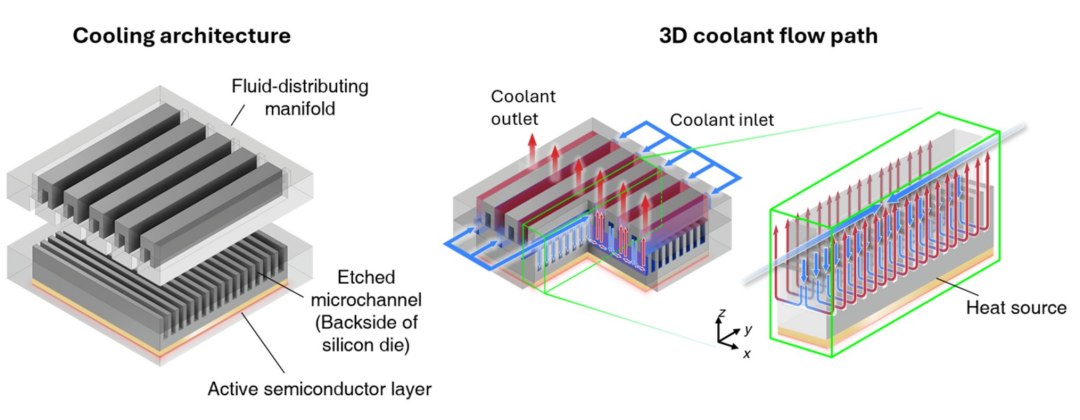
Microchannels remove maximum heat.
By incorporating cooling channels thinner than a human hair directly inside a silicon semiconductor chip, researchers were able to keep the chip’s temperature below 100°C using only room temperature water.
Even under extreme heat generation conditions, exceeding 2,000 watts per square centimeter (W/cm2 ) , the test processor never exceeded the established temperature limit.
In current processors, the coolant needs to travel through numerous microchannels from one end of the chip to the other. This long path increases resistance to coolant flow, requiring greater pumping power to circulate the liquid.
Young Lee and colleagues at the Korea Advanced Institute of Science and Technology (KAIST) have now used a multifaceted microchannel structure embedded directly within the silicon chip: The multi-distribution structure developed by the team moves the coolant fluid through multiple inlet channels and multiple outlet channels.
It works more or less like a product distribution network: Instead of sending all goods from a single origin to a distant destination, several distribution centers are strategically positioned to shorten transport distances. Because the refrigerant fluid travels only a short distance in each channel, the resistance to flow is much lower, requiring a similarly reduced pumping pressure.
Another advantage is that the coolant is supplied more evenly throughout the chip, helping to maintain a more uniform temperature distribution across the processor.
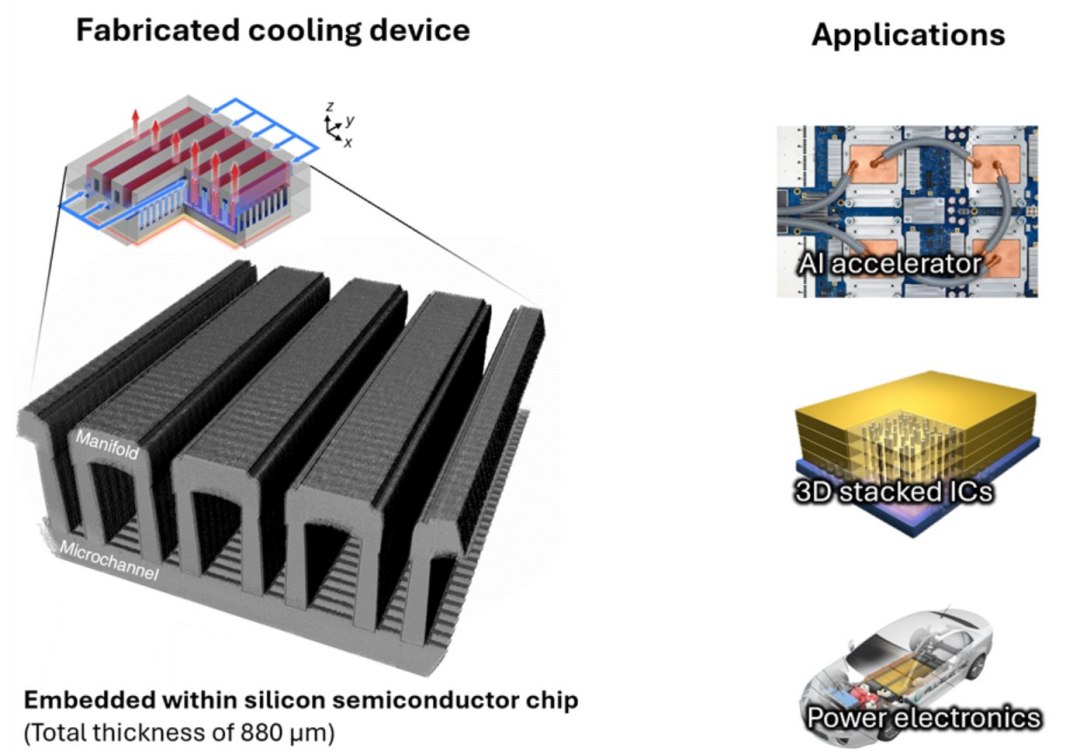
No exotic technologies, just water.
The innovation goes beyond reducing the size of the microchannels: The researchers systematically optimized the width, height, number, arrangement, and refrigerant flow rate of the channels to maximize cooling performance and minimize energy loss. To do this, they employed a multifidelity optimization framework, starting from a fast one-dimensional model to explore increasingly larger design spaces, and then refining the selected designs until they obtained one that satisfied them.
The optimized structure was then fabricated on a real silicon semiconductor chip and experimentally validated. Under the same temperature increase conditions, the cooling system achieved a coefficient of performance (COP) of 106,000, which is approximately 10 times higher than the previous record holder, presented in 2020 , which had a COP of around 10,000.
In practical terms, this means that only about one-tenth of the pumping power is needed to remove the same amount of heat. And this is without using any exotic or economically unfeasible technologies, such as phase-change cooling, nanoscale surface modifications, or expensive materials like diamond – it’s just water circulating in optimized microchannels.
“As the performance of AI semiconductors and advanced electronic packages becomes increasingly constrained by heat, we expect this technology to serve as a fundamental cooling solution for future high-performance computing systems,” said Professor Sung Kim.
Source: www.inovacaotecnologica.com.br
Source link