
Media and entertainment companies are full of AI ambition. The opportunity now is how to turn those ideas into repeatable, governed workflows that fit seamlessly into production, post-production and content operations. What we often hear isn’t a lack of ideas or successful pilots. Teams have already started by testing AI and showing where it can make an impact. The real challenge is the next step: scaling the early wins to measurable ROI, operational consistency and clear business value. That is where we have been focused — helping organizations get to their next step with Dell AI Data Platform, designed for your entire AI lifecycle. What makes this platform especially unique is it’s not a one-size-fits-all approach, but an open platform to support the complexity and pace of modern media and entertainment environments.
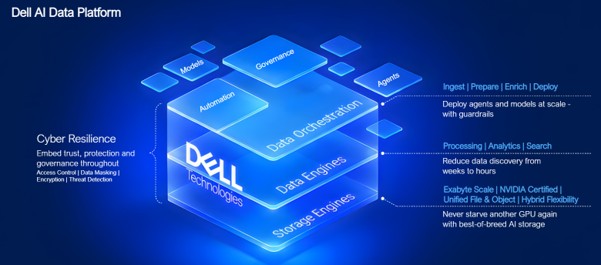
At a high level, Dell AI Data Platform provides an enterprise approach for organizations that want to move beyond experimentation and start building AI capabilities they can actually operationalize at scale — using best-of-breed tools in a modular architecture that avoids lock-in to rigid, proprietary solutions. The Data Orchestration Engine is a key part of that broader solution, serving as the orchestration layer that helps customers move enterprise AI from pilot to production faster, improve retrieval accuracy and response quality across multimodal data, reduce operational overhead with unified AI workflow automation and deliver consistent AI execution across hybrid and distributed environments. NVIDIA also plays a key role through its marketplace by providing validated blueprints that help standardize how these capabilities are deployed, giving organizations a clearer path to scale enterprise AI. For Media and Entertainment, the NVIDIA Blueprint to build a video Search and Summarization (VSS) agent is a strong example of how Dell AI Data Platform with NVIDIA can enable advanced AI-driven visual content workflows in a practical, enterprise-ready way. That is what we are showcasing at SIGGRAPH 2026, the leading conference for computer graphics, visual effects and digital media. For media and entertainment, the opportunity is not just better models, but better control over the content, metadata, workflows and governance that make those models useful in the first place.
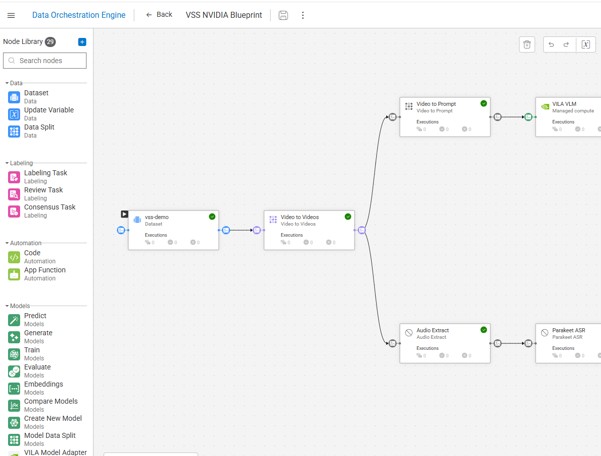
That challenge is easy to underestimate from the outside. Creative organizations are dealing with enormous and growing data estates, complex asset histories, multiple delivery formats and workflows that span production, post-production, marketing, archives and distribution. In our own discussions, we kept coming back to a simple reality: even when companies have valuable content, it can still be difficult to know exactly what they have, where it sits, how it is described and how quickly it can be reused. This is where the Data Orchestration Engine becomes far more than a technical feature. The Data Orchestration Engine helps organizations get better AI outcomes by managing content through multimodal data management, enriching it for use in AI workflows and continuously improving performance through built-in evaluation and feedback. Rather than forcing media companies to rip and replace existing tools or storage environments, it creates a controlled path between raw content and practical AI outcomes.
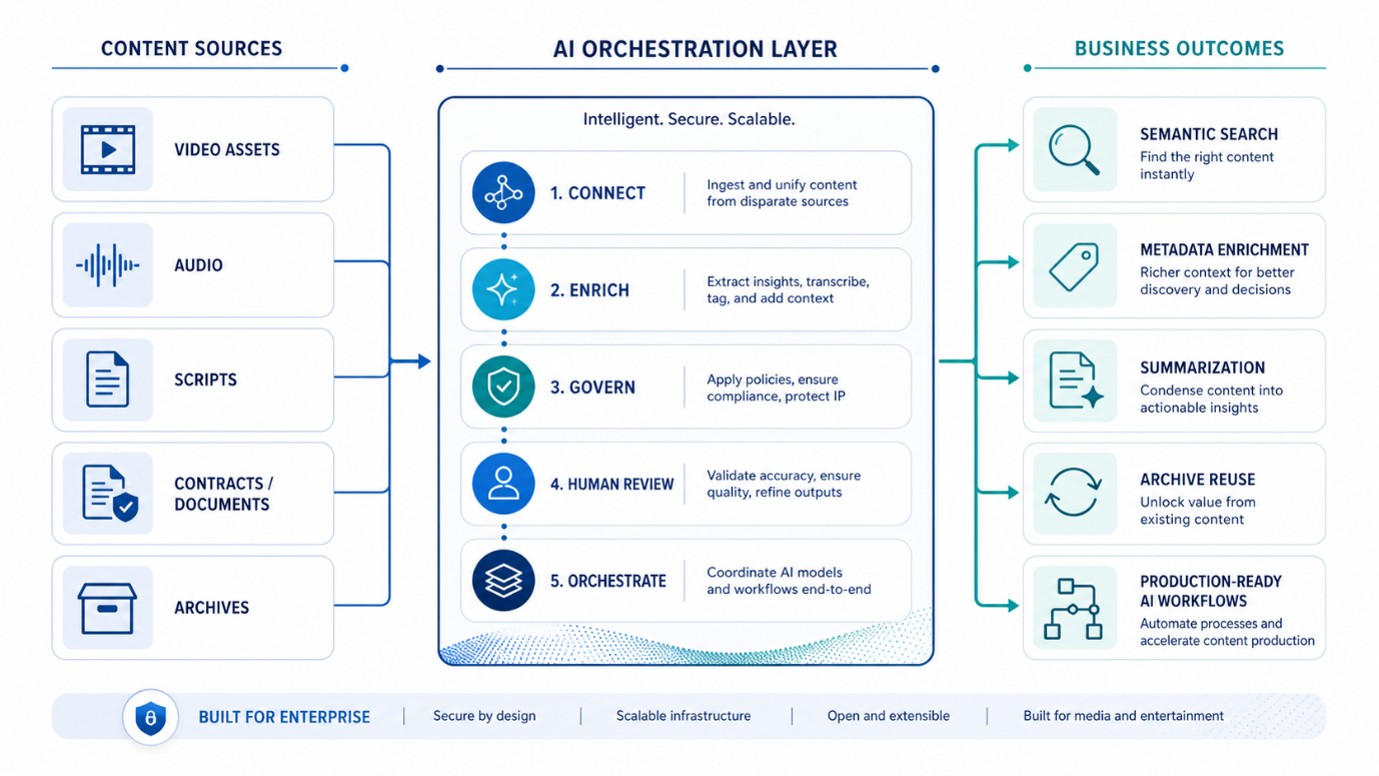
That matters because most media organizations are not asking for another isolated AI demo. They are trying to solve real workflow problems. Recent use cases that kept surfacing were highly practical: metadata enrichment, archive monetization, contract understanding, content retrieval, summarization, quality control and support for downstream model training. None of those outcomes depend on a single model. They depend on having a reliable way to ingest, process, enrich, validate and reuse content across different data types and environments. That is also why governance and repeatability came up so often in our conversations. Any compelling solution for a media customer must address more than a flashy user interface. It needs to answer harder questions around cost, repeatability, enterprise readiness and control. The real value is not just what an AI workflow can do once, but what it can do securely, repeatedly and in a way that a business can support over time. For media and entertainment, that distinction is critical. Creative teams often move fast, but production infrastructure cannot be treated as disposable. The workflows need to support variation in file types, quality requirements, rights constraints, approval steps and deployment models because the broader opportunity is to orchestrate knowledge and content across the whole production and marketing environment, not just a single narrow pipeline. For companies simply trying to get started with AI, a modular approach is far more practical than an all-or-nothing bet. NVIDIA Marketplace templates and blueprint-driven workflows within the Data Orchestration Engine can be adapted, cloned and extended for different use cases and different datasets. That is a much better fit for an industry where teams want to prove value quickly but still need a path toward production discipline. It also aligns well with how many media organizations are actually approaching AI today. There is strong interest in automation, semantic understanding and natural language interaction, but also understandable caution around usability, trust, cost and long-term control. The orchestration layer helps bridge that gap by creating a visible, manageable structure around how data moves, how services are applied and how outputs can be reviewed and reused. In other words, it turns AI ambition into execution. That is the real opportunity for media and entertainment. Not just generating something novel but building a foundation where content can be found more easily, enriched more intelligently, governed more confidently and put to work across more business outcomes. We will be talking more about that at SIGGRAPH. If you are thinking about how AI fits into production technology, archives, post-production, marketing workflows or broader content operations, come talk to us at the Dell booth 713 to learn more.
Dell reported this
Source: www.dell.com
Source link