Copper circuit printed on paper using new copper ink technology. (Image: Maryland Engineering)
Covers for everyone
Copper is an exceptional metal, serving everything from making electrical conductive wires and building coverings to providing a protective coating for statues and coins.
But copper is not perfect: Although much more slowly than most less noble metals, it oxidizes, degrades and corrodes.
Or, at least that was the case until now, as it has just become possible to paint surfaces with pure copper.
Jun Zhang and colleagues from several research institutions have just developed a ink reactive liquid that allows you to print copper on practically any surface, without oxidation or corrosion.
Given the widespread use of copper in various sectors, this reactive paint promises to significantly reduce costs. Just consider the importance of copper in modern life, carrying electricity in AI systems, data centers, wireless networks, printed circuit boards, solar panels and batteries.
“These printed copper tracks will act as the ‘wiring’ inside next-generation electronics, produced more quickly, cheaply and with less waste,” said Professor Shenqiang Ren from the University of Maryland in the US.
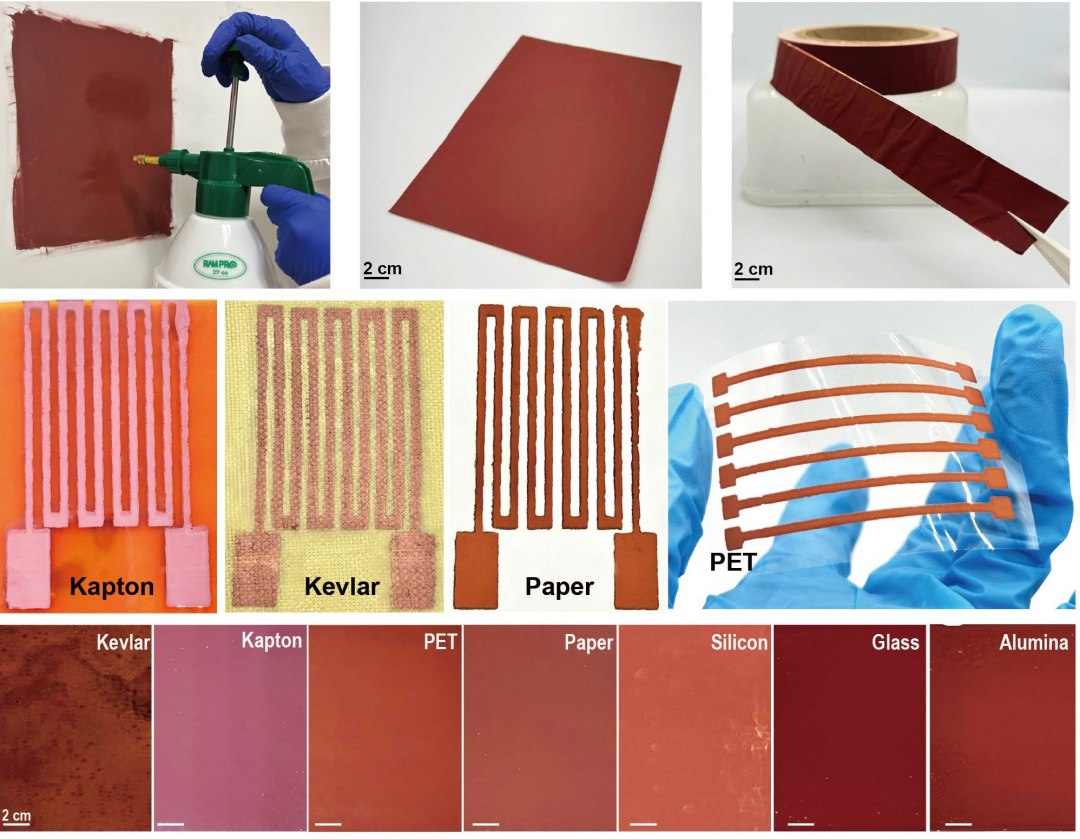
The tests involved the main candidate materials to receive metallic coatings. (Image: Jun Zhang et al. – 10.1126/science.aed4488)
Copper paint
Above all, the electronics industry has always looked for solutions that allow optimizing the manufacturing of copper printed circuit tracks. But two challenges persisted in these efforts: The development of a copper ink printable under environmental conditions and the prevention of corrosion and oxidation after applying a very thin layer of the metal.
Zhang came very close to solving everything. Starting from blue paint, he created a quick method for applying copper coatings that remain stable over time. The only requirement that remains is that the application must be carried out at a temperature between 100 and 150 °C, but this is relatively low compared to previous attempts.
“Catechol-based ligands mediate copper reduction, enable interparticle fusion at low temperatures and impart surface passivation, resulting in flexible copper with low resistivity and exceptional stability (more than 1000 hours in acid, more than 200 hours in sulfide and more than 240 hours at 140 °C),” the team detailed.
To demonstrate the versatility of the technique, the researchers printed copper conductive tracks for solar cells, printed circuit boards, small-scale replicas of the statue of Testudo, a turtle that is the university’s mascot, and even models of the Eiffel Tower.
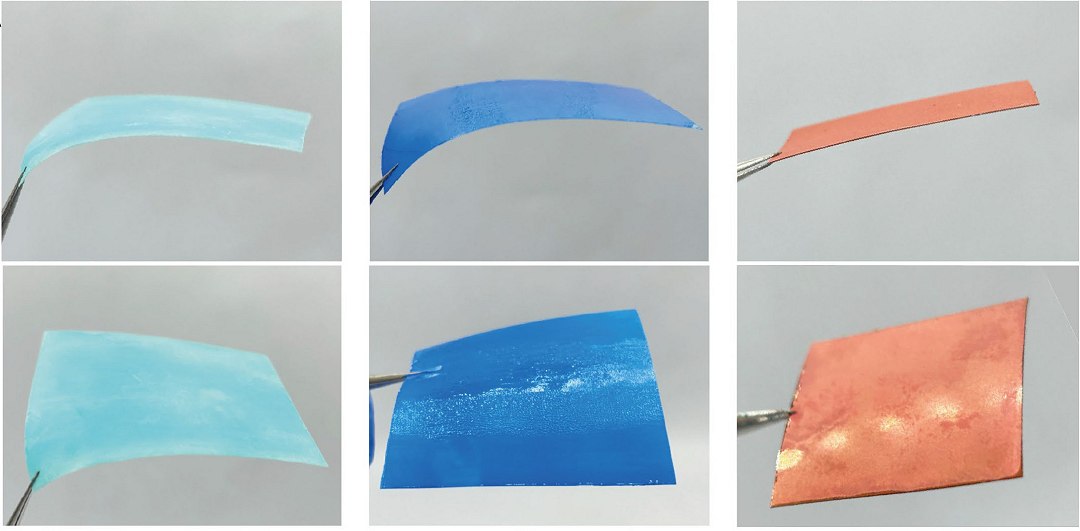
A blue ink served as the substrate for the development of the technique. (Image: Jun Zhang et al. – 10.1126/science.aed4488)
Conductive paints
Follow-up tests of the printed materials confirmed the material’s ability to remain intact after six months in one of the most aggressive environments in relation to metal decomposition: The samples were kept submerged in seawater. It’s a kind of “eternal copper,” researchers say.
The expectation is that this new application technique will replace conventional copper processing methods, such as electroplating and chemical corrosion, reducing time, cost and environmental impact.
“The newly developed ink has the potential to revolutionize the conductive ink industry by enabling the use of copper instead of more expensive metals such as silver in electronics, energy and environmental applications,” said team member Liangbing Hu.
Source: www.inovacaotecnologica.com.br
Source link