When signals become the bottleneck
Banks today don’t suffer from a lack of customer data. They suffer from a lack of usable customer data. Transaction streams, CRM records, channel interactions, and third-party market signals sit in different systems, arrive on different schedules, and rarely converge in time for a relationship manager to act on them.
This is the customer’s intelligence reality. And it’s where the conventional analytics playbook breaks down.
The problem: turning fragmented signals into next-best actions
For years, the standard approach has been to centralize everything into a warehouse, run nightly batch jobs, and hand reports to relationship managers the morning after. That works for monthly reviews. For a manager sitting across from a customer, it doesn’t.
Consider Acme Financial as a fictional but representative scenario. Acme has 10,000 customers, a premium card portfolio with roughly $10M in upgrade opportunity, and a relationship manager team whose job is to identify the right customer, ground the recommendation in real product facts, and give the customer something they can act on immediately.
Acme’s core constraint is straightforward: their customer signals must turn into decisions in the moment, not the next quarter. They need to identify high-value growth segments, predict next-best financial actions, and trigger personalized engagement while preserving the audit trail a regulated workflow requires.
Customer intelligence in three moves: turn data into real-time growth decisions
The Dell AI Data Platform addresses the customer intelligence reality through three capabilities working together:
- Connect and unify data. Access billions of customer signals across transactions, channels, and interactions.
- Understand context. Combine customer behavior with real-time signals to identify opportunities.
- Act in real time. Detect propensity and trigger next-best actions to drive growth.
The result: customer intelligence at scale, without manual segmentation.
Four engines, one platform
Underneath this sits the Dell AI Data Platform, consisting of four data engines and a storage layer, united by a shared Apache Iceberg lakehouse on Dell ObjectScale. Every engine reads and writes the same tables. No copy pipelines between layers. No proprietary formats locking one engine’s output away from another.
-
- Data Orchestration Engine orchestrates the AI data lifecycle and feedback loop across the engines: Ingest, Enrich, Analyze, Predict, Act, and Learn. Data Orchestration Engine runs five jobs that keep the rest of the system honest. A batch scoring pipeline picks up the latest ML models and writes results back to the lakehouse. A knowledge base ingestion pipeline chunks and normalizes product documentation before it reaches the Search Engine. A deep research pipeline fans out retrieval requests and assembles intelligence reports. A human-in-the-loop review queue routes AI-generated outreach to a compliance labeling interface before approval. And an agent execution dataset captures every prompt, retrieved chunk, tool call, and output so a compliance analyst can reconstruct exactly what the Advisor did and why .
- Data Processing Engine (Apache Spark) handles feature engineering, customer segmentation, and ML training for affinity scoring. GPU acceleration through NVIDIA Spark RAPIDS ML on Dell PowerEdge moves retraining from a manually coordinated event to something the Orchestration Engine runs on a schedule, so the scores the Advisor returns reflect recent transaction behavior rather than last quarter’s snapshot
- Data Search Engine (Elasticsearch) provides grounded retrieval through vector and keyword search across product and competitor knowledge bases. The Search Engine also holds agent memory. Preferences, session notes, feedback signals, and past campaign outcomes are indexed with embeddings and confidence scores. When a relationship manager returns a week later, the memory agent retrieves what matters through semantic search over its own history. Role-based index aliases and document-level security ensure an agent serving one region never retrieves documents from another .
- Data Analytics Engine (Starburst) exposes the Iceberg lakehouse as a governed SQL query surface the agents can call directly. A hosted MCP server means any MCP-compatible agent framework can discover available data products and execute governed queries without building a custom adapter. Column-level masking and row-level filtering travel with the result, so governance is enforced at the data layer, not the application layer .
- Storage Engines (PowerScale, ObjectScale, Lightning File System) provide unified file, S3-compatible object, and accelerated parallel-file storage as the substrate the data engines read and write against.
Sitting above the data engines is the agent layer, built on Google’s Agent Development Kit (ADK) with Gemini served on-premises through Google Distributed Cloud on Dell PowerEdge with NVIDIA GPUs. Nine specialized agents operate under a single orchestrator. For a prototype built around a regulated financial workflow, on-premises serving matters for three reasons. First, data sovereignty: prompts, retrieved chunks, and generated outputs never leave the bank’s environment. Second, confidential computing end to end on NVIDIA Blackwell. Third, GDC supports both connected and fully air-gapped configurations, so the same architecture works whether the deployment has public cloud connectivity or not .
The key design choice is what makes this work at the speed of a customer conversation: each workload runs on the engine built for it, but they share one data surface. Federated SQL for prospect identification. Vector and keyword search for grounded product retrieval. Distributed compute for affinity scoring. Pipeline orchestration features full auditability, all executed against the same Iceberg tables.
Inside the architecture: customer intelligence in action
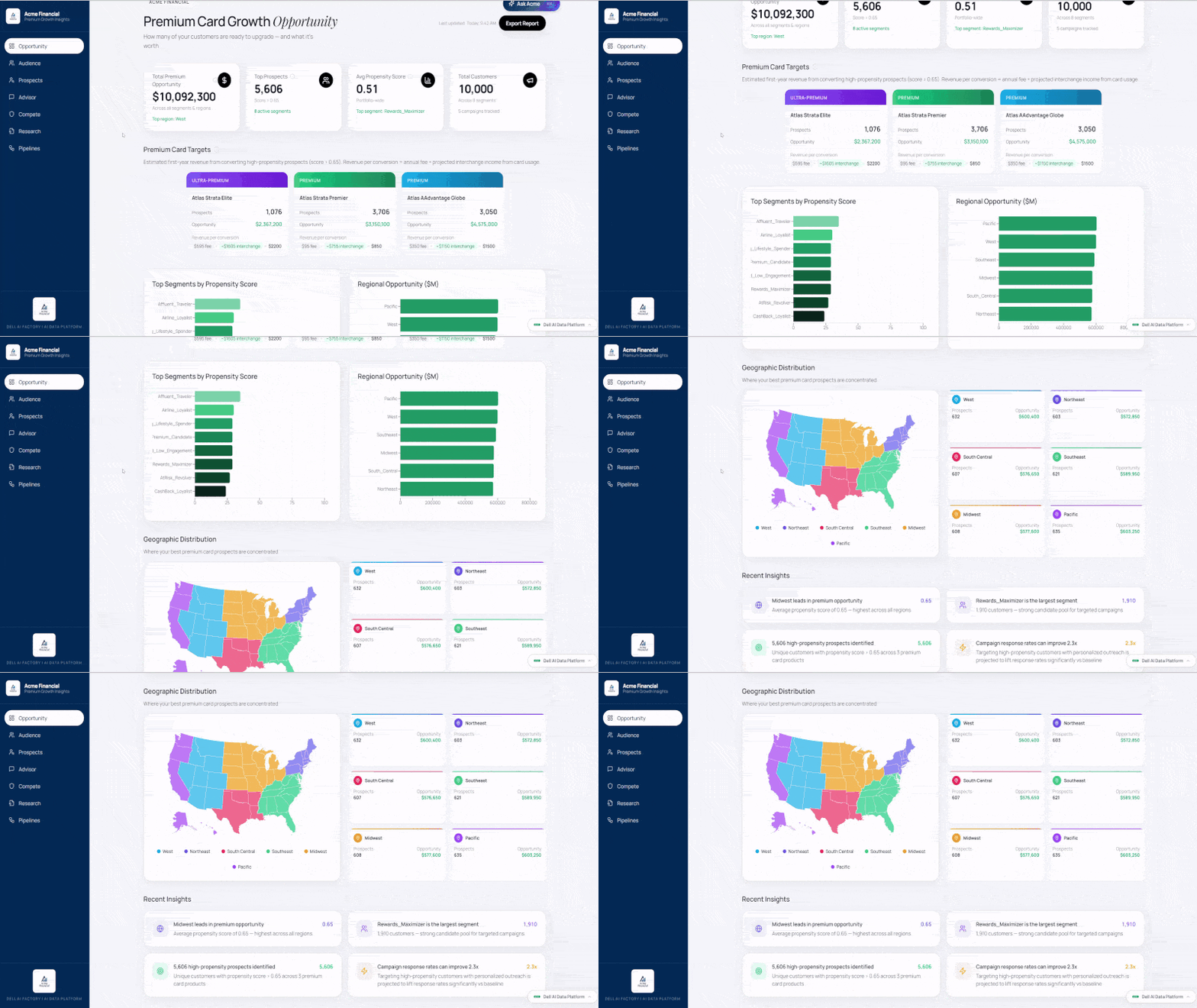
In a practical deployment, a relationship manager opens the Advisor at the start of their day or before a client meeting. From a single dashboard, they see the premium card opportunity across their entire book, eNcompassing segments, regional distribution, and the dollar value sitting in the pipeline.
The opportunity view
The first screen is an executive overview: $10,092,300 in total premium card opportunity across 10,000 customers, with the top 5,606 prospects already identified at an average propensity score of 0.51. Segments are broken down by product (Atlas Strata Elite, Atlas Strata Premier, Atlas AAdvantage Globe) with regional distribution. The scores behind this view are computed by the Data Processing Engine and refreshed on a schedule, so what the manager sees reflects recent transaction behavior, not last quarter’s snapshot.
Drilling into a prospect
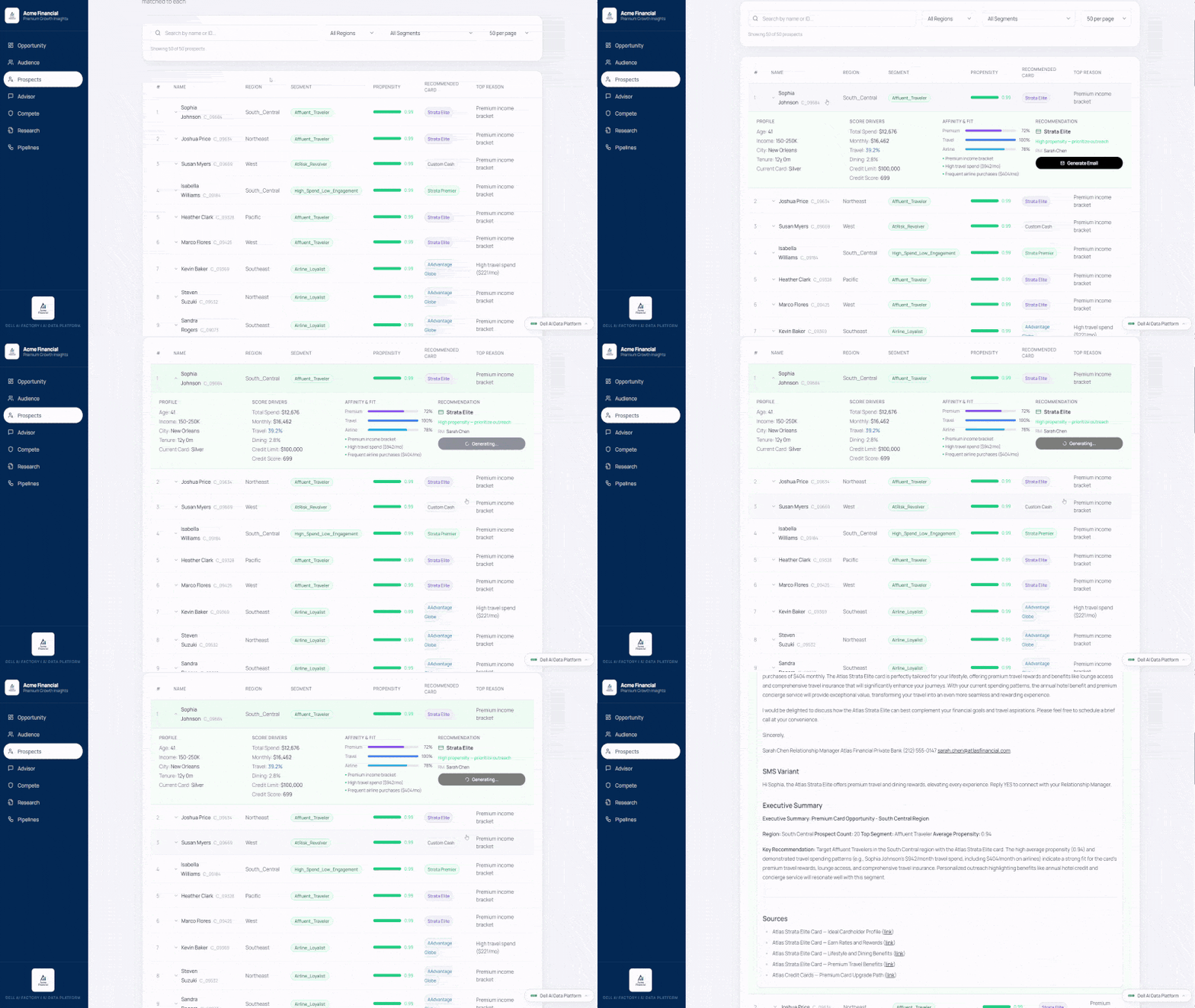
When the manager drills into an individual prospect, the Advisor pulls up their affinity scores, the products that match based on those scores, and a ready-to-send personalized email and SMS with the manager’s own contact details already filled in. The manager did not write the outreach. The agents composed it from the customer’s profile, the matching product details pulled from the Data Search Engine, and a campaign template — but the manager reviews and approves it before anything goes out.
Ask Acme Intelligence
From here, the manager can work in plain English. They can ask “who are my best prospects for the travel premium card in the Southeast” and get back a filtered list with the reasoning attached. Under the hood, the Data Orchestration Engine routes the question through the Data Analytics Engine (federated SQL across propensity scores, demographics, and transaction history) and the Data Search Engine (grounded retrieval over the product knowledge base). The manager can also hand the Advisor a photo of a competitor’s printed offer and ask what to counter with. In response, the Advisor returns a recommendation with citations pointing back to actual product documentation.

Why this matters for financial services
Some banks run cloud-native. Others can’t move customer data off-premises for sovereignty or regulatory reasons. Most are somewhere in between. The four-engine architecture is what lets a single platform serve all three.
The architecture specifically unlocks workflows that were previously off-limits to centralized AI tooling: regulated decisioning, sites with strict data residency requirements, and operations where every recommendation needs a verifiable citation. By running grounded retrieval directly against on-premises product and competitor indices, banks can perform vector indexing, model inference, feature engineering, and contextual retrieval right where the data lives.
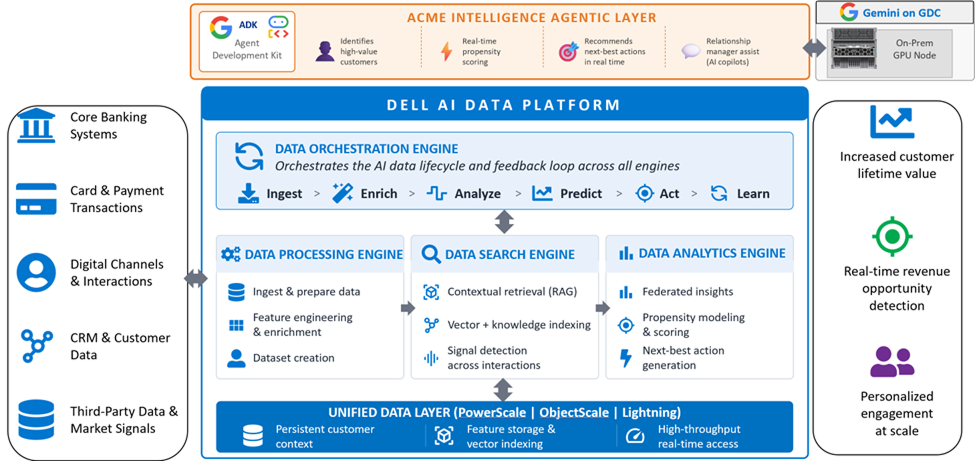
The Acme Financial architecture below shows how it comes together from start to finish. Data sources, such as core banking systems, card and payment transactions, digital channels, CRM, and third-party market signals — feed into the Dell AI Data Platform, where the Data Orchestration Engine runs the Ingest → Enrich → Analyze → Predict → Act → Learn lifecycle across the Data Processing, Data Search, and Data Analytics Engines. Above the platform, the Acme Intelligence Agent layer identifies high-value customers, scores propensity in real time, recommends next-best actions, and assists relationship managers as an AI copilot.
The signature element is that every product claim the Advisor makes traces back to a specific indexed chunk a compliance reviewer can verify. The outcomes follow directly: increased customer lifetime value, real-time revenue opportunity detection, and personalized engagement at scale.
What to take away
Three points worth remembering about customer intelligence on the Dell AI Data Platform:
- Scalable precision: Query billions of transactions in seconds, completely eliminating manual segmentation.
- Real-time decisions: Turn signals into action instantly. Engage before churn happens.
- Enterprise-scale AI: Faster RAG. Low latency. Unlock $M+ from existing data.
Dell reported this
Source: www.dell.com
Source link