The collapse of time
Quantum mechanics is famous for its strange and often counterintuitive ideas. At very small scales, particles don’t behave like everyday objects; instead, they can exist in multiple states simultaneously, a concept known as superposition. Physicists describe this behavior using a mathematical object called a wave function .
However, this description conflicts with what we observe in daily life, where objects occupy a single defined place or state at a time. To resolve this issue, scientists propose that when a quantum system is measured or interacts with an observer, its wave function collapses into a single result.
But now physicists are rethinking one of the greatest enigmas of quantum mechanics: How vague and simultaneous possibilities transform into definitive reality. More recent research indicates that spontaneous “collapse” processes—possibly linked to the action of gravity—can subtly distort time itself .
This won’t affect the clocks we use to mark our personal appointments, but it reveals a hidden limit to the temporal precision we can achieve, clarifying, for example, whether time is continuous or discrete . Furthermore, these results open a new path for attempts to harmonize quantum physics with the theory of relativity , which currently do not communicate.

Quantum collapse models
With the support of the Fundamental Questions Institute (FQxI), an international group of physicists has just completed the most in-depth analysis ever made of the various explanatory attempts known as “quantum collapse models,” proposals for understanding the conversion of quantum mechanical probabilities into definite measurement results.
The results indicate that these ideas may have surprising consequences for the behavior of time itself, including the existence of minimum limits on the precision with which time can be measured. The research also offers a possible way to test these models against standard quantum theory.
“What we did was take seriously the idea that collapse models might be linked to gravity,” explained Nicola Bortolotti, who led the study. “And then we asked a very concrete question: What does this imply for time itself?”
[Image: Lancaster University]
Uncertainties about the weather
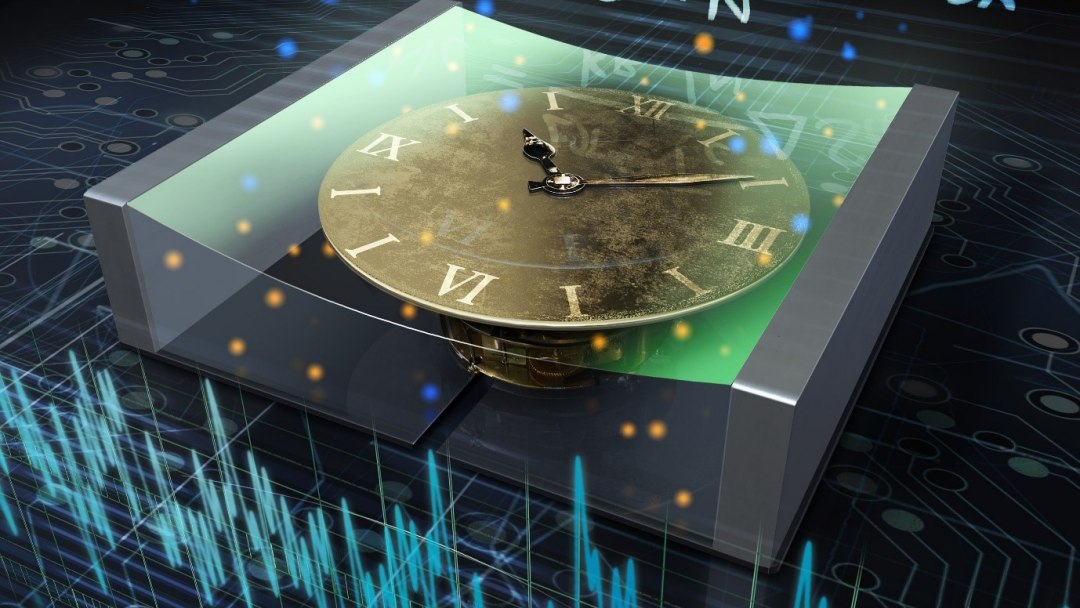
The analysis shows that if quantum collapse models accurately describe reality, then time itself cannot be perfectly precise. Instead, it would contain an extremely small level of inherent uncertainty. This would establish a fundamental limit to the precision any clock could have.
The effect is too small to impact any current technology – not even the most advanced atomic clocks would detect it.
“The uncertainty is many orders of magnitude smaller than anything we can currently measure, therefore it has no practical consequences for measuring time in everyday life,” said Catalina Curceanu, a member of the team.
But the uncertain nature of time has implications for the unification of quantum mechanics with relativity. “In standard quantum mechanics, time is treated as an external classical parameter that is not affected by the quantum system under study,” explains Curceanu. “In contrast, general relativity describes time as something that can stretch and bend under the influence of mass and energy.”
Now, if time can also be quantized, this establishes a connection between quantum behaviors, gravity, and the very flow of time. And all this without causing any revolution in any of the areas that we still study in a compartmentalized way today. “Our work demonstrates that even radical ideas about quantum mechanics can be tested through precise physical measurements and that, fortunately, the measurement of time remains one of the most stable pillars of modern physics,” said Curceanu.
Source: www.inovacaotecnologica.com.br
Source link