Quantum pendulum clock
The family of atomic clocks has gained another model, and a retro one at that: a quantum pendulum clock.
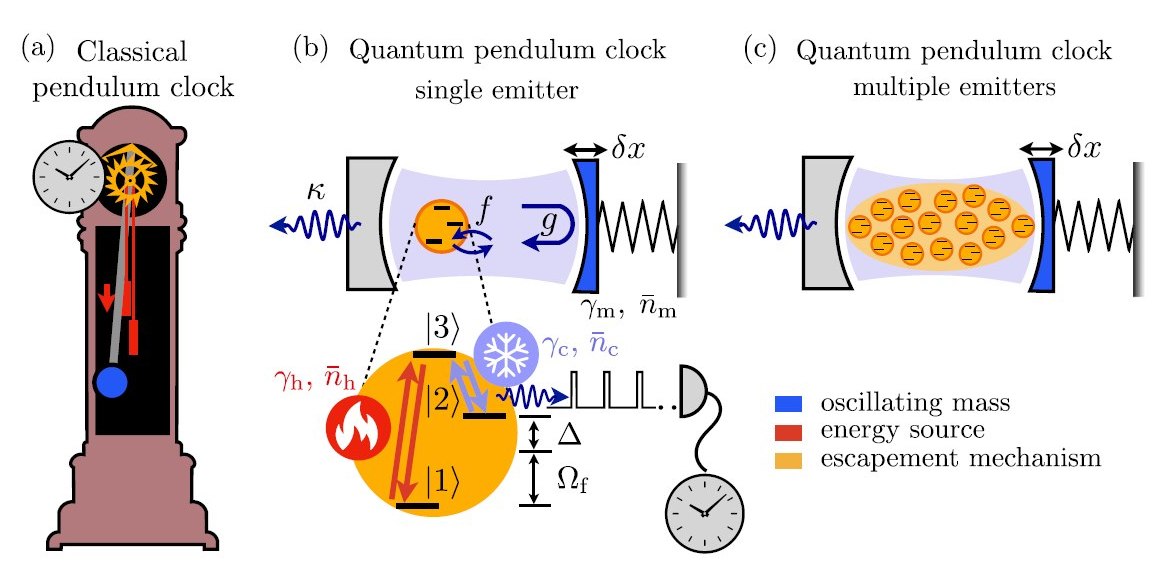
Matteo Brunelli and colleagues at the University of Basel in Switzerland have created a project using only quantum objects to replicate the three basic elements of a pendulum clock – the pendulum, the weights that move the pendulum by gravity, and the escapement mechanism, which converts oscillations into motion and provides small impulses to compensate for friction.
It is not only the first complete quantum version of a pendulum clock, but it is also a self-contained quantum clock, dispensing with the lasers for control, such as those required for the best atomic clocks in existence today.
And this is not nostalgia: In addition to breaking a precision limit known as the ” thermodynamic uncertainty relation ,” which limits many previous autonomous quantum clocks, independent operation creates a platform that allows us to study what makes any quantum clock more precise, and even to study the very nature of time.
The overall landscape of quantum clocks includes traditional atomic clocks, based on whole atoms, the more precise nuclear clocks, which use only the nucleus of an atom, and, more recently, optical atomic clocks.
Despite such precision, the essential nature of time remains an enigma: Specifically in the quantum realm, opposing arrows of time emerge, and just a few days ago, another team had to build a mini-universe in the laboratory to demonstrate how time emerges from nature.
Autonomous and with unlimited precision.
The design of the quantum pendulum clock is based on a cavity with two mirrors facing each other – one fixed and the other oscillating – and, between them, an atom with three energy levels. Tiny temperature fluctuations in the environment cause the atom to transition between energy levels, and some transitions are accompanied by the emission of a photon.
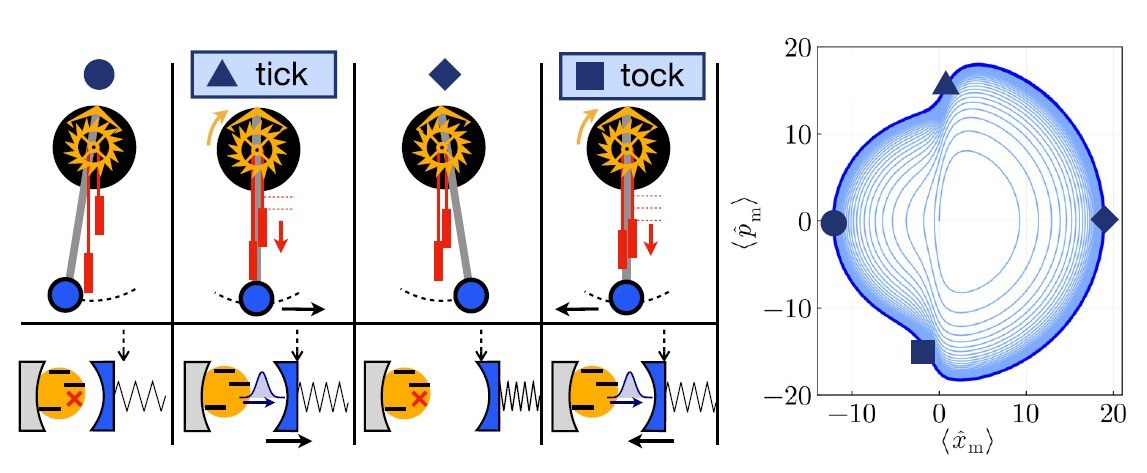
This photon bounces between the mirrors, causing the oscillating mirror to vibrate slightly, similarly to the weights that set the pendulum of a mechanical clock in motion. The atom acts as an escape mechanism, repeatedly moving through its energy states to ensure a stable sequence of ticking.
The team’s mathematical analysis showed that, if everything is adjusted correctly, the quantum pendulum clock will stabilize into a reliable ticking behavior, just like a classical pendulum clock. “As soon as the photon escapes the cavity, the restoring mechanical force brings the cavity back into resonance, favoring the injection of the next photon into the cavity. This autonomous and self-regulating mechanism can achieve self-sustaining mechanical oscillations,” the team wrote.
The accuracy of the quantum pendulum clock is related to its degree of irreversibility, that is, how much effort would be required to make it work backwards. The relationship between accuracy and irreversibility obtained by the team is exactly what is believed to be adequate for a precise time measurement, overcoming the limit of the thermodynamic uncertainty relationship that restricted previous designs.
Now all that’s left is to wait for someone to take up the project, build the quantum pendulum clock in practice, and verify that all the calculations made by the team are correct.
Source: www.inovacaotecnologica.com.br
Source link