Mathematical proof
The dark energy hypothesis , the mysterious force that would explain the accelerated expansion of the Universe, has not had an easy time, with numerous challenges: It’s not just that we don’t know what dark energy is, it’s that a growing number of physicists claim that dark energy doesn’t exist or that both dark energy and dark matter are just a cosmic illusion.
Now it was the mathematicians’ turn to question the idea that dark energy is responsible for accelerating the expansion of the Universe.
To do this, Christopher Alexander, Blake Temple, and Zeke Vogler analyzed not cosmological data, but the very mathematical tools that physicists use to draw their conclusions about how the Universe works. And not only did they dislike what they saw, but they provided mathematical proof that inherent instabilities in the equations imply that the current model of the expanding Universe is not viable.
And the problem can be well understood when one tries to move from equations to reality: “All the forces are in equilibrium when a pencil is standing upright, so it’s a ‘solution to the equations’. But it’s unstable. Any breath of air and it falls,” compared Temple, from the University of California, Davis.
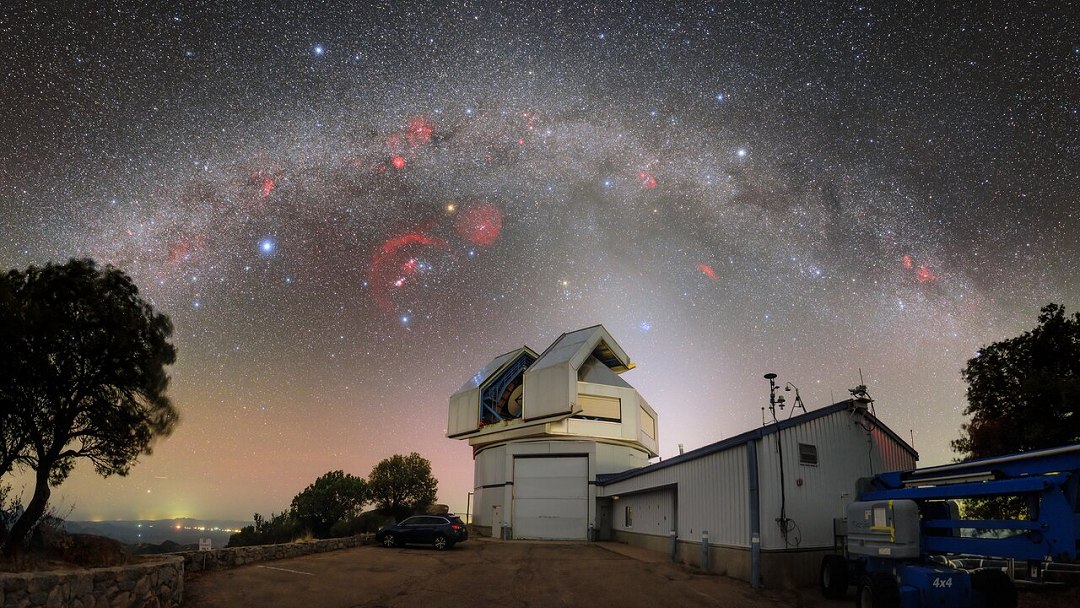
[Image: KPNO/NOIRLab/NSF/AURA/P. Horálek]
Unstable solutions are not physical
The mathematical tools in question are known as the Einstein-Euler equations, a combination of the equations of General Relativity and fluid dynamics, used to model astronomical phenomena such as galaxies, black holes, and cosmic expansion.
What mathematicians have now shown is that Friedmann spacetimes—mathematical models governing cosmic expansion—are unstable at both small and large length scales in the Big Bang, in fact becoming the most unstable solution of all.
“Unstable solutions in physics and science are considered non-physical,” Temple said. “You will never observe them in nature.”
This directly challenges the Lambda-CDM (Λ-CDM) model, the standard cosmological model of the Big Bang – Λ being the cosmological constant and CDM being the abbreviation for cold dark matter.
In fact, the instability identified by mathematicians suggests a simpler explanation—one based entirely on the structure of Einstein’s original theory.
“The instability of all Friedmann spacetimes to accelerated expansion suggests a simpler and more natural explanation for the acceleration of the Universe than dark energy,” Temple summarized.
[Image: AI generated]
Partial and ordinary differential equations
This simpler explanation was named STV-ODE, a reference to a system of ordinary differential equations ( ODE) developed by the authors themselves, who therefore added the acronym STV, composed of the initials of the names by which they are known: Smock, Temple, and Vogler.
It all begins with STV-PDEs, a reference to partial differential equations. These complex Einstein-Euler equations, which govern the dynamics of spacetime and fluids in the Universe, were reformulated using self-similar coordinates and variables, to make the classical standard model (Friedmann’s critical spacetime) appear as a rest point (a stationary state) within the system of equations.
Since partial differential equations (PDEs) are extremely difficult to solve, the trio applied a mathematical expansion technique to transform the original partial equation problem into a nested system of ordinary differential equations, turning the STV-PDE into STV-ODE, which is only time-dependent.
It was here, through the study of the phase portrait of these STV-ODEs, that mathematicians were able to rigorously prove that the Friedmann model is not stable. They demonstrated that the point representing our current Universe functions as a “saddle point,” a mathematical analogy to a pencil balanced on its own point, which would not hold up in nature.
Discarding the models
By analyzing the trajectories of solutions that move away from this point of instability in STV-ODEs, mathematicians discovered that the natural dynamics of fluid expansion generate acceleration curves that perfectly mimic the effects that cosmology currently attributes to dark energy.
“We have shown that, like Einstein’s static model, Friedmann spacetimes are all unstable to radial perturbations on large length scales,” Temple explained. “This seems to rule out the Lambda/cold dark matter model as a viable stable solution to Einstein’s equations of General Relativity, with or without dark energy.”
The calculations also call into question the Copernican principle, the idea that Earth’s location does not occupy a special place in the Universe. “Both the Lambda/cold dark matter model and a spherically symmetric spacetime produce a special place where we must be for the model to be physically plausible. If this principle excludes one, it also excludes the other,” Temple concluded.
Source: www.inovacaotecnologica.com.br
Source link