Sawdust against fire
Every time a piece of wood is sawn, sawdust is generated. Millions of tons of sawdust are produced annually worldwide, most of which is burned for energy generation.
A team from the Swiss Federal Institute of Technology (ETH) in Zurich and the Swiss Federal Laboratories for Materials Science and Technology (EMPA) believes that it’s possible to do better, since combustion releases the carbon dioxide stored in the wood back into the atmosphere, which is not ideal from an environmental point of view.
To achieve this, they developed a process capable of converting sawdust into a recyclable and environmentally friendly composite, using the mineral struvite, a crystalline and colorless ammonium and magnesium phosphate (NH4MgPO4.6H2O ) .
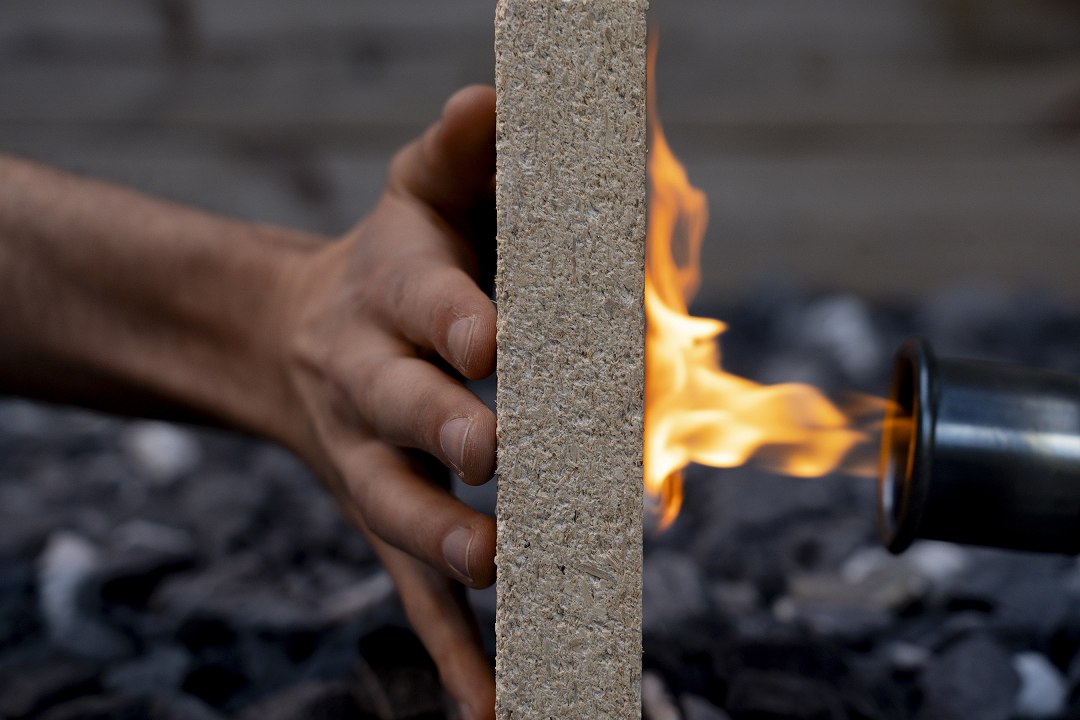
The impressive result is that the highly flammable sawdust turns into a flame-retardant material, a shield against fire.
It has long been known that struvite has fire-protective properties, but it had been difficult to combine the mineral with particles, such as sawdust, due to its crystallization behavior. The team solved this by using an enzyme extracted from watermelon seeds to control the crystallization of struvite from an aqueous suspension of its mineral precursor, called newberyite [Mg(PO3OH ) . 3H2O ].
The processing creates large crystals that fill the cavities between the sawdust particles, binding them firmly together. The material is then pressed for two days, removed from the mold, and dried at room temperature.
“The material is more resistant to compression perpendicular to the grain than the original spruce wood,” said researcher Ronny Kursteiner.
Multiple fireproof
The mechanical properties and excellent fire resistance of the new material make it particularly suitable for internal fire-resistant cladding elements.
This is because struvite is not only non-combustible, but also actively contributes to increased fire resistance. When heated, the mineral decomposes, releasing water vapor and ammonia. This process absorbs heat from the environment, producing a cooling effect.
The non-combustible gases released also displace the air, preventing the spread of fire and causing the material to char more quickly.
The team intends to continue optimizing and expanding the production process, with a view to industrial manufacturing. The acceptance of the material in the construction industry depends mainly on the cost of the binder, says Korsteiner, and today struvite is relatively expensive compared to polymeric binders or cement.
But this picture could change if it becomes possible to exploit another cycle: Struvite accumulates in large quantities in sewage treatment plants, where it clogs the pipes. “We could use these deposits as raw material for our building material,” said Kursteiner.
Source link