If at corporate events the uniform is usually predictable — blazer, shirt and dress shoes — at Gamescom Latam, in São Paulo, the logic is different. Here, executives share space with digital samurai, creatures from Brazilian folklore and characters straight from pixelated universes.
But behind the unconventional looks, there is something more structured than it seems at first glance. The largest games fair in Latin America, which takes place between April 30th and May 3rd, in São Paulo, is consolidated as a business showcase, especially for small Brazilian studios trying to gain space in a very competitive global market.
At the Sebrae stand, the contrast is even more evident. Between capes, swords and elf ears, young entrepreneurs present games that range from a pastry stand to the Amazon rainforest, all having in common the attempt to transform creativity into a company.
From the street fair to the Amazon rainforest
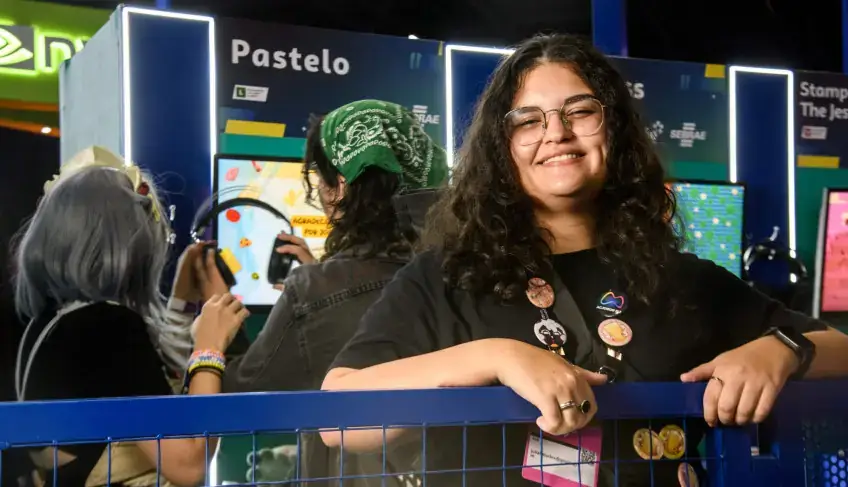
“I can say with great ease that Pastelo would not exist as it is today without Sebrae”, says Julia Lobo, founder of Lobo House Interactive. The game she brought to the fair is, to say the least, unusual: a pastry simulator inspired by Brazilian street fairs.
In Pastelo, the player manages a stall, fries pastries and evolves the business while serving customers. “The idea is to celebrate Brazilian street cuisine, bring flavors, cultural references and create a light atmosphere. It’s that moment after work, to relax and forget about your problems for a few minutes”, he says.
The delicate aesthetic may suggest a younger audience, but Julia aims for a different profile. “We think of young adults, people who want a calmer experience, but with cultural identity.”
Julia’s career in the sector began as a teenager on a technical IT course. “It was a very masculine group. Entering the games area was never simple, but today I am very happy when I see other girls interested. We need to occupy this space.”
According to her, Sebrae’s support was decisive in getting the project off the ground. “In addition to the technical and business part, there is motivation. We still work voluntarily. Knowing that you are here, at Gamescom, changes everything.”
 Ciro Facundo, from KGame
Directly from Acre, Ciro Facundo, from KGame, presents Reforest, a simulator based on syntropic agriculture, an agricultural production model that imitates the way nature works. “It’s a game to relax. There’s no winning or losing. You come in to try it out”, he explains.
The proposal mixes entertainment and environmental education. “But we also had to learn how to undertake”, he says. “Sebrae was essential for understanding the business model, taxes, structure. It was a leap.”
Another highlight is Lendas, by Kaio Pessoa, from Lendas Studio. Inspired by titles like Minecraft, the game mixes survival, Brazilian folklore and artificial intelligence. “The big difference is that you can resolve everything in dialogue. The characters use AI, so each interaction is unique”, he explains. His participation in the fair came through a national selection. “I went between projects all over Brazil. And it was worth it. Here you meet people, create connections, open doors.”
 Kaio Pessoa, from Lendas Studio (photos: Túlio Vidal)
The bridge between studios and the market
This connection with the market is precisely the focus of Sebrae’s activities at the event. In addition to the stand, the institution promotes business rounds and meetings with publishers, investors and international partners, a movement that seeks to insert small Brazilian studios into global chains.
“Our expectation is to reinforce the event as a great showcase of opportunities. This is where these studios test their projects and move forward in negotiations”, says Eúde Amor, Competitiveness manager at Sebrae Nacional. According to him, the look goes beyond the final product.
We not only evaluate the game, but the business model, strategy and ability to to grow,Eúde Amor, from Sebrae Nacional
This logic materializes in the Sebrae Games 2026 Notice, which organizes a national day of recognition and market access for developing studios. With registrations until May 5th, the initiative selects 15 projects with the best technical performance, which will become part of a digital showcase with national and international exposure. Among them, the five best evaluated advance to a mission at Gamescom Cologne, in Germany, expanding the possibilities of connecting with publishers, investors and global partners.
The advancement of these initiatives occurs at a strategic moment for the sector. Brazil is already the largest consumer market for games in Latin America and is among the ten largest in the world, but it is still working to consolidate its position as the most competitive producer.
Part of this turnaround involves public policies. The legal framework for the electronic games industry, in force since 2024, has brought more regulatory clarity to the sector, officially recognizing games within the creative economy and paving the way for new instruments for promotion, financing and internationalization. Still, the challenge remains in calibrating these tools to the reality of small studios.
“The instruments exist, but they need to better communicate with the profile of the sector”, stated Marconi Viana, from BNDES, during a panel on financing. According to him, more robust lines, often above R$10 million, still do not reach the majority of developers.
On the international front, ApexBrasil works to position the country in the global market. “Our role is to help companies project themselves abroad and attract investments, respecting the maturity level of each studio”, stated Eros Rams Tomás da Silva.
At the same time, the federal government has expanded the institutional presence of the sector. “Today we already have representation from the games sector in the Superior Cinema Council, which begins to directly reflect on the policies created for the area”, said Joelma Oliveira Gonzaga, from the Audiovisual Secretariat. Among the initiatives is the framing of games in mechanisms such as the Rouanet Law, expanding access to more robust resources, in addition to the structuring of teams dedicated to project analysis.
At the base of this ecosystem, Sebrae reinforces its structuring role. “Credit is important, but it needs to be assisted”, says Eúde. “The developer needs to understand how to use this resource, how to access the market. Without this, the path becomes much more difficult.”
Source: www.agenciasebrae.com.br