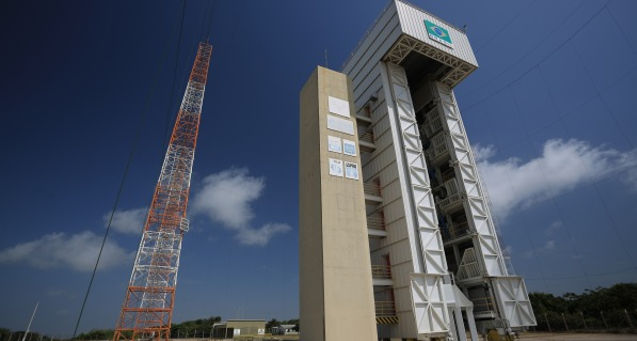
(Image: FAB)
The Brazil is trying to grab a share of the space market, which moves billions around the world and tends to grow more in the coming years, driven by SpaceX, Blue Origins and dozens of other smaller but relevant companies.
At the moment, there are around 20 contracts being negotiated between the federal government and multinationals to “rent” the Alcântara Space Centerin Maranhão. The expectation is that at least one launch will take place this year, serving as a lure for other contractors.
On June 22, the South Korean Innospace obtained authorization from Brazilian Space Agency (AEB) to perform a launch.
The multinational develops small satellite launch vehicles that serve sectors such as telecommunications, meteorology and defense.
Elon Musk’s SpaceX has already announced that it is looking for space centers around the world to expand its activities – and Brazil is capable of entering the race, experts say.
“We are interacting with companies interested in launching their vehicles in Brazil. There are approximately 20 companies, from America, Europe, Asia and Oceania, some of which are in a more advanced stage of negotiation”, says the director of projects and business at Empresa de Projetos Aeroespaiais (Alada), Paulo Ricardo da Silva Mendes.
Alada is the state-owned company created in 2024 by the Lula government with the aim of prospecting customers to use Alcântara’s infrastructure and launch services, as well as intermediating the interaction of these customers with the local public bodies that issue authorizations.
The revenue from the contracts will be converted into investments in the local infrastructure itself. The base had been little used. Now, it can become an asset, as there is a lack of available space centers on the planet.
In this preparation, Brazil signed a technological safeguards agreement with the United States in 2019, during the Bolsonaro government.
The agreement protects North American technology, which is considered an essential step to make the launches viable, since around 80% of the technology used in the vehicles comes from there.
“The aerospace market grew quickly. This created a window that Brazil cannot miss. What we seek is to explore the launch capacity, at fair market value, and place the country within this global market”, says Silva Mendes.
Trillion dollar market
The sector of satellites, rockets and support bases generated US$220 billion worldwide in 2025, with a tendency to reach US$315 billion (around R$1.6 trillion) by 2034, according to consultancy Global Market Statistics.
The number of active satellites in orbit is expected to jump from 11,700 in 2025 to 30,000 in 2030, reaching 60,000 in 2040, according to a report produced by the US Space Force (the military arm created in Donald Trump’s first term).
Alcântara, in turn, has the potential to handle around 90% of launches, estimates Colonel Adalberto de Rezende Rocha Júnior, director of the space center. “Alcântara is transforming itself to absorb part of this demand and be a global agent”, he says.
The infrastructure there is capable of handling small and medium-sized rockets, with the capacity to carry between 20 and 50 tons of cargo into orbit, which represents the majority of launches.
By way of comparison, it is a range compatible with SpaceX’s Falcon, which carries up to 23 tons, but below the Falcon Heavy ‘superfreighter’, which weighs up to 64 tons.
“Our infrastructure is already fully suited to the market. And if more companies come in the future, then we will need investments”, adds Rocha Júnior.
Advantages
Alcântara’s big difference is its location close to the Equator, considered the ‘filet mignon’ of the orbit, where the majority of geostationary satellites are located (which are ‘still’ in relation to the Earth, monitoring specific points).
At this latitude, fuel consumption to propel the rocket is around 30% lower than in other parts of the globe.
Another advantage is that traffic in Maranhão is low, without the need for major changes in the flow of planes. The region has few residents and has no history of climate disasters.
Finally, its main competitor, Kourou, a space center in French Guiana, is already practically full of European launches, with little room for growth.
Within this favorable scenario, Brazil should reach the rate of one launch per month in the short to medium term, estimates AEB Licensing coordinator, Danilo Sakay.
“It will be a good start and with the capacity to expand further.” According to him, the creation of Alada was an important step for Brazil to enter this market. “There is logistics behind it. Before, there were only Brazilian launches, so the government itself arranged it. Now they will involve foreign companies, which requires organization.”
South Korean Innospace will soon launch its second launch in Maranhão. The first occurred in December 2025, but the vehicle exploded after 33 seconds in the sky due to a combustion gas leak. The cause of the accident was the rocket design, not the base, says the director of Alada.
“It’s like a plane. If it takes off and crashes, it’s not the fault of the airport infrastructure.”
Turn
The Alcântara Space Center was opened in 1983 to be the launch point for a Brazilian rocket, but this was not as successful as expected. There were three attempts.
The last occurred in 2003, the biggest tragedy of the Brazilian space program, when the vehicle explosion killed 21 professionals in the sector.
“Along with them, all our knowledge about rockets also went away. They were our reference, our heroes. Then we were stuck in time”, observes the space director. “At that time, India was on the same level as us. Today, it lands on the far side of the Moon and we don’t”, he says, referring to the unmanned Indian mission that reached the lunar south pole in 2023.
In the following years, Alcântara was renovated and began to serve suborbital flights – which are not capable of launching satellites into orbit, but are used for scientific experiments in low-gravity environments. The project for its own rocket suffered budget cuts and difficulties in developing the necessary technology.
With the space center little used and the market growing, the strategy changed, with the search for corporate clients. “We still want to launch our rocket, but we envision this commercial side, as the market is overheated”, points out Rocha Junior.
Source: www.moneytimes.com.br
Source link