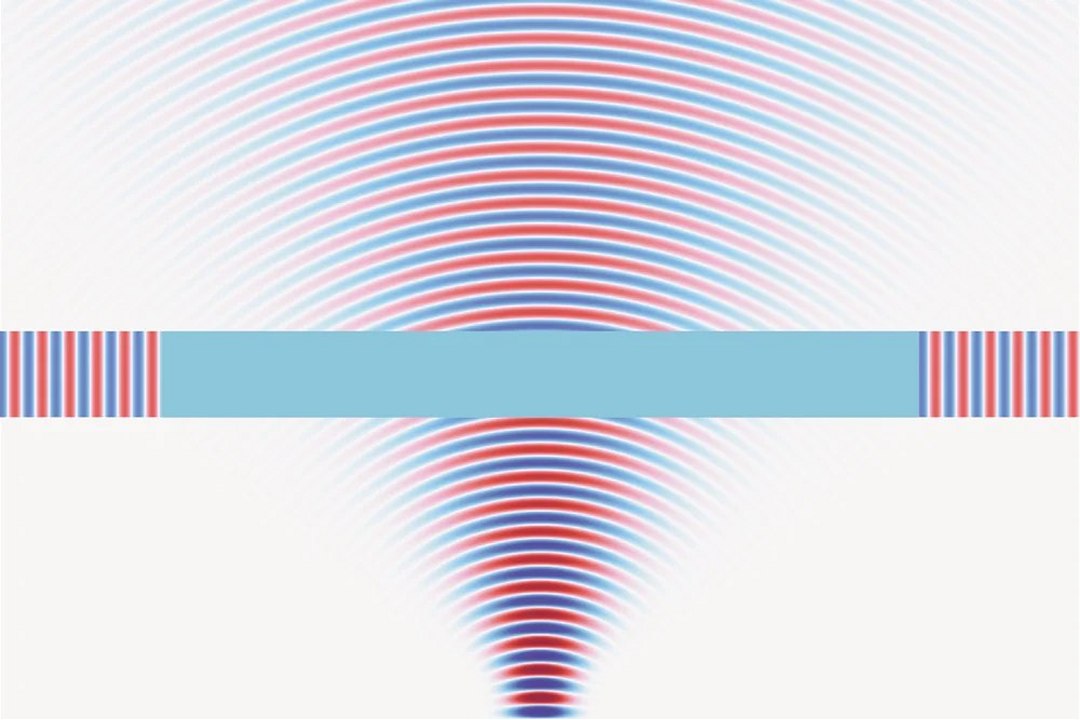
It is a perfect tunnel for the sound that passes through the interior (horizontally, in this illustration), and completely invisible for sounds that reach it from the outside (illustrated vertically). (Image: Changqing Xu et al. – 10.1103/9y6g-42nm)
Acoustic metamaterial
A new acoustic metamaterial, an artificial material designed to manipulate sound waves, has created an unusual “ghost tunnel”: The structure acts as an almost perfect waveguide for sound entering its edges, but is essentially invisible to waves incident on its sides, meaning that sound passes through it virtually unreflected and undamped.
You acoustic metamaterials which can be built to transmit, capture, amplify and direct sound waves at specific frequencies, have already become an important field of research. In addition to the acoustic camouflages today the sound waves are stopped, reversed and even stored, objects can be moved accurately among many others sound manipulation techniques.
Just as waveguides are an essential tool for light-based technologies, sound waveguides will also be a very useful tool if they can confine sound within a channel, imposing boundaries that reflect the waves back inward. The problem is that the waves disperse when they collide with rigid walls.
Changqing Xu and colleagues at Nanjing Normal University in China solved this problem using a metamaterial which manages to exploit an effect known as “zero index medium”, whereby the refractive index practically ceases to exist for a given wave frequency.
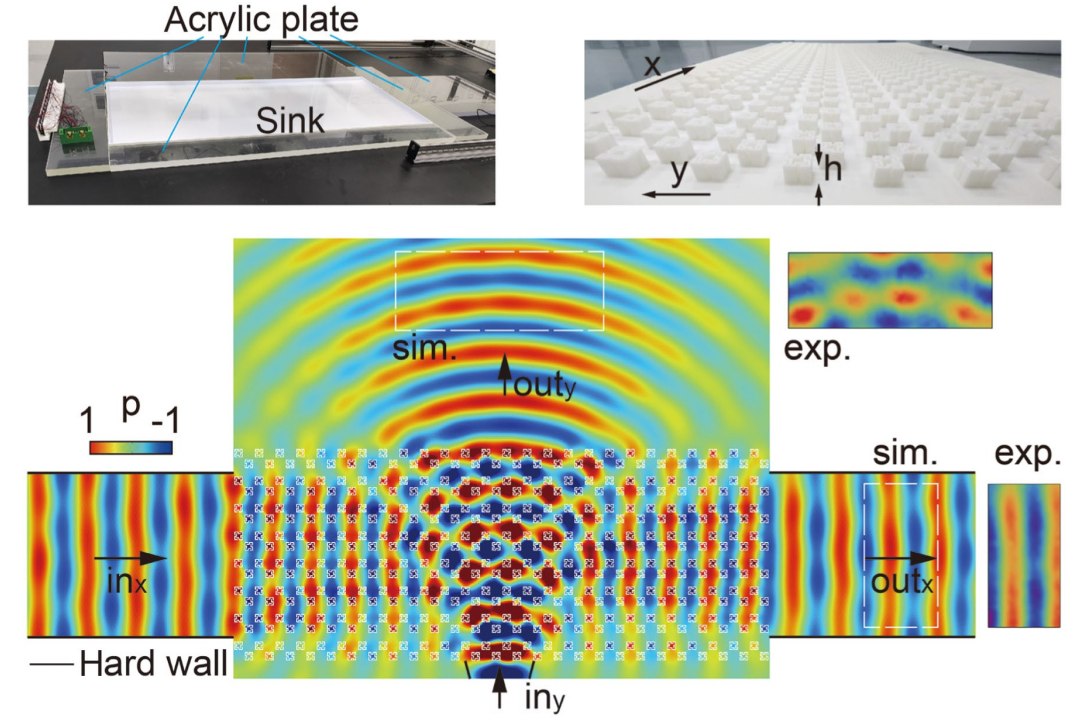
The ghost tunnel metamaterial is composed of a series of partially hollow plastic elements, each 15 mm tall.
(Image: Changqing Xu et al. – 10.1103/9y6g-42nm)
Ghost tunnel
The acoustic waveguide consists of an array of 3D-printed cells, each containing two air cavities connected by spiral channels, with a shape designed to reduce airflow velocity. This made it possible to obtain the zero-index effect within a very compact structure.
By tuning the geometry of the individual cells, the team was able to design the metamaterial so that it has an impedance matching that of free air, so that the outermost waves do not encounter any reflective barriers – an authentic acoustic invisibility cloak.
The entire ensemble forms what the team calls a “ghost tunnel”: Sounds entering the tunnel travel completely confined, reaching the other side with complete fidelity. Interestingly, when other sounds reach the side of the structure, they also pass straight through, as if the tunnel didn’t even exist, emerging undistorted on the other side.
“This method offers a new avenue to overcome key limitations of acoustic devices, such as bulky designs, limited functionality and susceptibility to interference in complex environments,” commented Xu. “Furthermore, the generality of the approach should also make it useful for other types of waves, including photons, plasmons, and even electronic waves.”
Source: www.inovacaotecnologica.com.br
Source link