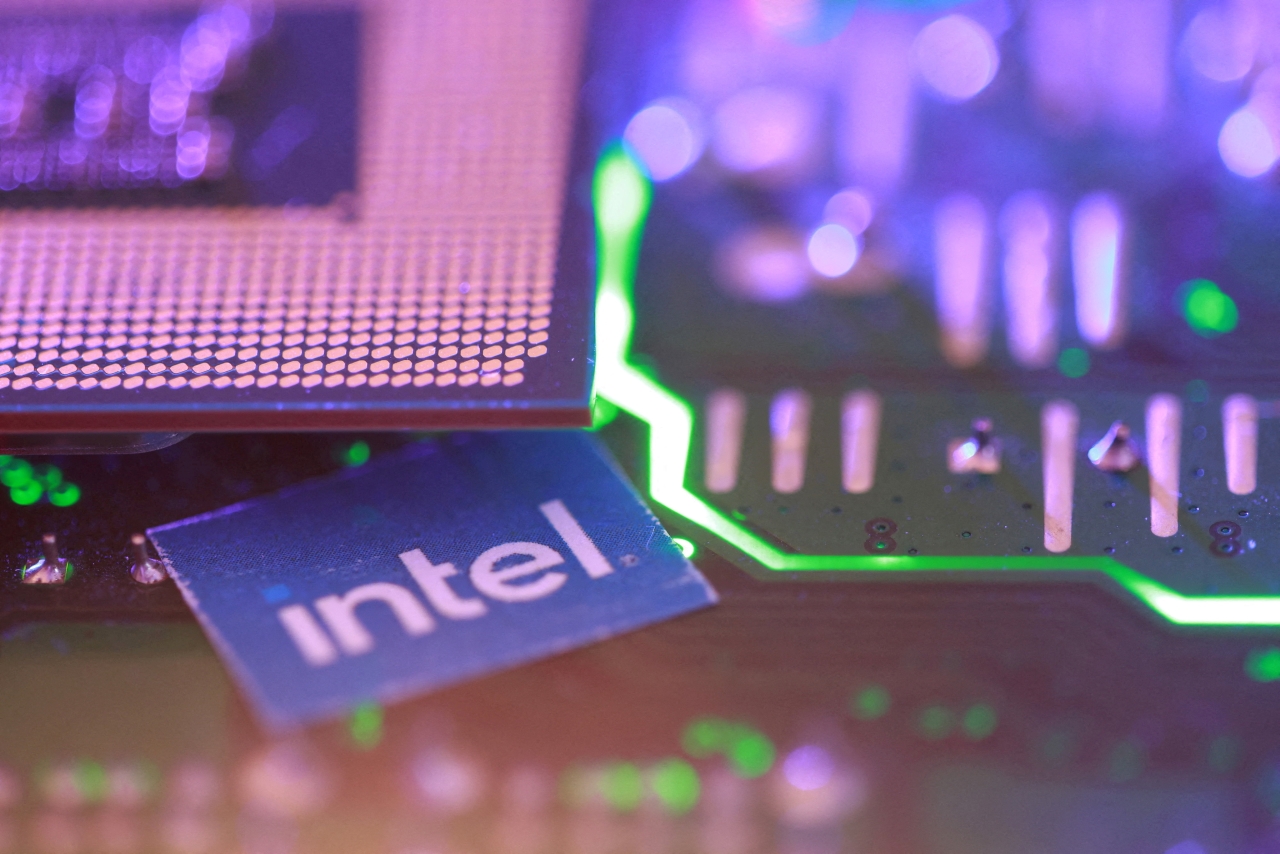
Illustration with a computer motherboard and an Intel chip August 25, 2025 (REUTERS/Dado Ruvic)
The Intel released this Thursday a quarterly profit and revenue forecast above market estimates, which boosted its shares by more than 5% and contributed to the company deciding to increase investments over the next two years.
Intel expects third-quarter revenue between US$15.8 billion and US$16.8 billioncompared to the average analyst estimate of US$15.1 billion, according to data compiled by LSEG. Adjusted earnings are expected to be 38 cents per share, versus analyst estimates of 27 cents.
Intel Chief Executive Lip-Bu Tan told a conference call with analysts that second-quarter developments had led Intel to “fully” commit to high-volume production of chips made with its upcoming 14A manufacturing technology in 2028. Last year, Intel had warned that it could be forced to abandon 14A if it could not find a major customer, which would have effectively taken the United States out of the race to make the world’s fastest chips.
“I am pleased to see the growing momentum in customer engagements for Intel 14A and am increasingly confident that 14A will be a highly competitive process,” said Tan.
In the second quarter, Intel reported that sales increased 25.4% to $16.13 billion, and adjusted earnings were 42 cents per share, compared to estimates of $14.42 billion and 21 cents per share. The adjusted gross margin was 41.8%, against estimates of 38.8%.
AI
Intel’s chief financial officer, David Zinsner, told Reuters that rising demand led the company to raise its investment forecast this year from US$18 billion to US$20 billion, with disbursements expected to “increase significantly next year” as well.
Zinsner said Intel has signed long-term contracts with customers for data center CPUs and specialized chips called XPUs lasting three to five years, with some including both volume and price commitments while others cover only volume commitments. He warned that Intel will continue to be disciplined about spending, noting that such agreements can be renegotiated when conditions change.
Zinsner said Intel has about $30 billion in cash and a $10 billion line of credit, and has not ruled out a share sale, although none are currently authorized. “I wouldn’t rule out the possibility of us doing that. But there are no specific plans at this time,” he said.
For Intel’s data center and AI businesses, second-quarter revenue was $6.26 billion, compared to estimates of $5.37 billion.
Intel reported that sales in its laptop and desktop segment totaled $8.88 billion in the second quarter, compared with estimates of $7.89 billion. Zinsner said unit sales fell but average prices rose as Intel moved away from low-cost chips for entry-level machines and refocused on chips for high-end devices.
Intel’s foundry business reported $5.77 billion in revenue in the second quarter, compared to analyst estimates of $5.55 billion.
The unit won Tesla as a client for the 14A process, intended for the “Terafab” AI chip project. Expectations of another high-profile achievement rose in April after US President Donald Trump announced that Apple had agreed to build processors with Intel. Neither company has confirmed the agreement.
“There have been lingering doubts since Lip-Bu Tan took the helm, and this has created a cloud of uncertainty around the foundry business,” said Bob O’Donnell, president and chief analyst at TECHnalysis Research. “All these doubts have now been dispelled.”
Source: www.moneytimes.com.br
Source link