
Every enterprise wants more from AI.
More use cases. More agents. More automation. More decisions made in real time.
But as AI moves from pilots to production, a different question is becoming harder to ignore: how do we make every token count?
The conversation about token economics often begins with model selection, GPU utilization or inference optimization. Those are important levers. The Token Economy is also a data problem.
When an AI system cannot find the right information, it does not simply return a less useful answer. It may search again. It may retrieve more documents than it needs. An agent may call additional tools, ask another agent for help or retry the workflow. The prompt gets larger, the workflow gets longer and the token meter keeps running.
The most efficient token is often the one the system does not need to spend because the right context was available the first time.
The hidden cost of inaccurate context
An LLM can only reason over the context it receives. If that context is incomplete, stale, duplicated or irrelevant, the model has to work harder to produce a reliable answer — and the surrounding application has to work harder to compensate.
That compensation can take several forms:
-
-
-
- Retrieving a wider set of documents to improve the chance of finding the answer.
-
- Repeating searches when the first results are incomplete or poorly ranked.
-
- Passing long, overlapping passages into the prompt because the system cannot distinguish signal from noise.
-
- Asking the model to reconcile conflicting or outdated information.
-
- Triggering human review or downstream agent workflows when confidence is low.
-
-
None of these actions is inherently wrong. In production, they are often necessary safeguards. But they are also symptoms of a data foundation that is not doing enough work before inference begins.
This is why accuracy matters to token economics. Better accuracy does not only improve the answer. It can reduce the amount of unnecessary work required to reach that answer.
That is the difference between spending tokens on business reasoning and spending tokens on data uncertainty.
Token economy starts before inference
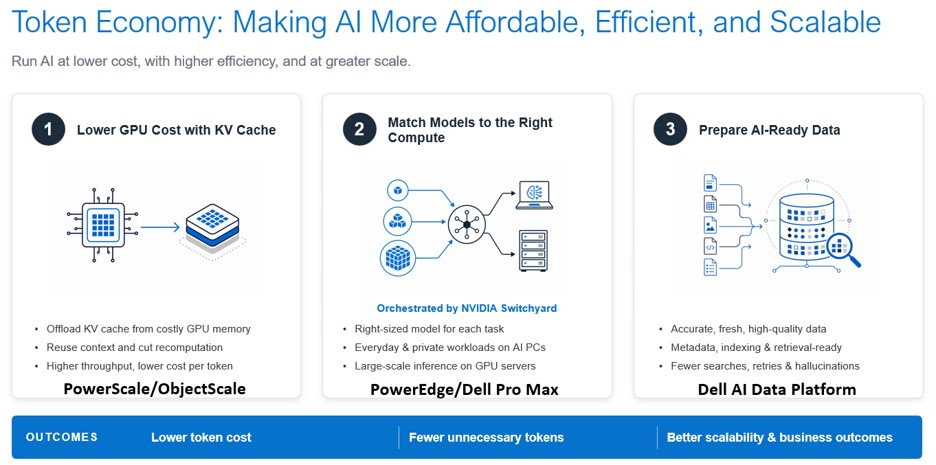
There are several ways to improve AI efficiency. Figure 1, above, frames three of them clearly:
-
-
-
- Lower GPU cost with KV cache by reusing context and reducing recomputation.
-
- Match models to the right compute, using the right-sized model for each task.
-
- Prepare AI-ready data that is accurate, fresh, indexed and ready for retrieval.
-
-
The third lever is foundational. If the data entering the AI workflow is not trustworthy or usable, the benefits of the first two are harder to realize. A smaller model may answer faster, but not necessarily better. A well-utilized GPU may process more requests, but not necessarily more valuable ones.
AI efficiency is not just about doing more work per second. It is about avoiding work that should never have been necessary.
Accuracy is a data pipeline capability
High-quality data does not happen at the moment an LLM receives a prompt. It is created through a series of data operations that need to work together:
-
-
-
- Measuring and improving the quality of the data used by models and agents.
-
- Discovering data across file systems, object stores, databases and other enterprise sources.
-
- Applying metadata, labels and access policies so data can be found and used appropriately.
-
- Transforming, chunking and enriching content so it can be interpreted in the right context.
-
- Creating embeddings and indexes that support semantic, keyword and hybrid retrieval.
-
- Keeping datasets synchronized as business information changes.
-
- Measuring and improving the quality of the data used by models and agents.
-
-
Each step has a direct effect on the context that reaches the model. A well-indexed dataset can improve precision. Fresh data can prevent an agent from reasoning from yesterday’s answer. Metadata can help the system narrow the search before it expands the prompt. Governance can ensure that better access does not mean broader-than-necessary access.
The goal is not to give an LLM more data. The goal is to give it the right data with less waste.
Why the data layer needs to be holistic
Enterprise data is not one thing. It includes structured records, documents, images, logs, emails, product information and other unstructured content. Different data tasks require different capabilities.
The Dell AI Data Platform brings those capabilities together without forcing every workload into one tightly coupled system.
Storage engines provide the durable, high-throughput foundation for AI data. PowerScale supports file and object workloads at scale. ObjectScale provides an enterprise object storage foundation for large unstructured datasets. Lightning File System is designed for demanding parallel workloads where data needs to move to thousands of GPUs with high throughput.
Data engines make that information usable. Analytics and query capabilities can help teams work across distributed data without creating another copy for every workflow. Processing capabilities prepare and transform data for analytics, machine learning and AI. Search capabilities bring semantic, keyword and hybrid retrieval to the documents, files and other unstructured information that often contains the context an agent needs.
The Dell Data Orchestration Engine connects those activities into a unified pipeline. It helps organizations coordinate ingestion, dataset preparation, enrichment, indexing, retrieval and inference across hybrid and multicloud environments.
This separation of roles matters. Storage, processing, search and orchestration should work together, but they should not have to scale in exactly the same way or be replaced as one monolithic stack. An open, modular architecture gives organizations room to match the platform to the workload and evolve as models, frameworks and data sources change.
From better retrieval to lower token consumption
Consider a typical agentic workflow.
A user asks a question about a product, policy or customer. The agent searches across enterprise data. It retrieves several passages, filters them, calls a tool and generates an answer. If the context is incomplete, it searches again. If the answer conflicts with another source, it may add another step to reconcile the difference.
Now consider the same workflow with AI-ready data:
-
-
-
- The relevant source is discoverable.
-
- Metadata narrows the search space.
-
- Hybrid retrieval balances semantic meaning with exact terms such as product names, identifiers and error codes.
-
- Fresh indexes reduce the need to compensate for stale information.
-
- Governance policies are applied as part of access, rather than added as a late-stage correction.
-
-
The model still reasons. The agent still performs work. But more of that work contributes directly to the outcome.
This is the practical meaning of token efficiency. It is not about minimizing tokens at any cost. It is about maximizing business value per token.
An AI Data Factory turns quality into a repeatable process
Most organizations do not have a single data-quality problem. They have a repeatability problem.
A team may prepare one high-quality dataset for a proof of concept. Another team may build a separate retrieval pipeline for a different business unit. A third team may create an agent that depends on a set of manually maintained indexes. Each workflow can work in isolation. The challenge is keeping data accurate, fresh, governed and reusable as the number of models and agents grows.
That is where the idea of an AI Data Factory becomes important.
An AI Data Factory treats data preparation as a production capability — not a one-time project. It creates a repeatable path from raw enterprise information to governed datasets, searchable context and production-ready AI workflows.
With Dell AI Data Platform, organizations can build that path across the full AI lifecycle:
-
-
-
- Ingest data from the environments where it already lives.
-
- Prepare and enrich it for training, RAG and agentic workflows.
-
- Apply metadata, indexing and governance consistently.
-
- Serve data to analytics, retrieval and inference workloads.
-
- Improve pipelines as business requirements and AI applications evolve.
-
-
The result is a data foundation designed to make AI more accurate, more efficient and easier to scale.
The next advantage is data efficiency
The first phase of enterprise AI was about access to models. The next phase is about operating those models economically and responsibly.
That requires a broader definition of performance. We should measure more than throughput, latency or cost per token in isolation. We should also ask:
-
-
-
- How many tokens were spent on relevant context?
-
- How often did the system need to retry a search or call another tool?
-
- How much of the retrieved data was actually useful?
-
- How quickly can new enterprise information become available to AI?
-
- Can the organization improve data quality once and reuse it across many models and agents?
-
-
These are data-platform questions. They are also business questions.
The Dell AI Data Platform with NVIDIA is designed to help enterprises turn fragmented data into AI-ready fuel through an open, modular architecture. By combining AI-optimized storage, data engines and orchestration, it helps organizations build the foundation for better retrieval, better inference and better outcomes.
The future of AI will not be won by the organization that generates the most tokens. It will be won by the organization that turns the right tokens into the most value.
Ready to build your AI Data Factory?
If you’re looking to turn enterprise data into a real advantage for agentic AI, this is the next step. Dell AI Data Platform is built to help organizations create AI-ready datasets, automate data pipelines and support modern workloads across the full AI lifecycle. Start by registering for the event.
Explore how Dell is helping customers build an open, modular data foundation for AI:
Dell reported this
Source: www.dell.com
Source link