Quantum supremacy challenged
Using a conventional electronic computer and innovative mathematical tools and codes, physicists have managed to solve a complex problem in quantum physics that was previously believed to be solvable only by quantum computers .
This achievement not only refutes recent claims of quantum supremacy , but also truly resets the field, which will now need to be discussed from its very beginnings – quantum supremacy, or quantum advantage, is the point at which quantum processors definitively surpass classical electronic processors , solving problems that would be impossible to solve with electronics-based technology in a reasonable amount of time.
This achievement disproves a claim of quantum supremacy published by the journal Science last year. The new algorithms are so innovative in terms of efficiency that the researchers were even able to use a personal laptop to solve the problem.
By allowing the extraction of problem-solving power from classical computers, this innovative methodology should be used as a protocol to solve problems related to finding an ideal solution in situations where there is an abundance of viable solutions – such as in logistics, financial applications, chemistry, etc. – and promises to open new avenues for research in quantum dynamics.
Compressing the wave function
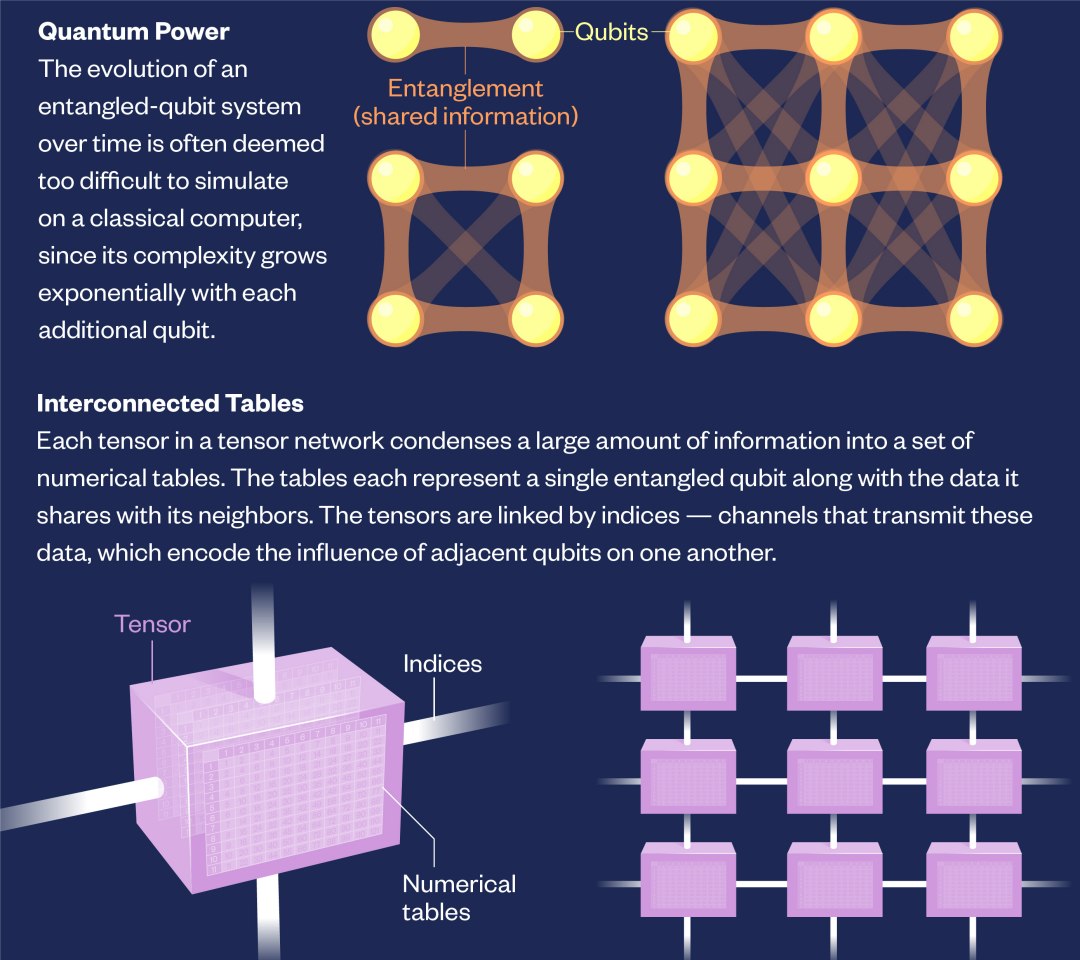
The team overcame the challenge by developing and implementing new tools based on tensor networks, which Professor Tindall compares to “a zip file for the wave function, where you’ve taken all this information and compressed it into a mathematical data structure full of small tables of interconnected numbers.”
Tensor networks have made the problem feasible for classical computers. “It’s this very powerful compression that can be very effective, but it’s a rather complex mathematical object. This really represents a frontier, because working with these objects – especially in three dimensions – is something very unexplored. You need sophisticated code and algorithms to deal with them; it’s a software engineering challenge in itself,” said Tindall.
And, best of all, everyone wins, both the programmers of electronic computers and the designers and programmers of quantum computers. “The upside of the debate between classical and quantum computing is that there’s a lot of synergy between the type of simulations that interest us and the code we write and what can be done on these quantum computers,” commented Tindall. “This can guide us, and it can also guide quantum computing researchers because, obviously, the barrier to entry for us to simulate certain things is much lower than for them, since we don’t need to build a quantum computer. I can simply write some code and click ‘run’ on my personal computer.”
Source: www.inovacaotecnologica.com.br
Source link