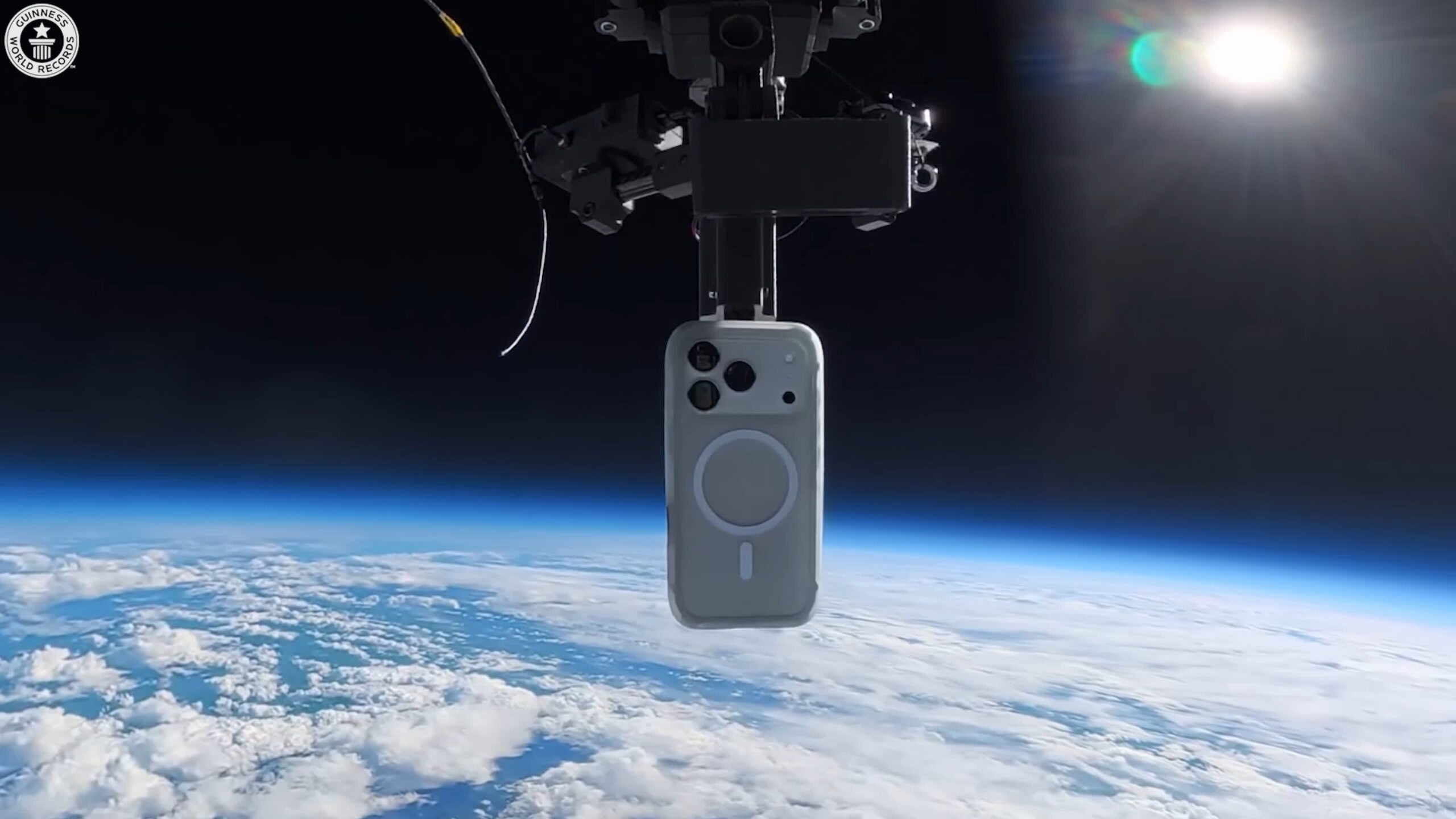
What just happened? An iPhone 17 Pro survived a 100,418-foot fall over northern Sweden with no visible damage, giving phone case maker RhinoShield and aerospace company Sent Into Space a Guinness World Record title for the highest drop of a mobile phone in a phone case onto natural landforms.
For RhinoShield, the test was a public demonstration of the high-tech materials and impact protection behind the case. Most phone cases are meant to handle drops onto pavement, tile, or concrete. This test added high-altitude cold, pressure changes, and a landing in remote terrain.
The companies launched the phone from Kiruna, Sweden, on June 24 using a high-altitude balloon. The iPhone, fitted with RhinoShield’s AirX case, was released at 30,607 meters, more than three times the typical cruising altitude of a commercial airliner.
There was no parachute or protective container around the device. The phone also had no heating system during the flight. Under Guinness rules for the attempt, the case had to make contact with the ground before the phone itself.
The device fell for about 25 minutes and was exposed to temperatures as low as minus 60 degrees Celsius before reaching the ground in a remote part of Sweden.
Finding it took longer. The phone’s tracker narrowed the search area to about two kilometers, but the team spent more than five hours locating it. After it was recovered, Guinness officials confirmed the iPhone could be turned on and off, make calls, and take photos. Its exterior remained intact.
The record is formally listed as the “highest drop of a mobile phone in a phone case (natural landforms).”
RhinoShield said the AirX case is made from a single recyclable material. Its design takes cues from automotive airbags and the cushioning used in athletic shoes. Before the launch, the company tested the case under freezing temperatures and changing atmospheric pressure.
The launch was as much a test of the case as it was of the phone. Once released from the balloon, the iPhone passed through the upper atmosphere before descending into denser air. It was exposed to cold temperatures and pressure changes, then landed without a planned recovery system to soften the impact.
The phone’s fall was not a straight 100,000-foot impact. Air resistance slowed it as it moved into denser air. But the case still had to protect the phone during an uncontrolled landing on natural terrain.
Phones have survived unusual falls before. In 2024, an iPhone remained intact after dropping 16,000 feet from an Alaska Airlines flight. That incident was accidental.
The record applies to the specific iPhone 17 Pro and AirX case used in the test. It does not mean other phones or cases would survive a similar fall.
Source: www.techspot.com
Source link