In media and entertainment, two trends never reverse: schedules compress and the amount of data you’re pushing through the pipeline keeps climbing, often exponentially.
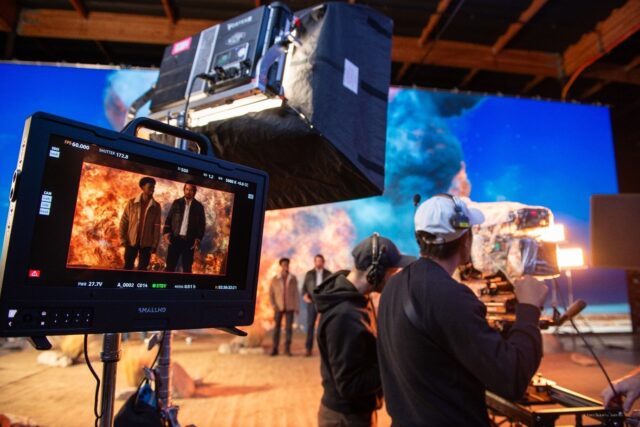
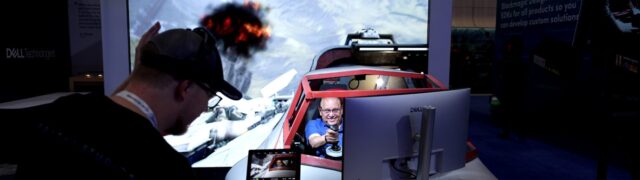
This year at NAB Show, Las Vegas, I was standing next to an LED wall where a full‑blown spaceship sequence was being driven off a handful of workstations and a Dell PowerScale F710, a high-performance flash storage system. The demonstration was delivered by Orbital Studios, a world leader in virtual production and related AI and real-time technologies. People were walking in, “flying” the ship, scanning a QR code, and walking away with a finished clip in minutes. That’s not a demo of what might be possible one day. That’s the reality of virtual production today.
In this piece, I want to pull together what I saw on the Dell NAB Show booth and what I discussed with Diana Blass, an accomplished journalist and host who focuses on technology and digital transformation, to explore why M&E keeps adopting new tech faster than almost any other industry, AI as an accelerant of creative ideation and iteration, and how customers like Orbital Studios are making AI-driven virtual production feel less like science fiction and more like the default way we deliver creative work.
Why media keeps living in the future first
Before Dell, I spent over fifteen years on the studio side. The first feature I worked on came in around 64 TB of final images and their dependencies (the data used to make the final images). One of the last projects I was privileged to work on, a hybrid animated feature, was closer to 5 PB. I’ve got friends at other studios working on feature films regularly hitting tens of petabytes.
That scale drives a certain mindset. Our industry has always been ruthless about using any tool that helps us:
- See what the director is asking for a bit earlier.
- Iterate more times before the money runs out.
- Avoid re‑doing big chunks of work late in the schedule.
That’s why M&E has a long history with things like machine learning and procedural tools, well before “AI” became a marketing term. As I said to Diana Blass, in our chat at NAB, the game has always been:
“The faster you can run through versions, the faster you distil the creative vision, and therefore, get to what the director actually wants to see on screen. Iteration speed is what gets you to the right creative outcome.”
Modern AI just turns that dial further. You can either:
- Get to the same quality faster, or
- Get more and better options in the same amount of time.
Either way, you’re spending more of the schedule making creative decisions and less of it waiting for renders. You’re essentially trading waiting time for creative time, which is a no-brainer.
From “big, static” stages to “where do you want it?”
When virtual production first hit the headlines, all the photos were of gigantic LED volumes in a handful of marquee facilities. You flew everybody there, bent your schedule around that stage’s availability, and hoped nothing slipped.
That model still has its place, but it doesn’t fit everything. TV is a great example. Most shows already have standing sets. Any day you leave those sets is a location day, and as Orbital Studios CEO AJ Wedding told Diana, that can be $40–50K just to move the circus before anyone rolls camera.
Orbital’s response was simple: take the volume to the show, not the show to the volume. They became known for what AJ calls “pop‑up volumes”:
- Bring LED walls and compute in road cases.
- Drop them into the show’s own stage footprint.
- Build the virtual environment around the production, not the other way round.
That sounds straightforward, but it only works if the tech stack shrinks while performance improves. When Orbital first came to Dell, a big part of the brief was:
- Fewer machines.
- More performance.
- Real collaboration, not a set of isolated boxes.
That’s where the combination of Dell Precision workstations, GPU‑dense PowerEdge servers, and Dell PowerScale all‑flash collaborative storage came in. The goal was to make something powerful enough to drive serious LED work, but compact and robust enough to fly and roll into a stage without a small army.
What’s actually running that wall?
If you strip away the buzzwords, virtual production is still just math and data.
On the compute side, Orbital are using:
- Precision workstations on or near the stage, with current‑generation GPUs from NVIDIA. These are doing both the heavy 3D lifting and, increasingly, AI‑based tasks like script breakdowns, upscaling, denoising, and real‑time look development.
- In some setups, GPU‑dense rack servers in a nearby room to spread work across multiple cards when a show really pushes scale.
On the storage side, everything hangs off a small PowerScale F210 storage cluster. That’s the shared brain:
- Every workstation mounts the same namespace.
- All the key datasets live there—environments, plates, caches, AI models, exports.
- Latency is low enough that teams can treat it like a single, very fast, very big local drive.
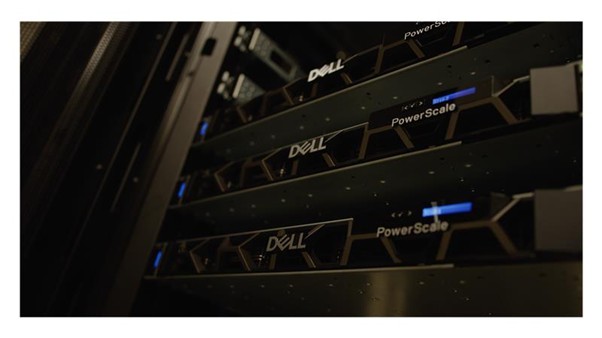
When Diana asked how Orbital is suddenly able to do so much at the edge, on desktops instead of giant farms, my answer was clear.
- GPUs grew up fast. Six years ago, 16 GB cards were a big deal on productions. Now we’re talking about hundreds of gigabytes of aggregate GPU memory in a single box. That changes what you can attempt interactively.
- Flash caught up. The only way to make use of those GPUs is to keep them fed. Spinning disks can’t do that at 8K, in real time, for multiple artists. All‑flash systems like the F210 can.
If you take that fast storage out of the system, the artists and supervisors are spending their day waiting on loads and writes. Put it back in, and a lot of the work that used to require a render farm can now happen on well‑configured machines in close to real-time.
A concrete example: turning car process into a spaceship
AJ has a good way of illustrating how far this has come. In his NAB interview with Diana, he described traditional car process work, i.e. tow rigs, trailers, trying to control light and traffic, and then contrasted it with what they’ve now built for the spaceship experience.
Here’s the short version:
- Half the ship is physical; you sit inside it.
- The glass, reflections, and the rest of the hull are fully digital, because trade‑show lighting makes real glass unusable.
- The background is also digital, running on the LED wall.
- An in‑house AI pipeline stitches the pieces together, does the finishing work, and publishes a 90‑second clip straight to the cloud.
From the attendee’s point of view at NAB Show, you climb into a cockpit, act for a minute, scan a QR code, and by the time you’ve stepped off the stage, your clip is there.
From the commercial production point of view, they’re doing new renders and design iterations in hours, not the weeks or months AJ remembers from older pipelines. He summed it up nicely: “We were doing new iterations every few hours, even on all the space‑flight material, thanks to the latest Nvidia GPUs in the Dell boxes.”
That’s virtual production and AI working together in a very practical way, not to remove people, but to get from idea to moving image while everyone is still in the room.
Fixing the “20–30 minute” problem
When we first sat down with Orbital, one of the issues they described was familiar from my own production days, slow feedback loops.
The pattern looked like this:
- An artist makes a change on their workstation.
- That change has to be pushed across the network to multiple machines.
- The LED wall gets updated.
- Only then can the director see it and give notes.
Depending on the show and the setup, that could easily be 20–30 minutes. Meanwhile you’ve got a director, a DP, supervisors, cast, and crew all waiting around for pixels to refresh. That’s expensive, and it kills momentum.
Our job was to help Orbital cut that loop down as far as possible:
- Put the important data on shared, all‑flash storage, so everyone’s looking at the same source of truth.
- Let multiple artists work against that same dataset without constantly copying files around.
- Give them enough edge compute that new versions of environments or looks can be pushed to the wall in seconds rather than half an hour.
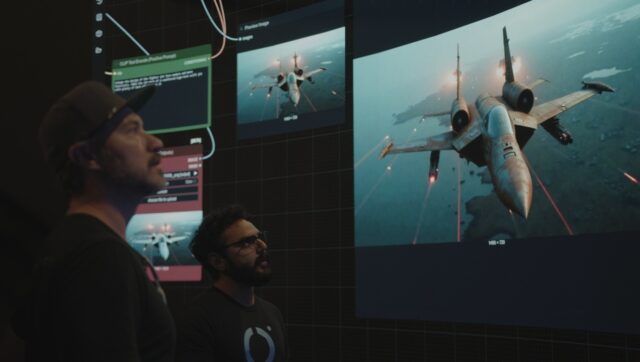
Orbital have gone a step further and built their own internal “AI Studio” framework. That lets them drop in new AI models as they appear, train them on their own approved data, and wire them into the pipeline without rewriting everything. They’re not stuck waiting on a single vendor to ship the next big feature.
Taken together, open AI tooling, GPU‑rich edge systems, and flash‑based collaboration, those changes are what move virtual production from “cool, but clunky and expensive” to something that can keep up with a tight TV schedule, a late script and limited budget.
AI as a creative accelerant, not a takeover
Any time a new technology lands in this industry, there’s a wave of concern. We saw it when digital cameras appeared. We’re seeing it again with AI.
AJ made a good comparison in his interview. When digital first turned up, plenty of people said “I’m never leaving film.” Today, film is still here, but as a choice, not the default. The people who leaned into digital helped make the cameras and workflows better, and they’re the ones still setting the standard.
AI is similar. Used badly, it can absolutely create problems, including ethical, legal, and creative. Used well, it’s a creative accelerant:
- It can break down scripts and help explore ideas earlier.
- It can generate previs or boards so a director can say, “This, not that,” before anyone builds a 3D asset.
- It can do a lot of the grunt work around organization and optimization so humans can spend more time on shots and less on plumbing.
On our side at Dell, we’re mainly focused on making sure the infrastructure doesn’t get in the way, i.e. enough compute, enough bandwidth, enough storage that when a team wants to plug these tools in, the platform can handle it.
On Orbital’s side, they’re using AI in very targeted ways. For example, they’ve trained systems only on data they control, and they’re quite public about air‑gapping those tools so that copyright and security concerns are addressed up front. That’s a very different mindset from “upload everything to a random website and hope.”
From my perspective, the teams that treat AI as a way to front‑load creative decisions, rather than a way to replace people, the ones getting the most value today.
What this means if you’re running a studio or facility
If you’re still relying on:
- Individual workstations with big local disks,
- USB drives and couriers to move data,
- Or a single, central facility everyone has to travel to,
you’re probably feeling the gap widen.
We regularly meet teams who are technically “doing virtual production,” but:
- It takes half an hour for a change to show up on the wall.
- Only one or two people can work on a scene at a time.
- They’re constantly fighting storage bottlenecks.
The pattern we’re seeing with the more forward‑leaning customers is different:
- All‑flash shared storage as the backbone, so you can keep dozens of TB, or more, online and hot.
- Edge‑ready Nvidia-powered workstations and servers that can live on or near the stage.
- A willingness to treat the pipeline as open and evolving, especially around AI, instead of betting the farm on one closed box.
That’s not about chasing shiny objects. It’s about making it realistic to:
- Iterate more during prep.
- Shoot with confidence that what you’re seeing on the wall is close to final.
- Avoid huge surprises in post because everyone’s been looking at something different.
In a world where budgets are under pressure and audience expectations are higher than ever, that combination, better decisions, made earlier, with less waste, is the real value.
Looking ahead
There’s no question we’re in a period of very fast change. Some people call it “creative destruction.” Old ways of working are being pushed hard, and new opportunities are opening up just as quickly.
That can be unnerving. But speaking as someone who’s been on set, in dailies, and now in the infrastructure trenches, I’m honestly optimistic.
AI and virtual production, when they’re grounded in solid infrastructure and new pipelines, are:
- Letting more people get ideas on screen who simply couldn’t have done it 10 years ago.
- Giving established studios new levers to pull when it comes to personalization, scale, and efficiency.
- Making it possible to experiment without blowing up the schedule every time.
My advice is pretty straightforward: don’t sit on the sidelines. Start small if you need to, a pilot stage, a single show, a limited environment, but start. Look at where your bottlenecks really are (it’s usually storage and collaboration more than compute) and fix those first.
The tools are ready. The audience is certainly ready. And if the view from the NAB show floor is anything to go by, the future of this industry is going to be built by the people who are willing to roll up their sleeves and play with what’s in front of them now, not wait for some perfect version later.
That, to me, is the exciting part. We’re not talking about hypothetical workflows. We’re talking about spaceships, built on Tuesday, shooting on Wednesday, and on someone’s phone by Thursday afternoon.
Dell reported this
Source: www.dell.com
Source link