Eighty years ago, the world witnessed the birth of the electronic computing era through ENIAC, the world’s first general-purpose electronic computer. Inside it, electrons were used to solve complex numerical problems.
Today, this same architecture continues to be the basis of general computing, but electrons are beginning to show their limitations. Because they possess a charge, they lose energy in the form of heat, encounter resistance as they move through materials, and become more difficult to control as transistors approach the atomic scale and chips incorporate more and more transistors.
That is why the scientific community has its eyes turned to the photon, the massless counterpart of the electron. With this, the foundations of optical computing are being laid .” pesquisar.php?keyword=”%22computa%C3%A7%C3%A3o%20%C3%B3ptica%22″”>Light computers and their photonic processors .“>
It sounds good. But messing with photons is anything but easy.
“Because they are electrically neutral and have zero rest mass, photons can carry information rapidly over long distances with minimal loss, dominating communication technology,” explains researcher Li He of the University of Pennsylvania in the US. “But this neutrality means they hardly interact with the environment, making them unsuitable for the type of signal switching logic that computers rely on.”
[Image: Zhi Wang et al. – 10.1103/gc15-qsvf]
Computing with quasiparticles
Fortunately, quasiparticles exist. And there are quasiparticles for computing in the standard we know today, as well as quasiparticles that can bridge the gap between electronic and quantum computing .
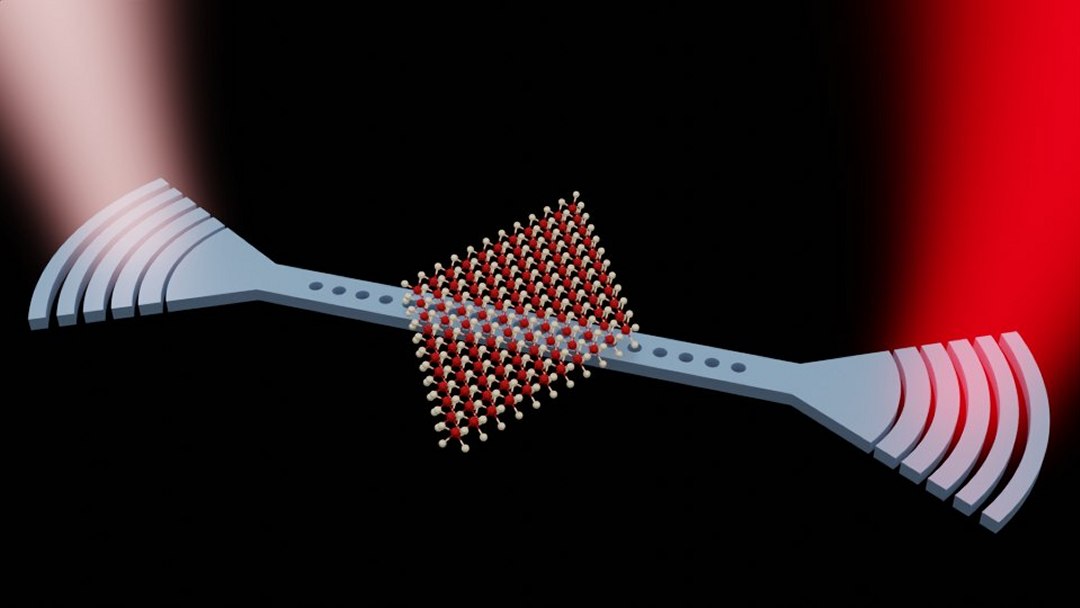
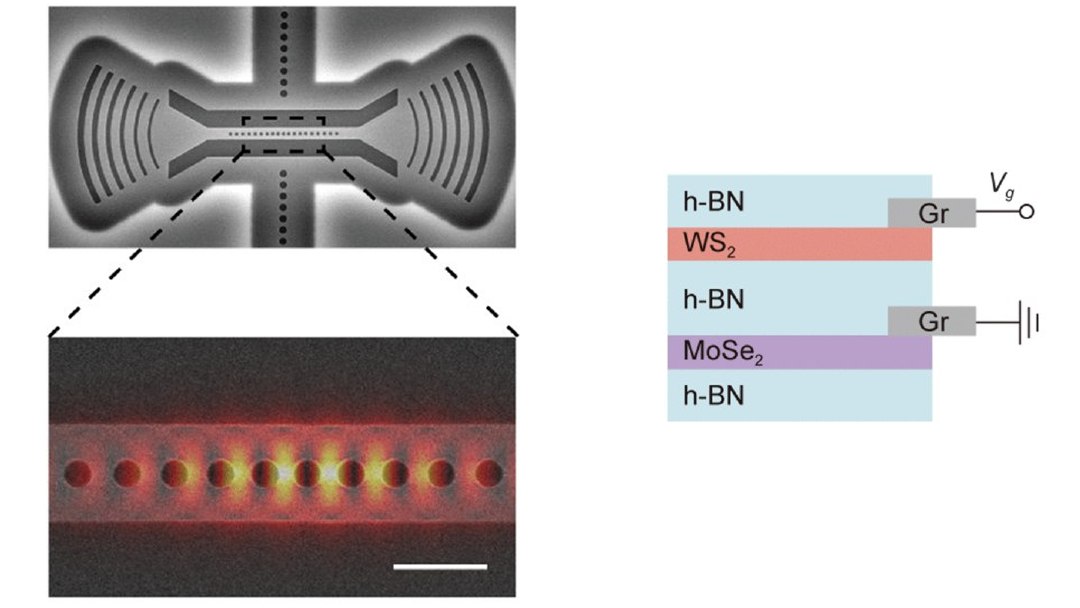
Le He and his colleagues are eyeing a specific quasiparticle, known as the exciton-polariton, a hybrid quasiparticle that combines the speed of light with the strong interactions of matter. To take advantage of it, the team discovered a way to produce them by coupling photons with electrons inside an ultrathin semiconductor. This allows light to interact with sufficient intensity for the signal switching necessary for computation, something very difficult to achieve with pure photons.
This advancement could be especially important because, although several photonic chips, particularly those aimed at AI applications , can already perform simple calculations using light, executing non-linear activation steps, such as applying decision rules, still requires converting the light signals back into electronic signals, resulting in reduced speed and higher energy consumption.
Using their excitons-polaritons, the team demonstrated that fully luminous switching can be done with about 4 quadrillionths of a joule (10⁻¹⁵ joules ), an extraordinarily small amount of energy.
If the technology, demonstrated in the laboratory, can be scaled to real computers, the platform could help photonic chips process light directly, reducing the energy demand of large AI systems and even paving the way for basic quantum computing capabilities on chips.
Source: www.inovacaotecnologica.com.br
Source link