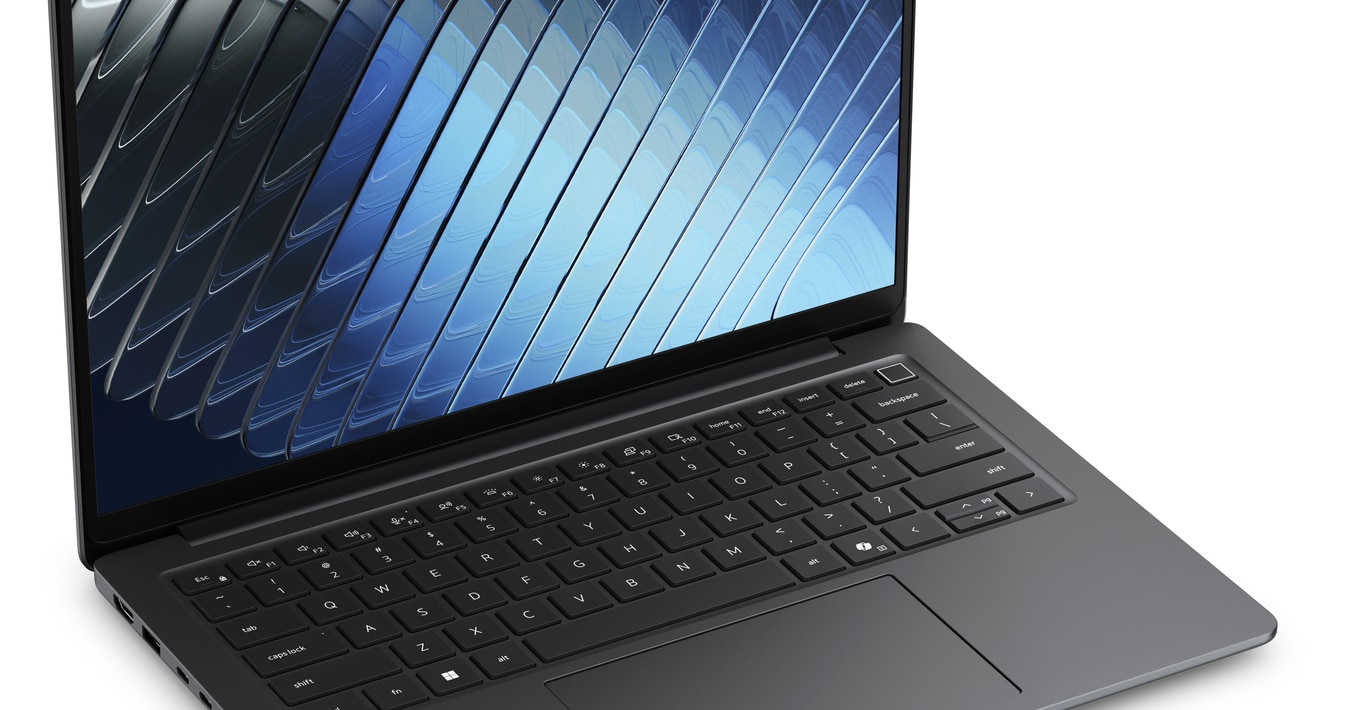
The challenge: Small speakers, big expectations
A thin commercial laptop has to stay portable, secure and serviceable, yet still fill a noisy room. Small speakers can’t move enough air at low frequencies, so bass always falls short of the source. Tuning can narrow that gap, but it can’t close it. And simply cranking the volume isn’t the answer: loudness, tonal balance, distortion and speaker protection pull against each other, so they have to be engineered together.
Measure what people actually hear
We pair lab measurements (anechoic testing, microphone placed where a seated user sits) with listening panels run internally and with customers. Two metrics matter most. Perceived loudness, in sones per ISO 532-1, models how human hearing weighs different frequencies. Balance, scored 0 to 100, shows how faithfully a system follows the source across low, mid and high frequencies. Too much mid and treble sounds harsh. Weak bass sounds thin, even when speech is clear. The surprise: in blind listening, the winners favored Balance over raw output. Among mainstream laptops tested, the Dell Pro 5 leads on both.

The secret: smart amps that tune themselves into the chip
Cirrus Logic smart amplifiers run two kinds of processing between the signal and the speaker:
• Enhancement linearizes the speaker response, extends bass beyond what the driver can natively do and shapes dynamics so speech stays intelligible at higher output.
• Protection uses excursion and thermal limits to keep speakers from being pushed past their limits, so you get the most sound without damage or distortion.
The best part: this tuning is hardened-on-chip in the smart amp’s DSP. No software driver to remove, no audio that changes after an IT update.

Tune, measure, listen, repeat
Every tuning update is scored on loudness, Balance and speech quality, then checked by real listeners, until the unit qualifies for release. Balance and loudness trade off, and scoring shows exactly how much. In one example, tuning for Balance lifted the score from 60.3 to 72.8 and held the response within about 3 dB of target from 300 Hz up, while improving bass that had strayed by as much as 10 dB.

From Balance to better calls
Mean Opinion Score (MOS) rates speech from 1 (very difficult to understand) to 5 (like face-to-face). Most VoIP calls land between 3.0 and 4.2, so a few tenths is a big deal. Across three same-tier laptops, MOS rose with Balance, and the Dell Pro 5 came out on top.

The scoreboard


What’s next
This is the first step that paves the way to our new audio improvement approach across Dell Pro Commercial laptops. Future iterations should allow for new acoustic designs, smarter signal processing and tuning that adapts to the application and the environment. Want the full story, methodology and data? Read the whitepaper: Redefining the Dell Pro Commercial Audio Landscape.
Dell reported this
Source: www.dell.com
Source link