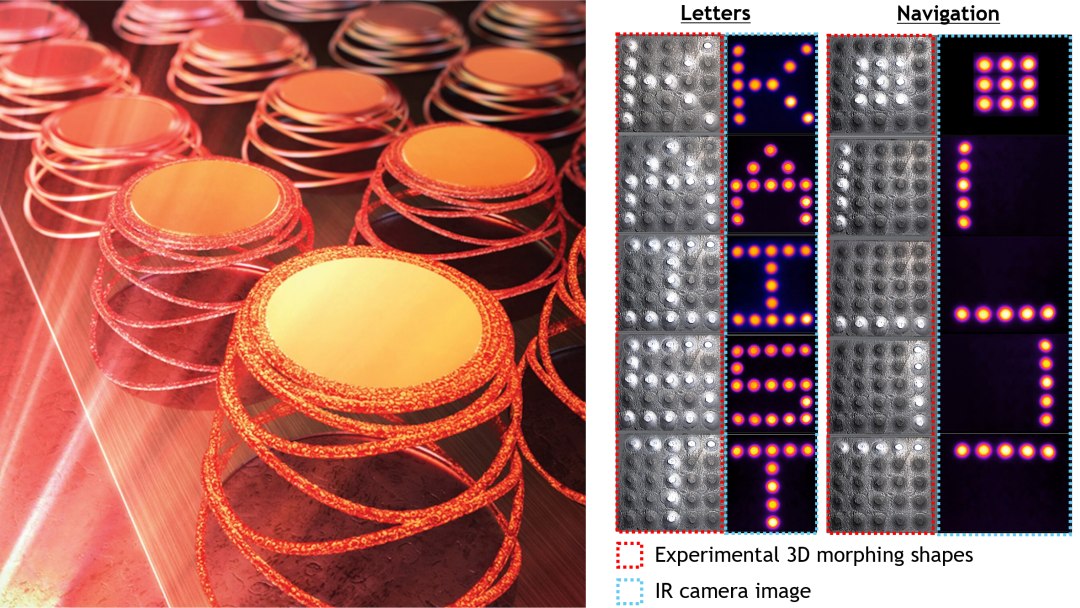
Concept and photothermal structures driven by UV light.
(Image: Advanced Science)
Lift buttons
Touch screens have left buttons somewhat forgotten, but mechanical actuation switches are still necessary in countless applications.
And, not to say that mechanical buttons and keys have been relegated to the technology of past centuries, they have just received a “photonic boost” that makes them candidates for several state-of-the-art technologies, such as tactile interfaces with retractable physical buttons, free-form screens, cutting-edge wearable devices and flexible robots.
Hyunsoo Kim and colleagues at the Korea Advanced Institute of Science and Technology have created a metal structure that changes shape simply by receiving light, and this without any light-absorbing coating: No wires, no actuators; Just shine a light on the metal surface and it rises like a button.
Drawing inspiration from kirigami, the art of creating three-dimensional structures by cutting out paper, Kim designed precise cutting and folding patterns and applied them not to paper but to a flat metal sheet. The result is a metallic structure with a predetermined three-dimensional shape.
It is possible to precisely control both the height of the three-dimensional deformation and the resulting force by simply adjusting structural parameters such as the hinge width and the slot width. In other words, it is possible to simultaneously program how efficiently the structure absorbs light and how it mechanically deforms.

Simple manufacturing process will allow for multiple applications.
(Image: Hyunsoo Kim et al. – 10.1002/advs.74930)
Shape memory
In addition to the cutting project, you need to select the metal. The natural choice is shape memory alloysspecial metals that return to a pre-programmed shape when heated to a specific temperature, even after being deformed. Because it is light and capable of generating great forces, this class of artificial muscles It is widely used in flexible robots and wearable actuators.
But there was an obstacle to actuating these structures from a distance, using only light: Photothermal actuators made of shape memory alloys, such as the best-known nickel-titanium alloy (NiTi), do not absorb near-infrared light efficiently, which requires the application of separate light-absorbing coatings, such as graphene oxide, polymer composites or thin films of titanium nitride (TiN). This complicates and makes everything more expensive and is not durable, reducing the application possibilities.
It turns out that using UV laser micromachining to cut kirigami structures into thin sheets of this actuator alloy simultaneously generates a porous layer of titanium oxide (TiO2) on the surface, due to laser-induced oxidation. As a result, the absorption of near-infrared light increases significantly without any additional outer coating.

Buttons can also function as pixels to display information, visually or tactilely.
(Image: Hyunsoo Kim et al. – 10.1002/advs.74930)
Photonic logic
In fact, the oxidation of sections of each button can be precisely controlled, so that different regions of the structure can deform sequentially at different speeds, even when the entire structure is exposed to the same light source.
This means that the order and timing of deformation are encoded directly into the material itself through light-absorbing properties, without any separate electrical control. This can be seen as a form of “photonic logic”, with the possibility of application in fully mechanical control instruments.
“The laser programming technology developed in this study is an easy-to-fabricate platform that encodes both mechanical deformation and optical properties into a single metal structure without any separate coating process,” summarized Professor Il-Kwon Oh. “It can be widely applied in next-generation light-controlled intelligent transformation interfaces, including adaptive surfaces, interactive haptics, and photothermal soft robots.”
Source: www.inovacaotecnologica.com.br
Source link