Battery almost alive
A new liquid material recharges itself like a battery, transforms like a living organism, and then restarts without any special apparatus, simply by coming into contact with ambient air.
This means that energy capture, storage, and utilization are condensed into a single material, something that currently requires separate devices for each task. It’s a kind of battery inspired by living organisms, which has allowed for an integration that opens up many possibilities for use.
Although the recharging process is still slow, integrating the three functions into a single material paves the way for adaptable and metamorphic systems, without the need to use plastics or metals, making the solution cleaner and more renewable. It also doesn’t require electricity to recharge: the material captures a variety of energy types.
Because the material can collect, store, and release energy repeatedly, researchers envision potential applications ranging from clean energy technologies and environmental remediation to adaptable flexible electronics and programmable materials.
In terms of electricity usage, just one gram of the material can store enough energy to charge a smartwatch or similar portable device.
“Living systems are remarkably dynamic,” comments Professor Samuel Stupp of Northwestern University in the US. “They constantly build structures, destroy them, and rebuild them. We wanted to create a synthetic material that behaved similarly while also performing useful functions. Our material’s ability to store and release energy on demand could make it useful for energy storage, environmental remediation, and next-generation flexible electronics.”
Inspired by the cytoskeleton
The new material was designed with inspiration from the cytoskeleton, the dynamic internal structure of living cells that allows them to maintain their shape, move, and divide. Unlike the rigid skeletons of animals, cytoskeletons are constantly built, disassembled, and rebuilt.
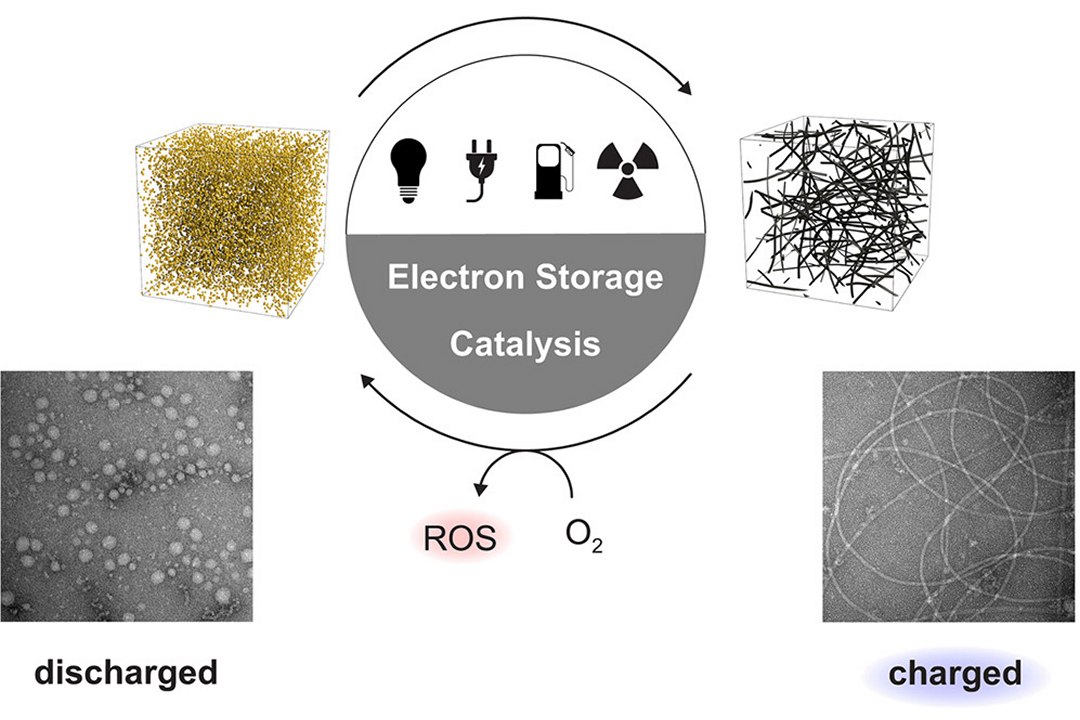
Biomimetic material behaves similarly, assembling and disassembling—more specifically, gelling and liquefying—repeatedly while storing and releasing energy. But instead of running on biofuels, it is powered by electrons collected from sunlight, electricity, X-rays, or other energy sources.
To use the energy and restart the process, simply expose the material to oxygen in the air, which causes the gel to dissolve, releasing energy and returning to a liquid state, allowing it to be recharged and used repeatedly.
“The world generates enormous amounts of solar energy , but storing it until it’s needed is a challenge,” commented Stupp. “For energy storage, our material performs the same function as a battery. However, it runs entirely on water, requires no metal or plastic, and can be recharged repeatedly. This type of clean and flexible platform can open new doors for renewable energy.”
After absorbing energy and recharging, the original yellow liquid transforms into a black gel, which can retain stored energy for months. This stored energy can be used to initiate and maintain chemical reactions, similar to generating electricity from the chemical energy of a battery.
But many other uses are possible. In one demonstration, the charged gel was able to transfer its stored energy to oxygen, creating highly reactive molecules that, in turn, drove chemical reactions in complete darkness. “Most photosensitive materials stop working when the light source disappears,” said Stupp. “Our material enables a form of ‘photocatalysis in the dark’.”
Source: www.inovacaotecnologica.com.br
Source link