Fractions of a joule
Scientists have achieved a milestone in energy measurement: They measured energy below one zeptojoule, more specifically 0.83 zeptojoules, or 830 ioctojoules.
The prefix zepto is equivalent to 10⁻²¹ , which is difficult to even imagine: It’s roughly enough to push a red blood cell through a space of 1 nanometer. The sequence of fractions of the unit is milli, micro, nano, pico, femto, atto, zepto, and iocto. This also brings our ability to measure energy to the same level as our current ability to measure time, since atomic clocks already measure zeptoseconds .
The unit of measurement, the joule, is the amount of energy expended when a force of 1 newton (the force required to accelerate a mass of 1 kilogram at 1 meter per second squared) moves an object a distance of 1 meter, or the energy transferred in 1 second by a power of 1 watt.
Studying the fundamentals of quantum mechanics requires the ability to make minuscule measurements. Therefore, scientists are constantly striving to obtain more precise resolutions to measure, quantify, and control these fundamentals, such as photons, which carry light and have no mass unless they are in motion. The more precise the measurement, the greater the possibilities for developing more advanced quantum and photonic technologies, or the ability to detect still unknown particles.
Calorimeter
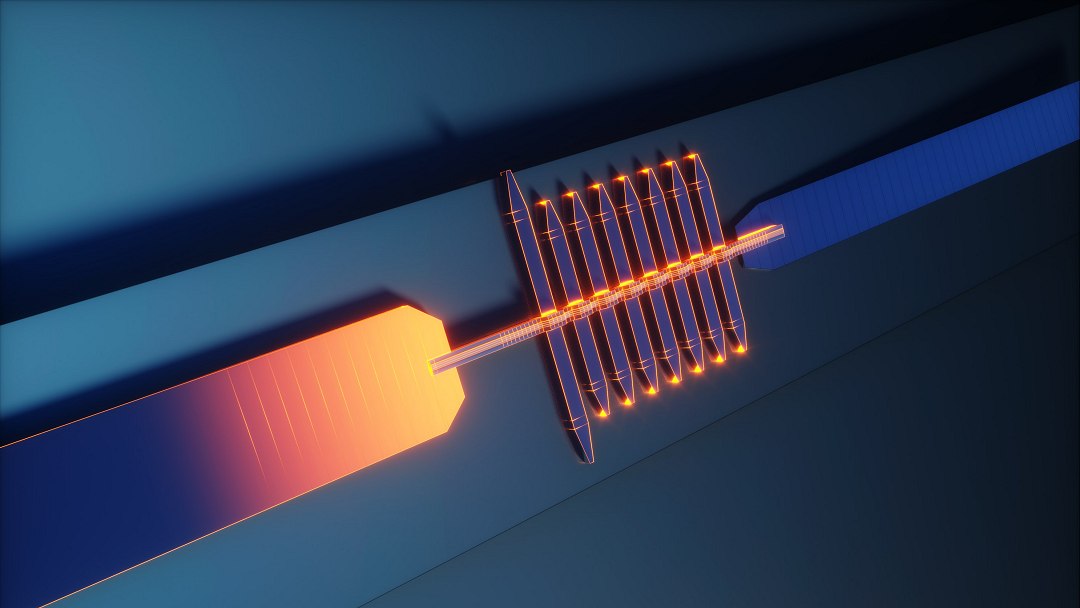
András Gunyhó and colleagues at Aalto University in Finland used a calorimeter, a type of ultrasensitive heat-based energy sensor designed to measure energy exchanges between bodies or systems when those exchanges occur in the form of heat.
The device fires a microwave pulse toward a sensor made of two different types of metals: superconducting metals , where the pulse propagates freely, and ordinary conductors, which offer resistance to the photon.
“This combination of metals makes superconductivity such a fragile phenomenon that it weakens immediately if the temperature in the ultracold conductor rises even slightly. This makes it an extremely sensitive configuration,” explained Professor Mikko Mottonen, whose team has been breaking records in heat detection for over a decade.
After making all the optimizations within their reach, the team read the final result, which showed the system detecting an electromagnetic pulse of 0.83 zeptojoules – you can also think of it in terms of taking one billionth of a joule and then taking one trillionth of that billionth. The result is unprecedented in the world for calorimetric measurement devices, considered some of the most sensitive in existence.
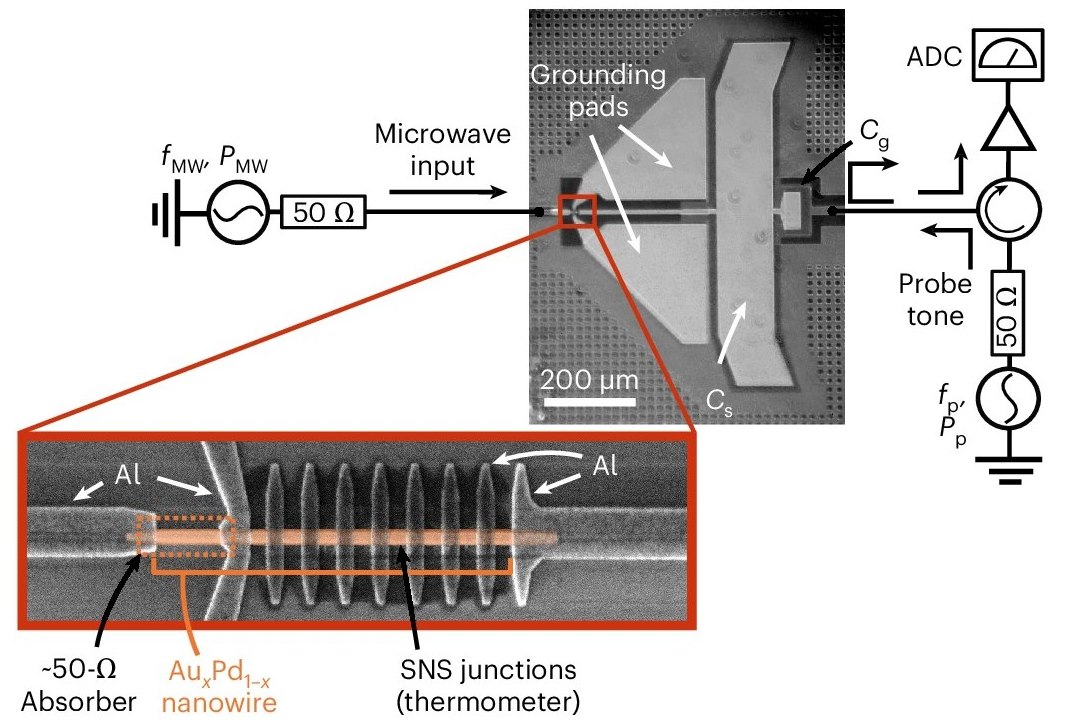
[Image: András Márton Gunyhó et al. – 10.1038/s41928-026-01615-2]
Qubits e áxions
This new equipment paves the way for counting individual photons, a sensitivity long desired not only in quantum technology but also in fields such as astrophysics.
“We want to make this system capable of measuring input signals with an arbitrary arrival time, which is important for things like detecting dark matter axions in space, when you have no idea when they might arrive at the system,” said Mottonen. The hypothetical axions are candidates for dark matter particles.
And, since the calorimeter can be integrated into a variety of measurement configurations, it could be used in quantum computing.
“A calorimeter operates at the same millikelvin temperatures that qubits require. This introduces less disturbance to the system, since we don’t need to heat the device to a high temperature or amplify the qubit’s measurement signal to obtain a result. In the future, our device could be a component for reading qubits in quantum computers, for example,” concluded Mottonen.
Source: www.inovacaotecnologica.com.br
Source link