

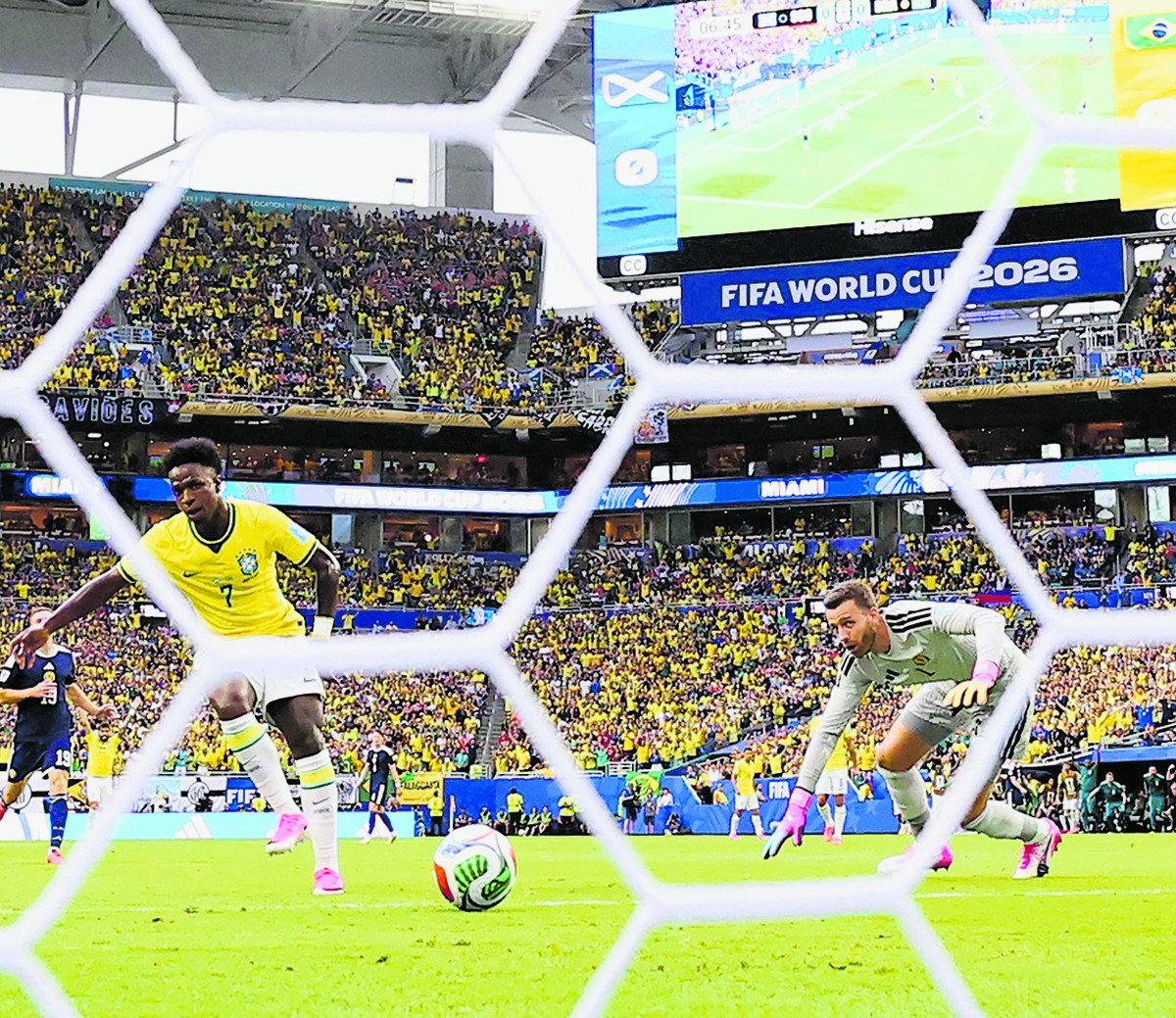
The semi-automatic offside used in the 2026 FIFA World Cup represents an advance over technologies from previous World Cups. With the support of artificial intelligence, sensors and high-frequency cameras, the system allows you to analyze bids more quickly and accurately. The tool can confirm the players’ position and issue alerts in a matter of seconds, with an average checking time between 25 and 70 seconds, according to information released by FIFA. The new version also started using digital avatars of the athletes, created from AI models.
According to FIFA, the resource, officially used for the first time in a World Cup, combines data collected by sensors installed on the ball and on the 16 cameras spread across the stadiums to monitor the athletes’ movements in real time.
The system was used in the testing phase at the 2022 World Cup in Qatar, and was later adopted in international competitions, such as the Champions League and the Premier League.
The main evolution for this World Cup is the creation of “digital avatars”. Before the competition, players from the 48 teams underwent a body scanning process, which allowed them to create 3D representations capable of reproducing individual physical characteristics, such as posture and body dimensions.
For Renan Borges, technology director at Agência End to End, a sports management company, the main change is the “transition from the generic skeletal models” previously used. According to him, the current system uses previous 4K scans of all athletes, generating “faithful 3D avatars that reproduce the exact posture and dimensions of each athlete’s body in real time”.
Camera analysis monitors specific anatomical points of the player ten times per second.
In addition to the automatic identification of irregular position, FIFA confirmed the new functionality for The Cup. In matches, assistant referees receive a real-time audio alert when a player is more than 10 centimeters in front of the offside line. The notice aims to speed up decision-making and reduce analysis time by the VAR, the video assistant referee.
Despite technological advances, the system continues to be considered semi-automatic because some decisions still depend on human interpretation. The tool identifies the player’s position when the ball is launched, but the assessment of possible interference in the play remains the responsibility of the refereeing team.
Sálvio Spínola, a former football referee accredited by FIFA, says that the semi-automatic offside is “automatic in requirement number 1 of rule 11 of offside”, which deals with the position of the attacking player: “This is totally automatic. Where it is semi-automatic is in interpretative moves, to know whether the player in the offside position interfered in the play or not”, he explains.
According to the FIFA Rule Book (Laws of the Game), the referee remains the authority responsible for the final decision. The document establishes that the arbitration team must always make an initial decision as if there were no VAR and that technology works as an aid tool, not as a substitute for human judgment.
The system also establishes guidelines on the use of the electronic sound signal by assistant referees, as provided for in football rules. The resource can be used to draw the referee’s attention in situations such as offsides, infractions outside the field of vision or difficult decisions involving game moves.
For Spínola, technology represents an important change in arbitration, but it does not eliminate the preparation of professionals. The resource “came to help, not to replace the field referee”, he states.
The assessment is shared by the Arbitration Commission of the Brazilian Football Confederation (CBF), which considers technology a tool to support decision-making, without replacing the referee’s authority. According to the entity, resources such as VAR, semi-automatic offside and advanced communication systems change the preparation of professionals, who now need specific training on technological protocols, operational simulations and integration between field referees and video teams.
Raimundo Góes Netto, director of arbitration at the CBF, said that the impact of the technology will be measured by indicators such as error reduction, accuracy of decisions and review time. “The success of technology is not only measured by the number of interventions, but by the ability to increase sporting justice and strengthen the credibility of arbitration”, he states.
Source: www.bing.com
Source link


