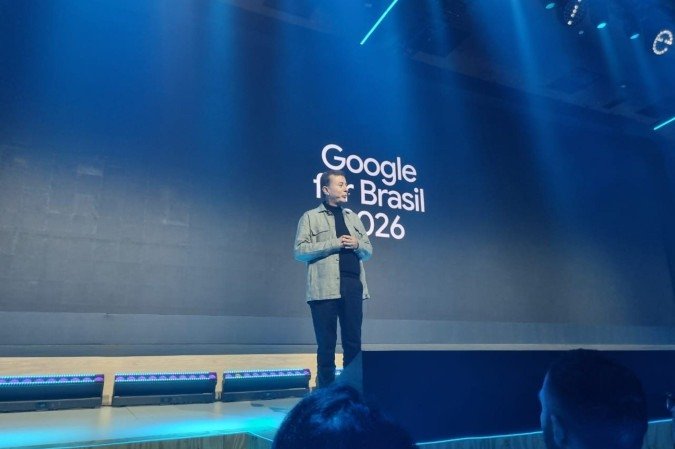
The technology giant Google will hold this Wednesday (10/6) the eighth edition of the now traditional Google for Brazil. The event brings together the main news that the company will implement on different platforms. And, among cool executives and foreign accents at the Allianz Parque viewpoint, it was clear that the order of the year is one: use the artificial intelligence (AI) to optimize productivity and facilitate the user’s routine.
Between the announcement that the technology giant now sponsors teams from different categories of the National Team, when taking the main stage of the event, Fábio Coelho, executive director of Google Brazil, tried to highlight AI as a technological advance, which “is already part of Brazilians’ routine”. “Over the last few years, we have been able to follow how Brazil adopted AI very quickly”, he argues.
Fábio Coelho, executive director of Google Brazil
(photo: Ronayre Nunes/CB/DA Press)
The investment in technology involves announcing million-dollar investments in qualification sectors. It was said that R$2 million will be invested in five Brazilian start-ups, as well as R$5 million will be allocated to national education projects.
Ask the Studio
One of the highlights is the implementation — for now restricted to the web — of “Ask the Studio” on YouTube. The feature works as an AI assistant integrated into YouTube Studio, bringing Gemini’s solutions and knowledge to improve the work of content creators.
In practice, conversational chat will help analyze metrics, provide user feedback, generate insights for new videos and more. Eduardo Brandini, director of responsibility at YouTube Brazil, defended the role of the video platform in education, in the creative economy and recalled that the space will broadcast the World Cup games and said: “YouTube is the epicenter of world culture”.
Chrome with built-in AI
That old story of needing to change tabs to consult Gemini has come to an end. This is what Charmaine D’Silva, Chrome’s product director, promises. The browser’s big new feature is the native integration with Gemini.
In updated versions, the browser will display an icon in the top right corner that opens Gemini chat in a sidebar. The biggest difference is that the feature allows you to access and cross-reference information from other tabs right there, without the user having to navigate between pages.
The assistant also integrates with Gmail, Maps and Calendar, being able to summarize texts from the active tab or even edit images using text commands.
The new feature is now available for the web and iOS and, according to the company, should arrive “soon” for Android devices.
Smart mobility and traffic lights
The arrival of the Green Light project in São Paulo was also a highlight. In practice, the system uses traffic trends from Google Maps so that the AI suggests adjustments in traffic light times to traffic engineering companies, optimizing the flow of cars.
AI can identify, for example, whether a traffic light should be activated a few seconds later to prevent the flow of vehicles from being interrupted. By avoiding starts from stationary cars, fuel is saved and, consequently, pollutant emissions are reduced. In Brazilian cities where the system already operates — Rio de Janeiro, Campinas and São Caetano do Sul — Google estimates a reduction of up to 30% in complete vehicle stops.
More interactive maps
In addition to YouTube and Chrome, the user will now have a conversational experience with Google Maps. The “Ask Maps” feature promises assertive answers to complex questions and can even plan travel and tour itineraries.
The new tool will also take into account each user’s historical preferences to personalize the experience. The new feature will be available to everyone in the coming weeks.
Direct bookings with AI
The proposal of “Table Reservation in AI Mode” is to allow the user to make a reservation at bars, restaurants or wineries directly through Google search — without the need to access the establishment’s website or migrate to WhatsApp.
The tool must be able to interpret complex requests, find the ideal location according to the user’s description and complete the scheduling considering day, time, environment preference and even the desired menu.
*The reporter traveled to São Paulo at the invitation of Google.
Source: www.bing.com
Source link