The most meaningful change occurs when technology, community insight and lived experience come together to solve real challenges.
That belief has shaped how we approach this moment in AI.
Because while artificial intelligence is rapidly reshaping how we work and live, what I see when I spend time with nonprofits is not hesitation — it’s determination. Organizations are eager to explore what AI can do for their missions. But they are navigating real and complex barriers: limited capacity, evolving governance needs and often no shared language for what AI should look like in their specific context. That’s why partnership matters. And it’s why Dell’s approach goes deeper than writing a check or donating devices.
We build impact alongside nonprofits through our Future Ready Nonprofits program, a global initiative run in partnership with TechSoup. Across the United States, United Kingdom, Canada, France and Germany, communities where Dell operates, we work directly with mission-driven organizations who are focused on digital inclusion, workforce development and strengthening communities where Dell operates. The program delivers a comprehensive assessment that informs a technology roadmap, while also providing specialized IT services, access to TechSoup’s community learning platforms and implementation funding to support the recommended solutions. Organizations engage through a cohort-based journey or a more intensive year-long partnership, both designed to embed digital transformation as a lasting capability, not a one-time project.
That foundation matters enormously as AI enters the picture.
We recently worked with Board.dev and TechSoup on a report, Building the Leadership Nonprofits Need to Make AI Work, based on insights from 180 nonprofits across 44 states. What we found, and what we discussed in a recent webinar, reinforced what many of us are seeing firsthand: nonprofits aren’t resisting AI — they’re navigating it without the leadership infrastructure and support systems needed to adopt it sustainably and responsibly.
They are ready. What they need is to be met where they are, with the right partners at the table. Listening cannot be an afterthought — it has to be foundational.
I see the power of this approach in partnerships like Hopeworks where I live in Philadelphia.
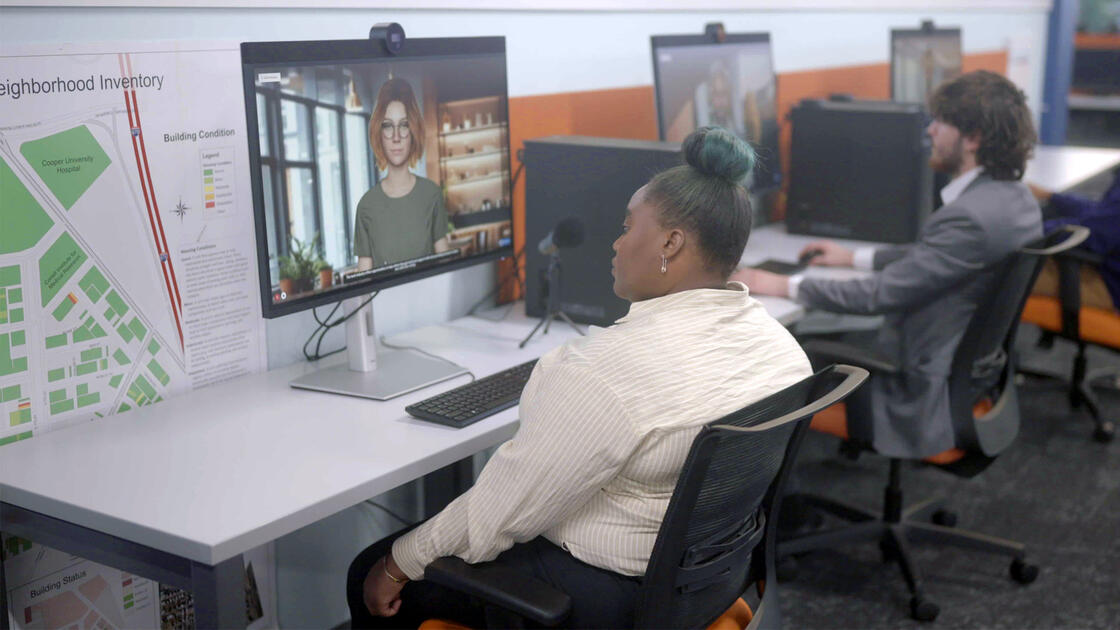
Hopeworks is focused on moving young adults into living-wage careers, and their question was never whether to adopt AI — but how to use it in a way that expands opportunity. Together, we introduced an AI-powered mock interview tool within Hopeworks’ AI Innovation Hubs in Camden, Philadelphia and Newark. These hubs go beyond training — they’re environments where young adults and staff build AI skills while working on real-world projects, gaining the experience and confidence needed to step into meaningful careers.
But what stands out to me isn’t just the technology — it’s the outcomes I witness firsthand.
I spent time with participants in these programs, to hear their aspirations and to see the transformation as they build confidence and step into careers in technology.
Participants using the mock interview tool are achieving job placement rates above 90% and significantly higher starting salaries. But behind those numbers are individuals who are not just learning, they’re earning, growing and redefining what’s possible for themselves, their families and their communities. One of those individuals, Angel, was among the first young professionals to participate in Hopeworks’ AI track and is now succeeding as a technology sales associate — a vivid example of what becomes possible when access, training and belief intersect.
That’s the kind of impact that only happens when we build with communities, not for them.
We’ve continued to expand these opportunities by bringing nonprofits together as a community — whether at Dell Technologies World, where this past May, 12 workforce development-focused nonprofit organizations joined us to engage directly with cutting-edge AI solutions, or through dedicated learning experiences where nonprofits can explore, ask questions and shape how these technologies fit into their missions.
These moments are important not just for access, but for dialogue. They create space for nonprofits, community leaders and technologists to learn from each other — and to build a more inclusive approach to innovation.
Because ultimately, the future of AI in the nonprofit sector won’t be defined by technology alone. It will be defined by who has access to it, who helps shape it and how deeply we listen to the communities it is meant to serve.
Dell reported this
Source: www.dell.com
Source link