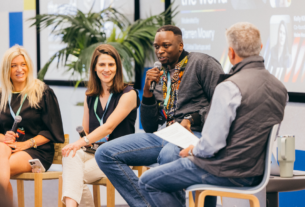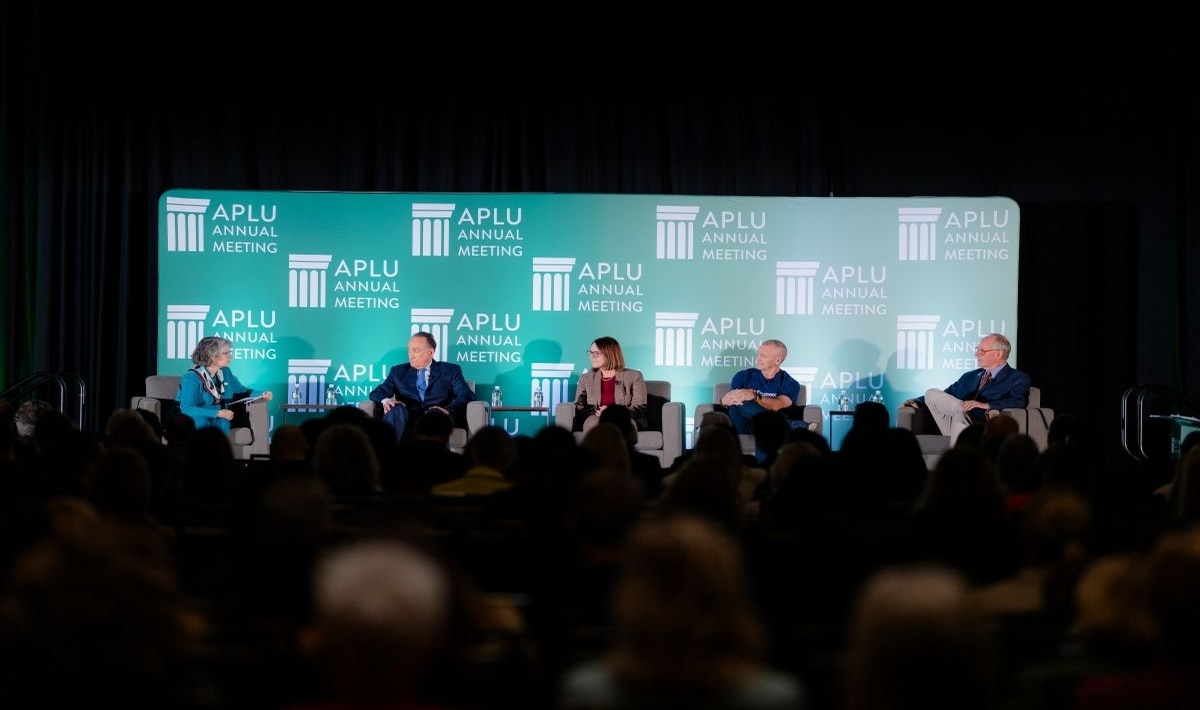
Universities exist to expand opportunity, advance discovery and strengthen the communities they serve. That enduring mission isn’t changing with AI, but AI gives us the best chance yet to deliver on it. It was the heart of the panel I joined earlier this week at the Association of Public and Land-grant Universities (APLU) Annual Meeting in San Antonio, Texas, where higher education, government and industry leaders discussed the convergence of higher education, workforce development and economic growth. As a UTSA engineering graduate, the conversation was personal to me. I left optimistic about what comes next, and I want to explain why.
What people can do now that they couldn’t before
After nearly 40 years in the technology industry, I’ve never seen a technology evolve this quickly or create this much opportunity across so many fields at once. Across higher education, we’re already seeing AI expand opportunities for students, researchers and communities alike:
- Students can gain hands-on experience with AI and data-driven problem-solving. Programs such as Bevo Labs at the University of Texas and the Dell Student Security Operations Center at the University of Tennessee give students real-world experience in areas like analytics, AI and cybersecurity, helping them graduate with practical, in-demand skills.
- Institutions and employers can strengthen the talent pipeline. Programs like the University of Tennessee’s Student Security Operations Center help address critical cybersecurity workforce shortages while improving institutional resilience and creating a stronger pool of job-ready talent.
- Researchers can tackle larger and more complex challenges. At the Texas Advanced Computing Center (TACC), advanced computing powers research ranging from hurricane modeling to next-generation AI. Horizon, the fastest, most powerful academic supercomputer in the U.S. will further accelerate discovery across scientific disciplines.
- Communities can get better insight into severe weather.Texas Tech University researchers are expanding advanced weather intelligence across the Texas Hill Country, helping improve forecasting.
In each case, AI widens what people can do: solve bigger problems, uncover insights earlier and gain hands-on experience. Skepticism is healthy. Students and administrators are right to ask whether AI is accurate, whether it helps or replaces learning and what it means for work. The answer is neither to ignore AI nor to trust it blindly. It is to put it in people’s hands, along with the judgment to evaluate it. As AI becomes more capable, human judgment becomes more important, not less.
Preparing students: judgment and AI fluency
At the same time, AI is forcing us to rethink how work gets done and what skills will matter most in the future. As an engineer, I think about work in three parts: intent, action and validation. Intent is deciding what problem to solve. Action is doing the work. Validation is checking that the result is what you wanted. AI is rapidly transforming action. Work that once took significant time and effort can now be drafted in minutes. But you still decide what the work is for, and you still check that it is right before your name goes on it. Intent and validation remain human functions. AI can assist with execution, but accountability cannot be outsourced.
That has a clear implication for universities: every graduate needs AI fluency, not AI specialization. A nurse, engineer, agricultural scientist or historian does not need to become a computer scientist. AI delivers its greatest value in the hands of people who understand their field, know what questions to ask and can critically evaluate the results. Expertise still matters. Critical evaluation still matters.
Three questions we should all be asking:
- Does every student, in every discipline, get hands-on experience with AI and data, not just those in computer science?
- Are we teaching students to question AI’s outputs and take responsibility for the results?
- Are we building programs with employers so graduates’ skills match the jobs that are growing?
Universities are well positioned to say yes. They have always taught people to analyze evidence, challenge assumptions and apply knowledge to real problems. Those skills aren’t becoming obsolete. They’re becoming essential.
Preparing the institution: infrastructure and talent
The same principle applies to the institution. Infrastructure is the hardware, but talent is the software. You need both. This is where technology infrastructure and talent development come together. Researchers and students need access to powerful computing resources, but they also need the skills and training to use them effectively. Three questions to work through together:
- Do our researchers and students have the computing power to do their best work?
- Are we investing in faculty, staff and training as fast as we invest in technology?
- Are we starting with the problems we most need to solve, not the technology we want to deploy?
Too often organizations start by asking what technology they should deploy. The better question is what problem they are trying to solve. When universities, industry and government align around a shared challenge, technology becomes an accelerator, not the destination.
Partnerships that outlast projects
Universities have long served as anchors within their communities. Increasingly, they are also becoming conveners, bringing together expertise, infrastructure and talent to address challenges no single organization can solve alone. Projects have endpoints. Partnerships shouldn’t. The most impactful collaborations are built around shared challenges and shared outcomes. They endure because the need doesn’t disappear when a project ends.
The pace of change also requires institutions to learn, adapt and decide faster than ever before. That doesn’t mean abandoning rigor. It means applying rigor quickly enough to keep pace with opportunity.
The mission endures
Every major technology shift creates uncertainty. I’ve seen many of them. The organizations that benefit most aren’t necessarily the first to adopt a new technology. They’re the ones that learn to apply it to meaningful problems.
AI will continue to change how work gets done. But deciding what matters, evaluating results and taking responsibility for outcomes will remain distinctly human work. The mission of higher education is as important as ever: preparing students, advancing discovery and strengthening communities.
AI may expand what people can do, but human judgment will determine what those capabilities ultimately achieve. That’s why I’m optimistic. The next decade won’t be defined by artificial intelligence alone. It will be defined by the choices people make about how to use it.
Dell reported this
Source: www.dell.com
Source link