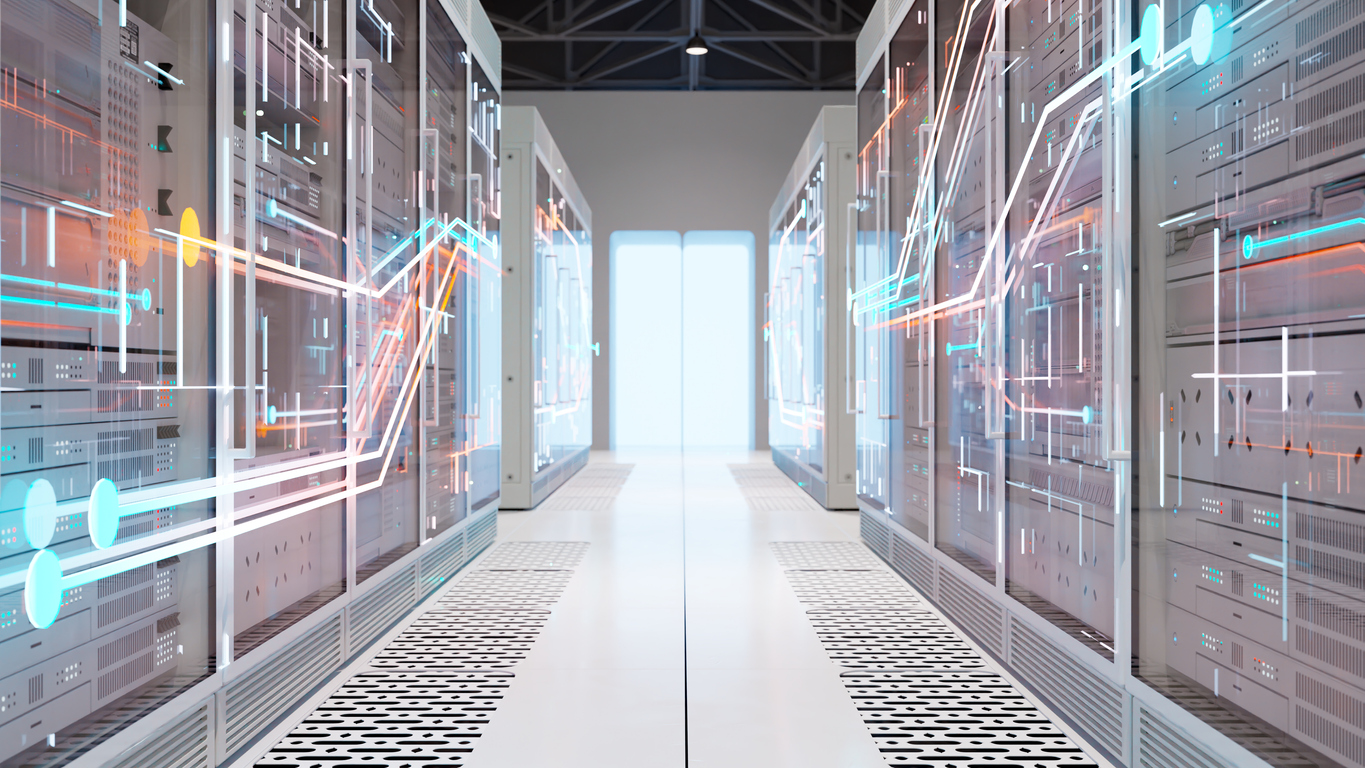
Most conversations about AI focus on GPUs, models and training clusters. But behind every AI deployment sits a supply chain, and that supply chain is undergoing its own transformation.
Traditional IT supply chains were designed for an era when servers, networking, power and facility infrastructure could be planned, sourced and integrated largely independently. AI changes that equation. As power densities exceed 200 kW per rack, air cooling can’t keep up, which is why liquid cooling is becoming standard.
Traditional supply chain models can’t keep up with the speed, power requirements and integration demands of AI infrastructure.
Three shifts redefining AI supply chains
The AI supply chain is not just faster. It is structurally different.
Sequential → Parallel.
Traditional data centers were largely built in sequence — design, procure, construct, integrate and deploy. AI infrastructure increasingly follows a parallel model. Compute, power, cooling and networking are engineered simultaneously, while modular power and cooling systems are factory-built and validated offsite before being deployed as integrated building blocks. This parallel approach compresses deployment schedules, reduces on-site complexity and enables organizations to bring AI capacity online much faster.
Independent → Interdependent.
AI infrastructure can no longer be optimized one component at a time. Servers, networking, cooling, power distribution and facility infrastructure must be engineered as a unified system because decisions in one area directly affect performance and reliability across the rest. As these interdependencies grow, so do the potential points of failure. The strength of a company’s ecosystem—its ability to co-design, validate and deploy complete solutions—becomes just as important as the capabilities of any individual supplier.
Transactional → Strategic Ecosystems.
AI is also changing how suppliers compete. Partnerships are no longer limited to procurement relationships; they increasingly revolve around shared engineering roadmaps, long-term investment and solution development. At the same time, acquisitions, joint ventures and strategic alliances are accelerating as suppliers expand beyond their traditional markets.
- Contract manufacturers are moving into rack-level integration.
- Power companies are adding cooling capabilities.
- Infrastructure providers are extending into adjacent technologies.
Rather than delivering individual products, suppliers are converging to provide more complete AI infrastructure solutions.
The supply chain is shifting from a linear model to an interconnected system—where technology, infrastructure and supplier ecosystems evolve together.
What AI means for supply chain leaders
This evolution changes the role of supply chain leadership itself.
For decades, supply chain excellence was defined by cost, quality and delivery. Those fundamentals remain essential, but AI raises the bar. When compute, cooling, power and facility infrastructure must be engineered and deployed as a single system, success depends on coordinating engineering, manufacturing and execution across an increasingly interconnected ecosystem.
The competitive advantage is no longer the size of a supplier network. It is the strength of the ecosystem — how early partners collaborate, how deeply solutions are integrated and how effectively execution is coordinated from design through deployment.
That shift is redefining what supply chain leadership looks like. As AI infrastructure becomes more complex and technology cycles continue to accelerate, supply chains must become more adaptive, more collaborative and more tightly integrated than ever before.
Dell has spent decades designing, manufacturing and delivering complex technology infrastructure at global scale. That experience becomes increasingly valuable as AI transforms infrastructure from a collection of products into an integrated system.
Dell reported this
Source: www.dell.com
Source link