How XREAL became the AR glasses market leader by rejecting the self-contained headset model Apple and Meta chased. Their battery-free glasses plug into whatever compute the customer already owns. The “split compute” bet kept the glasses light, affordable and upgradeable with the host device, taking XREAL to nearly 1 million units shipped.
Ralph Jodice is wearing sunglasses in a conference call and the person he’s meeting appears as a three-foot tall head inside his office. XREAL‘s general manager for North America is wearing a pair of XREAL One Pro AR glasses that look, from the outside, like slick sunglasses with a thin cable running out of one arm. Inside the lenses, a window hangs in space about 13 feet in front of him, sized to 150 inches diagonal, with the person on the other end of the call filling it.
“You look like Jor-El in the Fortress of Solitude in Superman,” Jodice says. “You’re huge in my office right now!” Jodice wears his AR glasses four to five hours a day. He runs meetings in them and works in them on planes. That makes him unusual among the executives building augmented reality hardware: most don’t live inside their own products.
The contrarian bet

The glasses have no battery, nor a content processor. A USB-C tether plugs into any compute the customer already owns: a PC, MacBook, smart phone or a Steam Deck. XREAL calls the approach split compute.
“When you put batteries and content processors into these, they get hot, heavy and expensive,” Jodice says, “and those are three things we’re trying to keep down so that we can appeal to a mass audience.”
Staying light and adaptable is how a nine-year-old company has shipped close to 1 million units and, by Jodice’s account, become the global market leader in AR glasses. The company got there by walking away from the design assumptions that have defined the virtual reality category for 15 years.
Apple’s Vision Pro and Meta’s Quest line chased immersion and ended up as what Jodice calls “big heavy bulky VR headsets.” XREAL stayed focused on optical see-through glasses with a button on the frame that triggers electrochromic dimming when the wearer wants the lenses to darken.
“I can see everything in my surroundings, including if I was sitting next to a colleague or if I’m on a flight and don’t want to miss as the cart comes by,” Jodice says, “So, it is a trade-off of immersion versus versatility. I will take versatility nine times out of 10.”
XREAL made it by subtracting
The first XREAL product, the Nreal Light, shipped loaded with six-degrees-of-freedom SLAM sensors and RGB cameras, built for a developer audience that did not exist yet.
“We probably put too much tech into them, and our customer wasn’t there,” Jodice says, “Customers wanted a wearable display they could plug into a Steam Deck. They did not need SLAM sensors. So, we had to meet our customers where they were.”
Jodice, who spent 12 years in PR at Microsoft’s Xbox group before joining XREAL, argues that video games are usually the first beachhead for new display technology. Steam Deck owners reaching for a second screen were a more eligible customer than developers waiting for a platform.
The subtraction went alongside one internal addition. XREAL built its own chip, the X1, and put it in the glasses. Investing in the X1 gave XREAL a boost in speed, stability and spatial control. By XREAL’s own measurements, motion-to-photon latency (aka speed) on the current generation runs below 3 milliseconds, down from 20 milliseconds a generation earlier. XREAL puts the Apple Vision Pro at 11 to 12 milliseconds by the same measure.
A recent firmware update, which XREAL calls Real 3D, converts 2D video to 3D on the fly. Jodice says the company built it to work without DRM restrictions or extra software on the host, so any video from any source can be converted.
TÜV Rheinland certified the glasses for flicker-free operation, blue light blocking and color accuracy. Jodice is careful about the ceiling on those claims. “I can’t say my glasses are healthy for your eyes,” he says. “Nobody should make a health claim like that, but we can say we are doing no harm.”
Opening the ceiling
XREAL’s split-compute bet has a consequence Jodice does not paper over. Because the host device is part of the product, the glasses are only as good as the machine on the other end of the cable. The benefit is that when a customer upgrades their laptop, it can feel like they upgrade their AR glasses for free.
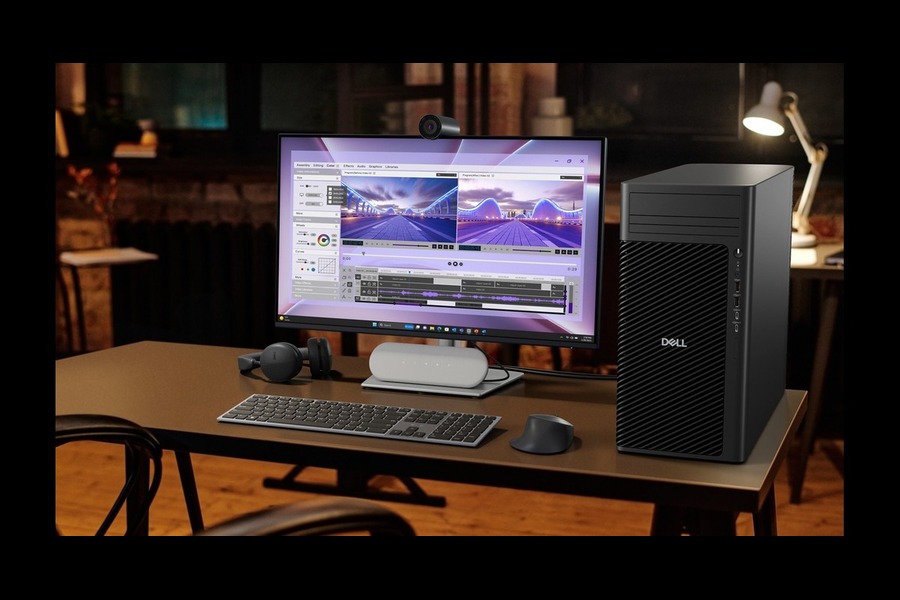
Jodice runs his daily work on a Dell Pro Precision with an Intel Core Ultra 9. There is no physical monitor on his desk. “Our devices pair together really well because it’s simple, it just works,” he says. “We install no software onto the Dell workstation; we just plug in.”

When Jodice switches to a thinner Surface laptop for other meetings, he can feel the ceiling drop. On a Dell Pro Precision workstation with an NVIDIA RTX PRO Desktop GPU, the headroom opens up. Jodice clocks sub-3-millisecond latency, and on an overclocked machine he says it feels like it drops lower. The low latency processing power provided by a Dell Pro Precision workstation with NVIDIA RTX PRO enables XREAL glasses to cycle through multiple applications in three-dimensional augmented reality without any noticeable lag. “The immediate feedback allows me to work in this setup 4 or 5 hours a day, almost every day. It feels like a superpower,” Jodice offers with a smile.
Project Aura

Later this year, XREAL will ship Project Aura, an all-in-one headset built on Android XR with Google and Qualcomm, powered by Snapdragon. Project Aura glasses come with their own wired compute unit. It’s a different solution with different experiences than the XREAL display glasses Jodice spoke about earlier. Interestingly, though, Project Aura can connect with Dell Pro Precision PCs for shared, hyper-powered AR experiences across devices. “We can’t wait to discover how our customers use this technology,” Jodice adds.
Some customers want a self-contained device offering true AR applications that phones cannot push. The wearable display XREAL glasses will ship alongside the self-contained spatial computing Project Aura, not be replaced by them. “There’s nothing wrong with simplicity, as long as it meets the customer where they’re at and delivers value,” Jodice says. A million units in, some customers want simple and some want greater power. XREAL is about to offer them both.
Dell reported this
Source: www.dell.com
Source link