


Remote control of materials
An unusual way to remotely control a material’s behavior using sound promises to lead to the development of protective equipment, robotic muscles and medical implants that adjust their stiffness on demand.
The material responds to specific frequencies of acoustic waves, altering specific regions, mechanical folds that determine whether different areas of the material are soft or rigid.
Folds function as boundaries between two different internal states. On both sides of a fold, the material may be composed of the same atoms or building blocks, but these blocks are oriented differently in three dimensions.
This subtle change can lead to very different mechanical properties because mechanical bends mark where the material deforms. And this behavior is very general: Mechanical bends appear, for example, where metals bend permanently or where DNA strands separate.
Thus, controlling mechanical bending gives the power to reshape the entire behavior of a material.
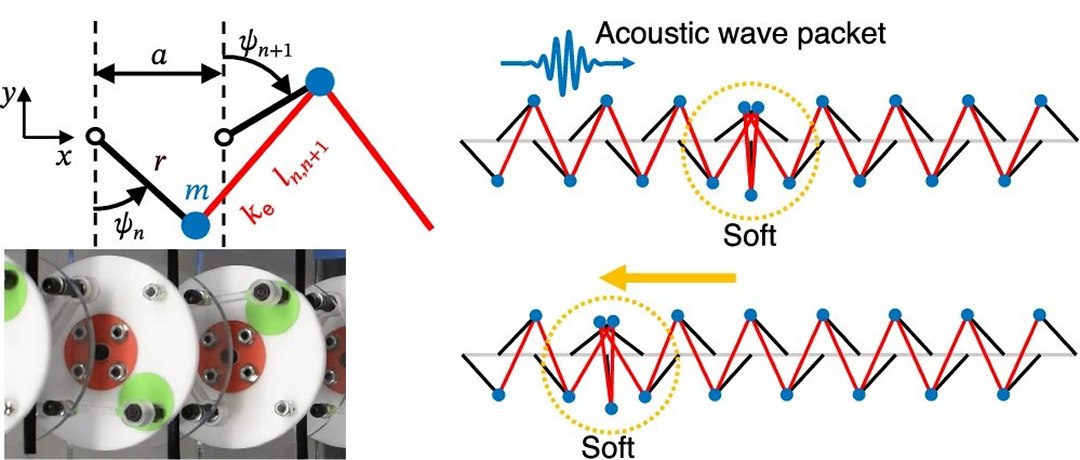 Overview of a small amplitude acoustic wave packet moving zero energy static twist.
(Image: Kai Qian et al. – 10.1038/s41467-026-68688-7)
Moving mechanical folds
Kai Qian and colleagues on an international team devised a way to move a mechanical warp in a controlled way using sound waves. To demonstrate this, they modeled a synthetic material, a metamaterial whose behavior is dictated by its structure, not its composition.
In this material, wherever the bend is located, it defines a soft region, while the rest of the material becomes progressively stiffer. If the bend is moved to one end, that end becomes soft, while the stiffness increases exponentially toward the opposite end. Move the bend to the other side and the stiffness profile reverses. Move the fold to the middle and the material becomes soft in the center and stiff towards both ends.
Even better: Moving the warp does not consume energy, an unusual, rare and very useful property.
“The idea here is that we essentially create a acoustic tractor beam that moves an irregularity and changes the way a material behaves to the touch – creating stiffness gradients – on demand,” said Professor Nicholas Boechler of the University of California, San Diego. “We demonstrated that if you send acoustic waves from one side, they push the bend in the direction where the sound came from. You can send a little pulse and the fold moves a little. Send another pulse and it moves some more. It’s basically a remote control of the internal state of the material.”
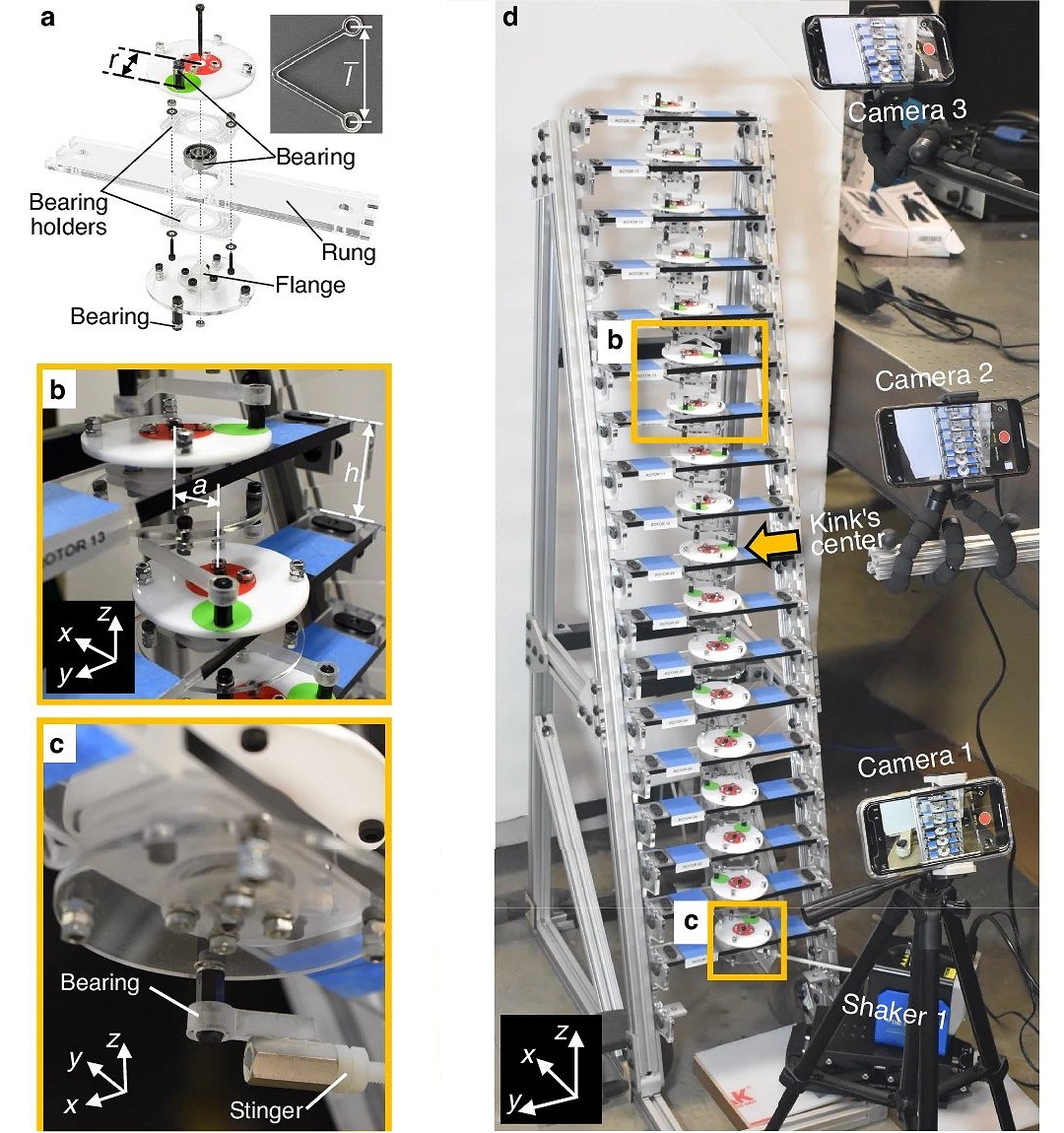 Despite appearances, this is a demonstration of a 2D metamaterial. The next step will be to build a 3D version. (Image: Kai Qian et al. – 10.1038/s41467-026-68688-7)
Acoustic tractor beam
To demonstrate the mechanism, the team built an experimental model made up of a chain of stacked, rotating discs, connected by springs. Each disk represents a meta-atom of the metamaterial, while the springs simulate atomic bonds.
A disc, arranged differently from the others, represents the fold. When short pulses of acoustic waves are sent into the structure, the fold is pushed toward the sound source, moving a few discs at a time. Each additional short pulse of vibration pushes the bend a little further. When longer vibrations are applied, the bend is continually pushed along the entire length of the chain, effectively reversing which side of the chain is flexible and which is rigid.
The demonstration points to potential future applications, such as materials with tunable stiffness, shape-shifting structures, and robust signal transmission. “Right now, this is a toy model,” Boechler noted. “If something like this can be turned into a real material, we can imagine structures that adapt instantly – materials that can be reprogrammed using sound.”
The next steps of the research will include building three-dimensional versions of the model system, studying whether similar effects exist on smaller, even atomic, scales, and finding a way to allow mechanical folds to be pulled, not just pushed.
Source: www.inovacaotecnologica.com.br


