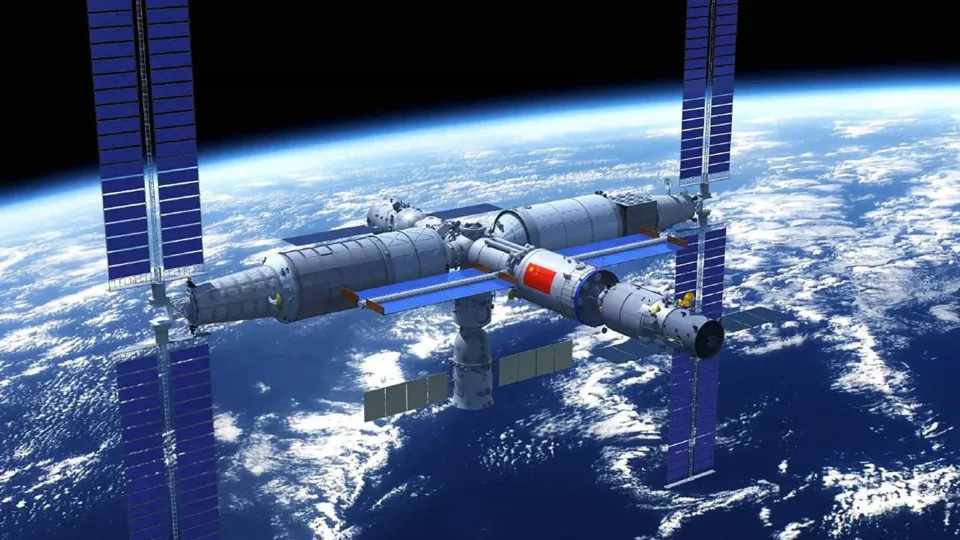
UAn analysis by the Financial Times newspaper points out that China has been expanding its military capacity in space, including the development of technologies capable of capturing or even destroying satellites. The move comes amid growing rivalry with the United States and the increased risk of conflicts beyond Earth.
Military documents and dozens of studies linked to the People’s Liberation Army (PLA), analyzed by the British newspaper, indicate a strategy that ranges from close-range operations between satellites to attacks on space infrastructure and, in an extreme scenario, targets on the Earth’s surface.
“Today, when we look at the sky, we see that space is already shrouded in the smoke of a potential conflict,” wrote Chinese military expert Jiang Lianju in a 2024 manual, cited by the Financial Times. He adds that control of space represents “a powerful strategic and military incentive.”
The analysis highlights that powers such as the United States, China and Russia already carry out close operations between satellites, used for maintenance, but also with offensive potential. This type of maneuver has already been classified by American authorities as a form of “close combat in space”.
According to the Stockholm International Peace Research Institute, the space domain has become essential to modern military capabilities, including communications, navigation and command systems. This increases the risk that attacks from orbit could compromise critical infrastructure on Earth.
For Howard Wang, a researcher at the think tank Rand Corporation, the PLA’s central strategy is to reach key points in the adversary’s networks to “paralyze” decision-making throughout the chain of command, from data collection and transmission to its analysis.
Beijing also invests in technologies such as lasers, electronic jamming systems and satellites capable of moving other objects to different orbits, in addition to developing refueling and capture capabilities in orbit.
An example cited is the Chinese satellite Shijian-21, which in 2022 used a robotic arm to tow a deactivated satellite to a more distant orbit, demonstrating a capability that raised concern among American military authorities.
More recently, Chinese satellites carried out coordinated maneuvers in geostationary orbit, behavior that the United States compared to combat exercises.
The investigation also indicates that Chinese military doctrine foresees different phases in an eventual space conflict, including deterrent actions, such as public demonstrations of capability, repositioning of satellites, space blockades and attacks on enemy systems.
These operations may involve electronic interference, cyberattacks, or the use of directed energy weapons, with the aim of degrading communications and command systems without provoking immediate escalation.
At more advanced stages, scenarios analyzed by the PLA include the direct destruction of satellites and even attacks on terrestrial infrastructure from space, reflecting a growing integration between the space and traditional military domains.
The military space race is also gaining momentum in low Earth orbit, driven by the proliferation of satellites in constellations like Starlink, which is transforming the global strategic landscape.
According to Howard Wang, both Washington and Beijing seek to increase the resilience of their space systems, increasing the number of satellites to reduce vulnerability to attacks.
China plans to launch more than 37,000 new satellites by 2030, with the aim of consolidating its position in this sector and keeping up with the United States’ advances.
“We are in an environment where no one has ever fought a war. The potential for something to go wrong very quickly is enormous,” said a Western military officer interviewed by the Financial Times.
Source: www.noticiasaominuto.com.br
Source link