AI budgets are committed, projects are in motion, and the business is asking when the infrastructure pays off. The enterprises finding their answer are the ones building on a hybrid foundation — right-sized on-premises compute for consistent workloads, cloud for variable peaks — and discovering it is closer, more reliable, and simpler to deploy than most teams assumed.1
The enterprises moving fastest on AI are not choosing between cloud and on-premises — they are combining both deliberately. Right-sized on-premises compute for consistent workloads, and cloud for variable peaks. GPU capacity on the major public cloud providers is tightening,2 and the organizations with a hybrid foundation already in place are the ones with the flexibility to respond. The cost curve and the operational control both point in the same direction. Research from WalkMe and BCG also found that organizations scaling AI successfully are the ones integrating AI into operational processes rather than treating it as isolated experimentation.3
That is exactly what the new PowerEdge portfolio is built to address.
Dell built this generation to meet enterprise customers where they are — in existing data centers, running mixed workloads, with real constraints on facilities, budget, and staffing. The R-series starts there and scales from it.
Built for the environment you already have

The PowerEdge R9825 and R9815 are built for the infrastructure reality most enterprise teams are working in today. The R9825 is a dual-socket, 3U platform delivering up to 256 cores on AMD EPYC™ 6th Gen server processors — purpose-built for consolidating virtualization, analytics, and emerging AI workloads in standard air-cooled environments. The R9815 brings that same architecture into a single-socket, 2U footprint, maximizing performance per socket while reducing software licensing overhead.
Both platforms run in the data center you already operate. Predictable power draw, predictable cost, standard facilities — the cost stability and operational control that on-premises infrastructure is designed to deliver.
For enterprise teams consolidating demanding workloads without stepping into multi-socket complexity, the PowerEdge R9810 offers a high-end, single-socket 2U option built for next-generation Intel server processor, codenamed Diamond Rapids. Significant gains of 2x in memory bandwidth4, increased cache capacity and up to 50% more cores per socket5 give the R9810 the headroom to run virtualization, databases and core business applications while lowering system overhead and software licensing costs.
A clear path to rack scale
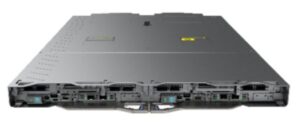
For teams ready to move beyond air-cooled infrastructure, the PowerEdge M9825 extends the story without forcing a platform change. A high-density, direct liquid-cooled compute sled for the IR7000 rack-scale ecosystem, it pairs with dense AMD EPYC™ 6th generation server processors configurations with factory-integrated rack management — and runs the same PowerEdge management and security tooling as the R-series servers. The skills and processes built at one scale carry forward to the next.
Where mid-market deployments quietly break down
The network and management layers are where mid-market AI deployments most often lose momentum — and open infrastructure is what keeps that from happening. The same shift that defined enterprise software a generation ago, when open, interoperable foundations beat proprietary stacks, is playing out in AI infrastructure today.
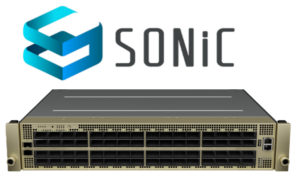
The latest release of Enterprise SONiC Distribution by Dell Technologies is built on that principle. Spanning multi-silicon PowerSwitch Ethernet platforms, it adds high-frequency telemetry (HFT), What Just Happened (WJH), Link Level Flow Control (LLFC), and iSCSI support — delivering deeper visibility, faster fault isolation, and tighter Dell storage integration.6
Gartner research on successful AI scaling is worth sitting with: the defining factor was not model sophistication, it was how well the technology integrated into existing environments, with executive alignment behind it.7 Infrastructure that fits the environment you have, managed by the team you already have, with a clear path to scale when the business demands it — that is the foundation the analysis points to consistently.
The enterprises moving from pilot to production share a common discipline: they right-size their on-premises foundation, build governance in from the start, and choose infrastructure that grows with them. Open fabric is what makes that possible at scale.
Dell reported this
Source: www.dell.com
Source link