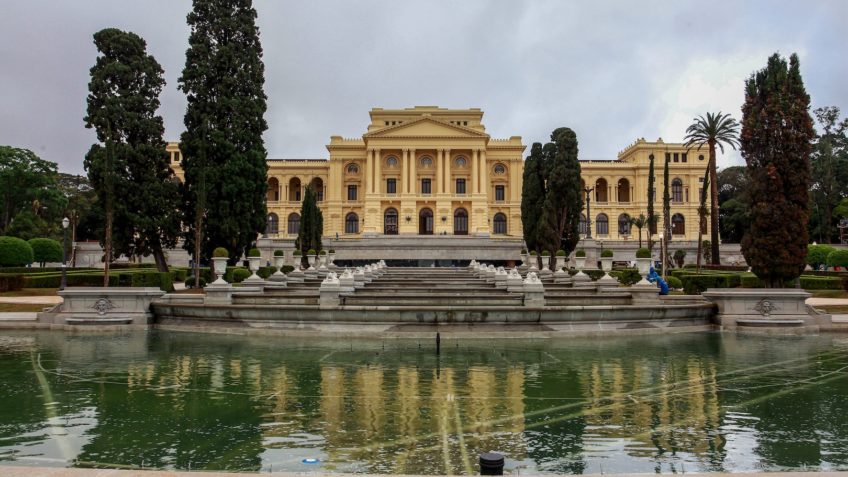
3D laser scanning will allow you to create a digital model of the renovated building and establish a preventive maintenance system
The same three-dimensional laser scanning technology used to monitor the Coliseum in Rome, Italy, will be used in a conservation project at the Ipiranga Museum, in São Paulo. The initiative, scheduled to begin in July, was presented by the professor at FAU-USP (Faculty of Architecture and Urbanism and Design at the University of São Paulo) Beatriz Kuhl during the Fapesp Week Londonwhich was from June 2nd to 4th in the British capital.
The project involves the complete scanning of the museum, inside and out. The objective is to analyze the behavior of the building after the restoration works carried out in recent years, establish a monitoring system and, mainly, create an information management model for preventive conservation purposes based on the HBIM methodology (acronym in English for Historic Building Information Modeling). It is a 3D modeling process for historic buildings and sites that allows data on physical characteristics, systems and other elements to be introduced into a three-dimensional digital environment, integrating technologies, processes and information from a building.
“The idea is to feed an HBIM system from a pilot area of the museum in order to allow information management for preventive conservation purposes”Kuhl told Fapesp Agency.
After a decade closed to the public, the museum, built from 1885 to 1890, reopened its doors in September 2022.
The technical execution of the scanning will be carried out by the Diaprem laboratory, at the University of Ferrara, in Italy, the same laboratory that recently completed the scanning of the Coliseum and that had carried out a scanning of the Ipiranga Museum before the works. The partnership between the Italian group, researchers from FAU-USP and CPC-USP (USP Cultural Preservation Center) has several years of history: the same team scanned the FAU-USP building itself, designed by Vilanova Artigas, and is now returning to the Ipiranga Museum to record the state of the monument after restoration.
The continuity of the partnership is strategic. “To have truly comparable data, it is essential to use the same methodology and the same reference points”said Kuhl. “Depending on how the scanning is done, it can have a lot of inaccuracies. If it is very well planned, with a lot of consistency, it gives very accurate results.”
Periodic scanning
The portable equipment, the size of a shoebox, emits laser beams that map with millimeter precision the geometric coordinates of each point on the building’s internal and external surfaces. In addition to geometry, the scanner captures so-called reflectance data: the percentage of emitted light that returns to the sensor varies depending on the material found, its degree of humidity or the presence of mold.
This variation makes it possible to identify anomalies. “When you manage to pick up a point that is different from the neighboring one and should be the same, it is possible to question whether that indicates some pathological manifestation“, said Kuhl. The resulting data forms a dense point cloud that serves both the geometric memory of the building and the diagnosis of structural and conservation problems.
The scanning will be carried out gradually, so as not to interfere with the functioning of the museum. “The scanner will work inside and outside the museum and activities will be planned so as not to alter the operating routine. The museum will absolutely not be closed”assured the researcher.
Preventative conservation
The Ipiranga Museum project is part of a broader line of research that Kuhl has been developing for years at FAU-USP, focused on preventive conservation, that is, with the aim of anticipating and avoiding problems before they require invasive and costly interventions.
A previous project, funded by the Getty Foundation within the program Keeping It Moderninvestigated the state of conservation of the FAU-USP building and generated recommendations that influenced specific works, such as a new waterproofing system for the roof and an access ramp to the building. But Kuhl recognizes that changing the culture of maintaining public assets is still a challenge.
“We are still unable to act preventively, because there are large liabilities to face”he said. But this new research aims precisely to achieve this goal: “anticipate and avoid more invasive interventions.”
For Kuhl, the Brazilian experience can benefit from consolidated references, such as Casa de Rui Barbosa, in Rio de Janeiro, where a systematic policy of preventive conservation was successfully applied in the first two decades of this century.
On the theoretical side, the professor’s research group will work on critical reflection on advanced diagnostic methods and their articulation with conceptual conservation issues and the planning of conservation plans. “These are two things that tension each other and that help us see problems in a different way”he stated.
Source: www.bing.com
Source link