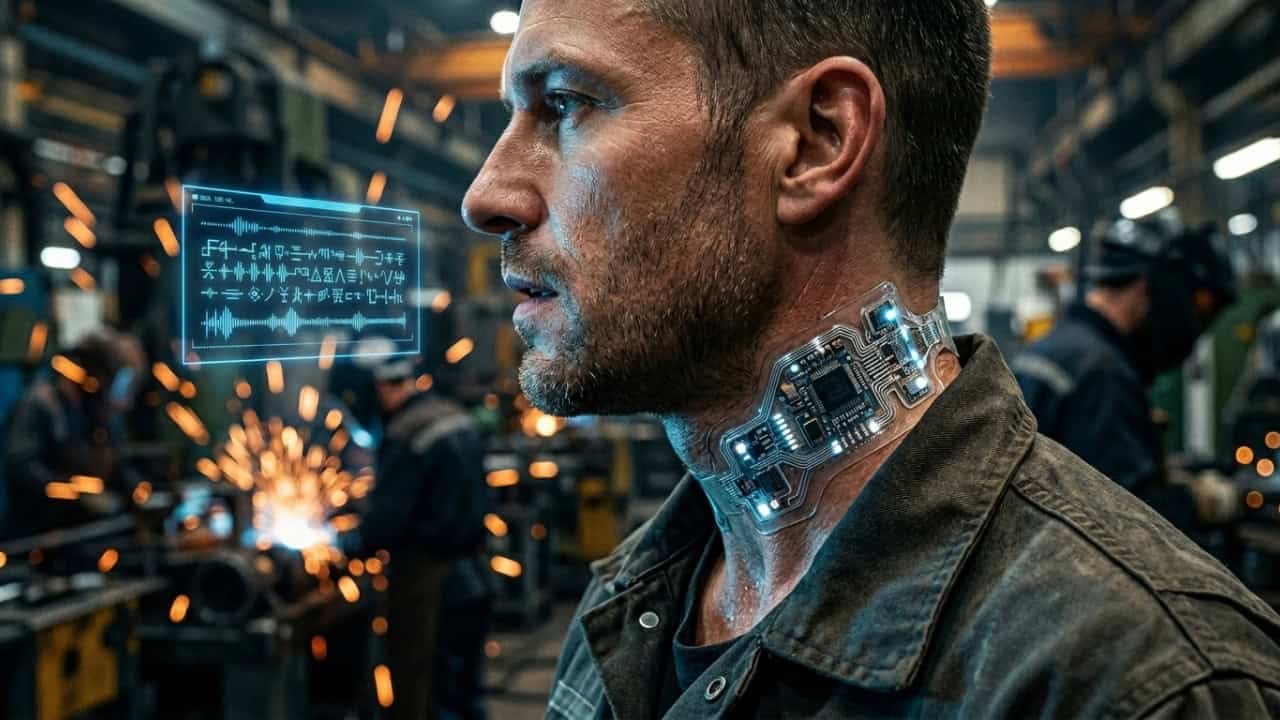
The new silent speech technology promises to revolutionize the way we communicate in noisy or private environments. Korean researchers have developed an innovative choker capable of translating muscle movements into crystal-clear audio. This tool uses high-precision sensors to capture the intention of speech without the need to emit any audible sound, ensuring a clear communication even in total silence.
How does Korea’s new silent speech technology work?
According to a study carried out by POSTECH the system uses a film of flexible polymer attached to the user’s neck. This innovative device does not rely on acoustic microphones, but rather on sensors that detect skin deformation and electrical signals from muscles during attempted speech.
This interface captures the dermal vibrations and the electromyographic signals generated during the articulation of words, allowing artificial intelligence to interpret what is being said. By ignoring ambient noise and focusing only on human physiology, the technology can reconstruct the original voice with a impressive fidelityeliminating external noise such as construction or traffic.
🧠 Step 1: Motion Capture: Polymer sensors detect tiny contractions in the neck muscles.
🤖 Step 2: AI Processing: Deep learning algorithms translate physical data into digital phonemes.
🔊 Step 3: Audio Output: The system reconstructs the user’s voice with natural timbre and intonation.
What are the main benefits of this smart choker?
One of the biggest differentiators of this innovation is the full immunity to background noise interference, allowing use in extremely noisy places. Unlike noise-cancelling headphones, which attempt to filter sound, this device simply does not “hear” the environment, focusing only on the sound. muscle activity of the neck.
Furthermore, the device guarantees absolute privacy in public places, allowing the user to send voice commands or messages without making an audible sound. This opens the door to a new era of discrete interaction with virtual assistants and smartphones on public transport or silent meetings.
- Superior resistance to extreme noise from construction sites and shows.
- Ability to communicate clearly without vocal noise.
- Flexible and comfortable design for long-term use on the skin.
- High accuracy in speech reconstruction through machine learning.
Why does silent speech technology outperform traditional microphones?
Conventional microphones depend on the sound pressurewhich makes them vulnerable to wind interference, echoes or constant background noise. In critical situations, such as on battlefields or heavy industrial environments, the signal quality of a common microphone can drop drastically, preventing the message from being understood.
The new sensor focuses exclusively on muscle deformationconverting this physical data into synthetic audio waves of high technical fidelity. THE silent speech technology ignores external sound shock waves, ensuring that only the speaker’s communicative intent is captured and transmitted to the final recipient.
Continues after advertising
What is the role of artificial intelligence in this process?
Artificial intelligence acts as the brain translator of the system, processing complex skin movement patterns in fractions of a second. Without neural processing power, electrical signals from muscles would just be random data without any linguistic meaning to the final receiver.
Through algorithms deep learning trained with thousands of samples, the AI can accurately reconstruct the original timbre and intonation. The system learns to associate each muscular micro-movement with specific phonemes, allowing the synthesized voice sound exactly like the natural voice of the user using the device.
Continues after advertising
When will we see this innovation integrated into our mobile devices?
Although the current prototype is focused on academic research, the miniaturization of sensors indicates that commercial use may be closer than many imagine. Technology companies are already showing interest in wearable sensors that can replace microphones in extreme situations or on high-end headphones.
Experts believe that integration into wearable gadgets could transform accessibility for people with severe vocal cord or larynx disabilities. In the future, human communication may do without air vibrations, making the act of speaking something purely internal and digitally assisted by Korean technology.
Source: www.bing.com