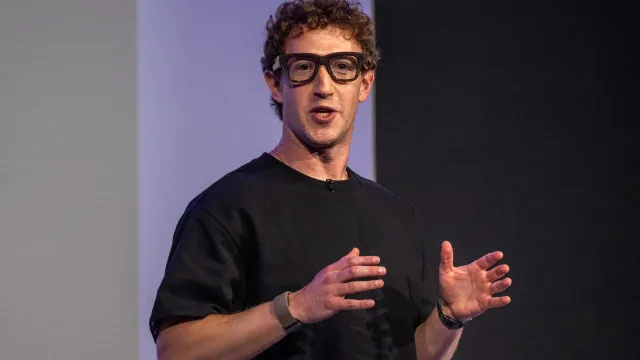
Meta’s CEO, Mark Zuckerberg, went on the attack against Anthropic and OpenAI and stated that how they developed artificial intelligence software could lead to a centralization of power that would restrict people’s access to technology.
In an interview with The New York Times, Zuckerberg stated that developing AI in a tightly controlled way would be “abandoning our values” in American technological development and would stifle innovation.
“Much of the talk from many of the other labs that are developing this is overly loaded with catastrophism,” Zuckerberg said. “There needs to be a voice or several voices that bring realism to this debate.”
In addition to the statements, Zuckerberg also wrote an opinion article for The Wall Street Journal, stating that the history of democracy and the economy shows that the centralization of power stifles human potential.
He asserted that AI will create greater prosperity, freedom and health and could lead “to a new era of personal empowerment, in which individuals have greater freedom to pursue interests and reach their full potential.”
In another interview, also with the Wall Street Journal, the owner of Facebook declared that he finds it surprising “that the speech of those who are developing AI is so full of disgrace”, and defends the acceleration of technology development, not the pause.
Dario Amodei, CEO of Anthropic, and Sam Altman, CEO of OpenAI, said some of today’s leading AI models are too dangerous to be shared and developed without strict controls. Both advocate a slowdown in the development of the resource.
But Microsoft, Nvidia, Google and Meta disagree, arguing that many AI models need to be developed in a widely open way so that people can advance the technology and create new businesses.
The disagreement intensified when advances in Chinese models appeared to erode the advantage of Anthropic and OpenAI, leading those companies to lobby in Washington against open source Chinese models.
On Friday, Nvidia CEO Jensen Huang published a letter supporting open source software development, around which others in Silicon Valley rallied. This week, Huang announced a coalition to work on open-source cybersecurity and protection tools for AI, with participation from other technology giants such as SpaceX and IBM.
Tech executives including Huang and Altman are traveling to Washington this week to make their case to the Trump administration, which is weighing how to handle the issue.
Zuckerberg told the Financial Times that the government should not block Chinese models and warned against “regulatory capture” by American laboratories, which could stifle domestic competition.
For the executive, banning cutting-edge Chinese AI in the US would not be “an effective solution”, while Washington threatens to target laboratories over allegations of intellectual property theft.
Zuckerberg stressed that North American companies should “systematically” identify bottlenecks and obstacles to better compete with Beijing. Both countries consider the AI race critical to national security and prosperity.
However, the executive has repeatedly argued that more people, not fewer, should have access to AI technology, a veiled criticism of Amodei and Altman.
He said both peer review and verification could be positive for the industry if “done well, with thoughtful people.” However, Zuckerberg warned that leading AI companies should not have too much influence.
“There’s always this issue of regulatory capture when you have a set of companies with their own interests doing peer review,” Meta’s CEO commented to the Financial Times. “Will frontier labs… want an open source model to be successful? I think there have been some mixed signals on that,” he asked.
The Trump administration is expected to announce later this week a voluntary framework for developers of AI models to submit tools for testing before launch in an attempt to improve security.
Anthropic CEO Dario Amodei has called for stronger AI regulations, while Demis Hassabis, head of Google DeepMind, has proposed a “self-regulatory organization, much like the Financial Industry Regulatory Authority (FINRA),” that could set standards for the industry.
Amodei, in particular, has warned about the dangers of “alignment risk”, a problem related to programming artificial intelligence in a way that is safe for humans.
“I think a lot of people have this notion that if you build some kind of singular AI, you can, through some idealized form of alignment, ensure that it is benevolent toward humanity,” Zuckerberg said in the interview. “Personally, I’m skeptical of this path.”
Instead, he advocated for “personalized superintelligence” for everyone, which would mean configuring AI bots to meet people’s needs and wants. A “benevolent” central AI superpower, he argued, would be unsustainable because people have different views and value systems.
“I think it’s literally impossible to have a single benevolent superintelligence that is simultaneously aligned with everyone at the same time,” Zuckerberg said.
Representatives for Anthropic and OpenAI did not immediately respond to requests for comment requested by The New York Times. This week, Altman advocated slowing AI development, said he supports open source software and is working with the White House on safe ways to support AI development.
On Monday (27), Amodei said Anthropic was focused on “keeping powerful chips out of authoritarian hands, preventing industrial-scale distillation, and requiring safety testing of all sufficiently capable models, open and closed.”
On Tuesday, top AI researchers from Anthropic, OpenAI, Meta, and Google also signed an open letter titled “Pacing the Frontier,” advocating for an international effort to develop technical and governance tools to slow down AI development for security reasons. OpenAI published the letter on social media, which has more than 1,000 signatures.
Meta’s own philosophy regarding AI development has fluctuated. For years, the company has championed open source AI and distributed its AI models for free. Last spring (fall in Brazil), after falling behind Anthropic and OpenAI in the AI race, Zuckerberg took action.
He invested US$14.3 billion (R$ to be converted) in ScaleAI, an AI startup, and hired its founder, Alexandr Wang, to revamp Meta’s AI division, which was renamed Meta Superintelligence Labs. Meta spent billions to assemble a team of top-notch AI researchers around Wang, and they began to develop an AI model that was not open but closed.
The move gave Meta the potential to sell access to new models to generate more revenue. This month, it began selling access to its latest AI model, Muse Spark, for the first time. Meta also continues to develop open source models.
Zuckerberg has long believed that AI will transform society in positive ways that are not yet understood. This month, Meta launched a national advertising campaign saying that investing in AI tools and making them widely available meant the company was “betting on people.”
Looking at the trajectory of technology, he said that the democratization of technological tools tended to eventually prevail. “I believe the overall arc of the industry has been toward more openness and putting the power of technology in the hands of more people, not fewer,” he said.
Zuckerberg recalled last week’s incident – when an OpenAI program escaped human control and hacked a startup – to support his criticism of those who want to restrict access to the resource.
“We’ve seen some large model breaches (where) basically the company that was breached didn’t have access to the closed frontier models because it was restricted… so they turn to open source models to fix the problems,” he commented.
Source: www.noticiasaominuto.com.br
Source link