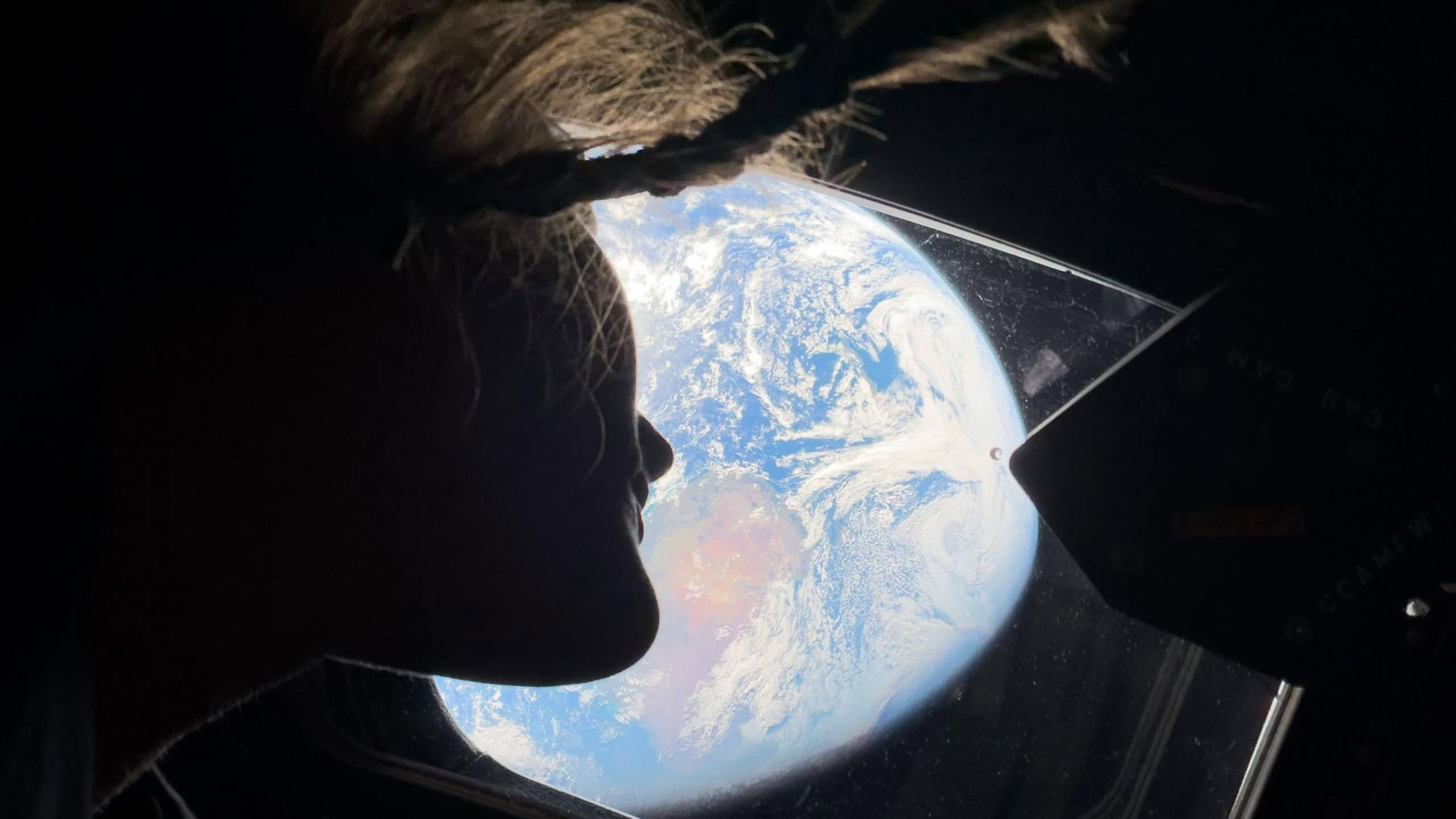
The astronaut Christina Kochwhich remained ten days in space during the Artemis 2 mission, showed the effects of space travel on the human body. On Instagram, she published a video in which “relearn” walking under the Earth’s gravity, demonstrating difficulties walking with his eyes closed.
Koch performed a test called tandem walkin which the heel of one foot is placed directly in front of the toes of the other, as when walking in a narrow straight line. “When people live in microgravity, the systems in our bodies that evolved to tell the brain how we are moving — the vestibular organs — do not work correctly“, wrote the astronaut.
“Our brain learns to ignore these signals, and so when we return to gravity for the first time, we rely heavily on our eyes to guide us visually,” added Koch. The astronaut — who became the first woman to participate in a mission to the Moon — stated that this type of exercise could become a big challenge.
According to her, understanding the phenomenon can help guide the treatment of vertigo, concussions and other neurovestibular conditions on Earth. “Fortunately, we are already readapting to gravity seven days after landing in the water,” concluded Koch in his publication.
Next, check out the video:
Commander filmed “Earth setting” behind the Moon
The astronaut Reid Wisemancommander of the Artemis 2 mission, filmed a “sunset of the Earth“, a phenomenon in which our planet disappears behind the lunar horizon seen from space. The video by 52 seconds was recorded in April 6 common iPhonethrough the capsule docking window Orionwhile the crew flew over the far side of the Moon.
Wiseman posted the images last Sunday (19) on X; by Monday night (20), the video had already 14 million views. “Like watching a sunset on the beach, but from the strangest place in the cosmos,” wrote Wiseman. “Just one chance in life.”
Wiseman was responsible for filming the event – Image: Disclosure/NASA
In the video, the Earth appears as a small blue and white sphere that gradually disappears behind the gray, cratered surface of the Moon. While Wiseman filmed with his cell phone, Koch photographed the same phenomenon with a camera Nikon. The astronauts Victor Glover and Jeremy Hansen They followed the scene through another window of the ship.
“I could barely see the Moon through the window, but the iPhone was the perfect size to capture the scene,” added the commander. “The video has no cutting or editing, with zoom 8x — very similar to what the human eye sees.”
Check it out:
Only one chance in this lifetime…
Like watching sunset at the beach from the most foreign seat in the cosmos, I couldn’t resist a cell phone video of Earthset. You can hear the shutter on the Nikon as @Astro_Christina is hammering away on 3-shot brackets and capturing those… pic.twitter.com/8aWnaFJ69c
On Monday (20), NASA transported the core stage from the Artemis 3 rocket from the agency’s factory in New Orleans (USA) to a ferry that will take it to the Kennedy Space Centerin Florida (USA), where it will be assembled and prepared for the launch scheduled for 2027;
With 64 meters tall when complete, the stage is the largest part of the rocket and carries the fuel tanks that power the four engines responsible for placing the spacecraft into orbit. Artemis 3, however, will not land on the moonas well as Artemis 2;
The mission will test, in Earth orbit, the coupling between the Orion spacecraft and commercial spacecraft from SpaceX and from Blue Origina maneuver considered essential for Artemis 4, in 2028actually manage to land astronauts on the lunar surface for the first time in more than 50 years;
Artemis 2 was the first mission to take humans to the vicinity of the Moon since Apollo 17in 1972. The objective of the program is to prepare for the return to the lunar surface and, in the long term, send astronauts to Mars.