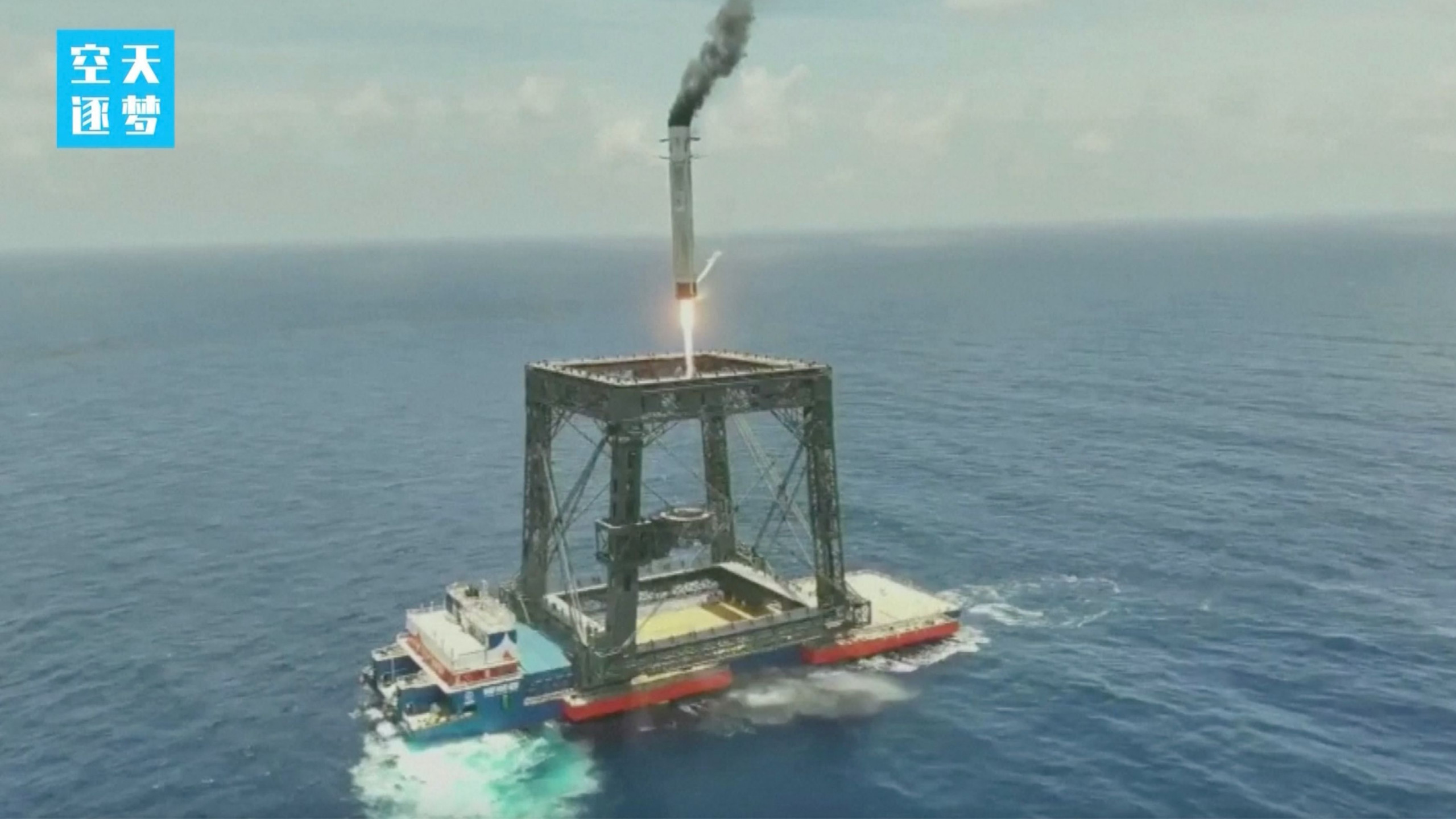
China successfully tested, this Friday (10), an experimental rocket recovery system. The Long March 10B rocket took off from the Hainan commercial space launch center, in the south of the country, at 1:15 am (Brasília time). About six minutes after the booster separated from the upper stage, the first stage returned vertically and was successfully recovered on a sea platform, state broadcaster CCTV reported.
With this feat, the Chinese achieved what American companies, such as SpaceX and Blue Origin, have already mastered: making the rocket “go in reverse”. Beijing’s objective is to break United States hegemony in the reusable rocket sector. However, the system adopted by China is not identical to that of the Americans. The Long March 10B does not land autonomously on extendable legs on dry land or on a drone ship. Instead, the vehicle uses “landing hooks” that capture a net attached to a sea platform.
China gets closer to having reusable rockets
This test marked the first successful recovery of an orbital-class booster by China, in a path of almost a decade of research and development of reuse technologies. “A historic day for China’s space program,” wrote Mao Ning, a spokesman for the Ministry of Foreign Affairs.
A historic day in China’s space program!
China’s Long March-10B has successfully completed its maiden flight—and recovered its first stage via a sea-based net. This marks the country’s first-ever controlled rocket recovery. A major leap toward reusable launch capabilities.… pic.twitter.com/FWuQXLltaD
— Mao Ning 毛宁 (@SpoxCHN_MaoNing) July 10, 2026
This engineering milestone preserves the most valuable part of a rocket: the propellant, where the engine is located. This drastically lowers the cost of orbital operations. For comparison purposes, SpaceX currently launches the Falcon 9 about 150 times a year (an average of three times a week), reusing its boosters dozens of times.
Capable of carrying at least 16 metric tons of payload to low Earth orbit, the Long March 10B was developed for the commercial market by the Chinese Academy of Launch Vehicle Technology, the country’s top state rocket agency. The reuse technology is expected to reduce the launch costs of China’s commercial satellite constellations.
However, the plans go further: the Long March 10 “line” is being designed to take manned missions to the Moon before 2030. In this context, the experimental model will serve to provide crucial data and validate technologies for the lunar program. CCTV reported that the country plans to reuse this same propulsion stage in another launch by the end of 2026.
Source: www.olhardigital.com.br
Source link