
This blog is part of an ongoing series offering a peek behind the curtain at the investments Dell Technologies is making to deliver cyber resilience control plane capabilities to customers in the future. The first blog in this series described a scenario most infrastructure teams will recognize: a ransomware event developing across several platforms simultaneously, each generating a signal that falls below any individual action threshold, none of them aware of the others. The organization doesn’t act because no single signal justifies it. By the time the pattern is clear, the window for early intervention has closed. That scenario isn’t a failure of detection. It’s a failure of correlation. Solving it requires more than aggregating alerts — it requires a system that can interpret signals across platforms as part of a developing pattern, establish confidence from what they collectively show and act before the situation escalates, so that what eventually reaches the SOC is a pattern worth acting on rather than more noise to triage. This is what the cyber resilience control plane is designed to do.
Why is signal correlation so difficult?
Different storage platforms describe anomalies using different internal models, thresholds and event schemas. PowerStore doesn’t speak the same language as PowerProtect. An I/O pattern anomaly on primary storage and an entropy shift on a backup copy aren’t obviously related when they arrive as separate events — even when they’re describing the same underlying attack. And workload behavioral signals only mean something relative to a baseline: a write spike that would stop a database team in their tracks may be entirely unremarkable for a video ingest pipeline. What Makes Signal Correlation Possible?
-
-
-
- Normalization: translating signals from different platforms into a common model so they can be evaluated together.
-
- Time-series correlation: evaluating signals in sequence rather than as isolated snapshots, so that an anomaly at 11pm and a related shift at 2am are understood as part of the same developing event.
-
- Context: interpreting behavior relative to what’s expected in this environment, not against a generic threshold that generates false positives at the speed of noise.
Without all three, you’re not doing correlation. You’re just creating more noise.
-
-
How Does Signal Correlation Work?
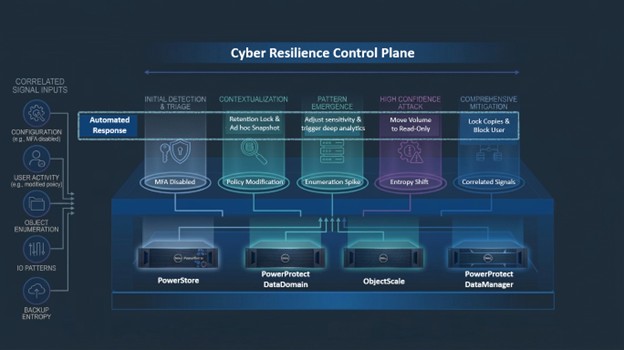
Here’s a real-world attack chain spanning storage and data protection platforms. A signal is detected on PowerStore flagging that Multi-Factor Authentication (MFA) is disabled — worth noting, but potentially a minor misconfiguration rather than an active threat indicator. A second signal arrives on PowerProtect Data Domain: a recently created administrator account is attempting to modify a protection policy. Now data anomaly signals emerge. ObjectScale surfaces a spike in enumeration requests across buckets the application doesn’t normally touch — behavior consistent with an attacker reading data before encrypting it. PowerStore detects an unusual I/O pattern: repetitive read-write sequences on the same disk sectors, beginning around 11pm. PowerProtect Data Manager runs its backup cycle and surfaces a significant entropy shift — the statistical fingerprint of the data has changed dramatically since the last copy. None of these signals in isolation would have clearly identified an attack or justified action. Together, corroborated across time and systems, they cross the threshold from ambiguous to actionable. The control plane doesn’t wait for the next signal. It responds.
How does coordinated response work?
The response isn’t a single action. It’s a sequence calibrated to the confidence level of what the signals are showing. At early-stage confidence — where signals are elevated but not yet conclusive — the control plane takes protective actions with low operational cost. An ad hoc snapshot on PowerStore preserves the current state of data before conditions change further. A retention lock on an existing backup copy ensures recovery points remain intact regardless of what happens next. These actions cost very little if the signal proves false. But if no protective measures are taken and the threat is real, the consequences can be catastrophic. As additional signals reinforce the pattern, the response scales. Detection sensitivity adjusts across related systems. Deeper inspection is triggered on potentially affected workloads. At high confidence — where correlated signals across multiple systems describe an active attack — more decisive actions become appropriate. An affected volume can be moved to read-only, stopping further modification while analysis continues. Compromised users have their access suspended. Recovery points on both primary storage and the backup platform are locked simultaneously, ensuring a clean, validated copy is preserved at exactly the moment it’s most at risk. These actions are genuinely disruptive and should only fire when the evidence warrants them. The value of the control plane is that it makes that determination based on corroborated evidence across platforms — not a single system’s alert.
Why cross-platform coordination matters
Critically, this coordination extends beyond systems that generated the signals. A platform showing no anomaly of its own can still receive and act on protective instructions from other systems — because coordinated attacks progress laterally, and infrastructure not yet compromised is precisely where preemptive defenses matter most.
What this changes for the SOC
The implications extend beyond the storage layer. When the storage layer is operating as a coordinated first responder — normalizing signals, establishing confidence and acting on patterns rather than individual events — what reaches the SOC is fundamentally different. Instead of a flood of disconnected events, analysts receive an assessment with confidence already established and protective actions already underway. The focus shifts from interpreting signals to making decisions. Correlated intelligence closes the gap between detection and response. But stopping an attack is only half the challenge — what comes next matters just as much.
Dell reported this
Source: www.dell.com
Source link