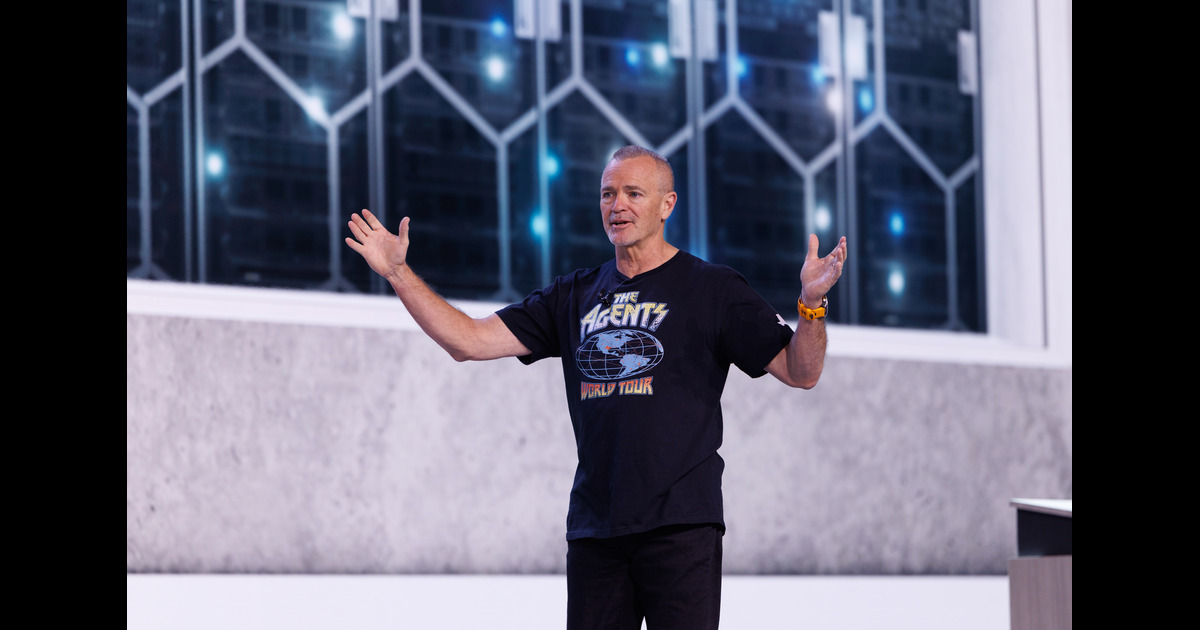
Dell Technologies World 2026 Day 2 keynote: Jeff Clarke defined the AI-native enterprise as an operating model built on the assumption that intelligence flows through every workflow and decision. Key announcements included Dell Deskside Agentic AI, the Dell AI Data Platform, PowerProtect One, PowerStore Elite and next-generation Dell AI Factory infrastructure. Clarke challenged enterprise leaders to audit their AI cost models, identify super users, and lead operating model change before it leads them.
Jeff Clarke’s Dell Technologies World 2026 keynote outlined how agentic AI has broken the assumption that cognitive output scales with human hours, and that most enterprise operating models were built for a world that no longer exists. Clarke outlined five imperatives for building an AI-native enterprise and demonstrated how on-premises AI infrastructure can reduce token costs from thousands of dollars per day to near zero. Arthur Lewis detailed Dell’s full infrastructure portfolio spanning data management, cyber resilience, private cloud and the Dell AI Factory, now deployed by more than 5,000 customers.
The time has come, and it has come swiftly, for enterprises to stop asking whether they should embrace AI and to begin asking how fast they can build an organization designed around it.
Dell Technologies Vice Chairman and COO Jeff Clarke asserted during a Dell Technologies World keynote in Las Vegas Tuesday that the answer to that question is the AI-native enterprise and the window to build one is open now.
Twelve months that changed everything
To set the stage, Clarke walked through the developments that reshaped the AI landscape in the past year alone: AI went from an advisor to an operator. Model prices fell roughly 80%. Token consumption surpassed 100 trillion annually in 2025. Context windows crossed a million tokens, meaning an entire codebase or a full year of contracts can now be processed in a single pass. Enterprise generative AI software spend tripled to $37 billion in 2025. Physical AI left the lab and showed up in factories, warehouses, hospitals and farms.
Any one of those developments, in any prior era, would have been the headline of the year. Today, they’re simply the context for what comes next. “What we thought was a three-year journey happened in twelve months,” Clarke said.
Three observations you cannot unsee
From inside Dell’s own operations and across thousands of customer environments, three patterns stand out.
Token costs are collapsing while token use is exploding. Costs are down roughly 80% year over year. Token use for reasoning alone is up 320x. The industry has seen this dynamic play out in bandwidth, storage and compute for decades, but it has never seen it move this fast, Clarke said. One group of Dell engineers consumed a month’s worth of tokens in hours, he said. Not because something went wrong. Because it was working.
Still, AI productivity is nonlinear. Inside almost every company deploying AI today, roughly 5 percent of people are driving 95% of the value. Once someone learns to work effectively with agents, they use them for everything. Clarke put the challenge plainly: “Who are my super users? What are they doing? And how do I get everyone to become one of them?”
Tokens are becoming a line item in the P&L. As agents take on more cognitive work, cost migrates from headcount to tokens. The companies planning for that shift now, Clarke said, will have a significant advantage over those who wait.
All this points to a conclusion Clarke said nobody wants to verbalize: most enterprise operating models were built for a world that no longer exists. Every one of them assumed output scales with human hours. Agentic AI broke that ratio. The companies that win in the next decade will be AI native.
In a way, that’s the agentic AI challenge for enterprises. “Just because you didn’t start with AI doesn’t mean you can’t get there,” he said. “Are you ready to tear down to the ground the old ways and build the new way?”
Five imperatives for the AI-native enterprise
Going AI-native quickly is only half the goal. It’s just as important for enterprises to do it right as it is to do it right now. With that in mind, Clarke outlined five things enterprises must get right, right now.
-
- Build an AI-ready data foundation. In most enterprises, data is scattered across dozens of systems and 80 to 90% of it is unstructured. The architectural principle is straightforward: move AI to the data, not data to the AI.
- Build distributed AI infrastructure. Training and inference are fundamentally different workloads. Reasoning models executing multi-step chains are 10, 100, 1,000 times more compute-intensive than what most enterprises were running 18 months ago. The AI-native enterprise is built for both.
- Secure autonomous systems. Agents call the CRM, the ERP, financial systems, customer databases. Every touchpoint has to be secured, logged and reversible. “When an agent takes an action on your behalf,” Clarke said, “you need to know what it did, why it did it, and how to undo it if it got it wrong.” In an AI workforce, every action needs a receipt.
- Integrate the enterprise stack. Agents need to plan tasks, call tools, execute work and handle exceptions across the entire stack. A siloed agent is an expensive agent.
- Restructure for agentic AI and tokenomics. Get the right workload, right model and right tier: edge, on-premises or cloud. Run everything in one place for convenience, Clarke warned, and “be ready for a surprise, a large bill that only gets larger.” Token routing will be one of the most consequential infrastructure decisions enterprises make in the next few years.
Partners building the ecosystem
Thomas Kurian, CEO of Google Cloud, joined the keynote via video to discuss the availability of Gemini on Google Distributed Cloud running on Dell infrastructure, with air-gapped deployment options for organizations with the strictest security and sovereignty requirements. Dell is customer zero for the joint solution.
“The hardware is from Dell and the software is from Google Cloud, but we take joint responsibility for your success,” Kurian said. “We’re making AI accessible on premises for business and governments of all sizes with security at the core.”
Clarke also welcomed Dave Morin, co-founder of Offline Ventures and co-founder and board member of OpenClaw Foundation, one of the most significant open-source agent projects in enterprise AI.
Morin had a seemingly simple AI message for enterprises: “Give people the tools to try this,” he said. “Models need context in order to provide the best possible answer. People are coordinating their work in vastly more efficient ways. Get started. Don’t be afraid.”
This drove home a key point for Clarke. “The enterprise has to own its AI, not rent it,” he said.
The deskside as a deployment model
The most efficient AI token is the one produced closest to the data, and most enterprise data is not in the cloud. Dell Deskside Agentic AI made for one of the morning’s most eye-opening demonstrations.
A single developer running agent workloads in the cloud can generate a $3,400 bill in a single day. On a local workstation, the cost is effectively zero. One developer, 10 agents, 1 billion tokens in 24 hours. “That’s not a demo,” Clarke said. “That is a deployment model we’re helping customers build right now.”
Dell’s new Pro and Pro Precision portfolio spans the full range of local AI compute needs, from the GB10 at one petaflop for individual agent prototyping to the GB300 at 20 petabytes for the most demanding workloads. The GB300 draws over 1,500 watts, requiring a closed-loop liquid cooling system that Clarke noted does not exist anywhere else.
Building the infrastructure to run it all
Clarke handed the stage to Arthur Lewis, president of Dell’s Infrastructure Solutions Group, to show how the AI-native enterprise scales from the desk to the data center.
Most enterprise data still lives on-premises and most of it remains invisible to AI, Lewis said. Every byte an organization has collected is potential fuel for intelligence. The Dell AI Data Platform addresses this with an architecture spanning data preparation, high-speed, disaggregated inference and storage, so agents can access and act on data wherever it lives.
On security, Lewis noted that 94% of ransomware attacks attempt to compromise backup data, with a 57% success rate. The new PowerProtect One platform integrates Dell’s backup appliance and management software into a unified solution, cutting time to first backup by 75% and daily management time by half.
Lewis highlighted the newly refreshed and more powerful PowerStore Elite, and closed with the Dell AI Factory, the integrated full-stack solution tying compute, networking, storage and software into a single engineered system. More than 5,000 customers are running on the platform today, reporting up to 269% ROI in the first year. Sandisk deployed the Dell AI Factory with NVIDIA and cut factory costs by 32%, reduced energy costs by 46% and drove defect rates from 800 parts per million down to 100.
What worked for Dell, and what enterprises should do next
Three years ago, Dell found thousands of shadow AI projects running internally. This wasn’t a governance failure, Clarke said, but a signal of demand. Dell responded with five use cases tied to real outcomes, the creation of an AI Office, and sprints that compressed from 90 days and headed toward 3 hours. Today Dell’s service assistant is live across its global services organization, deployed on-premises on Dell infrastructure in an existing data center. ROI came in less than three months. “This is not a pilot,” Clarke said. “This is how our company is running today.”
Clarke closed with three challenges. Look honestly at the AI cost model and ask whether the budget accounts for both compute and token consumption. Find the super users and build alongside them: “The gap between your super users and everybody else is the gap between your future and your past,” he said. And decide whether to lead the operating model change, the disruption, or be reorganized by it. “Both options are in front of you,” Clarke said, “but only one of them is yours to choose.”
Dell reported this
Source: www.dell.com
Source link