Film that cools the car.
Passive cooling, or radiative cooling, has finally arrived in the automotive world.
This means that instead of driving around looking for shade, or simply leaving your car to heat up in the sun, you’ll soon be able to return to the shady parking spot and find your car nice and cool.
It all started when researchers at Seoul National University in South Korea created a material that heats and cools the environment without using energy , all integrated into a single device. This caught the attention of Hyundai and Kia, who invested in the research.
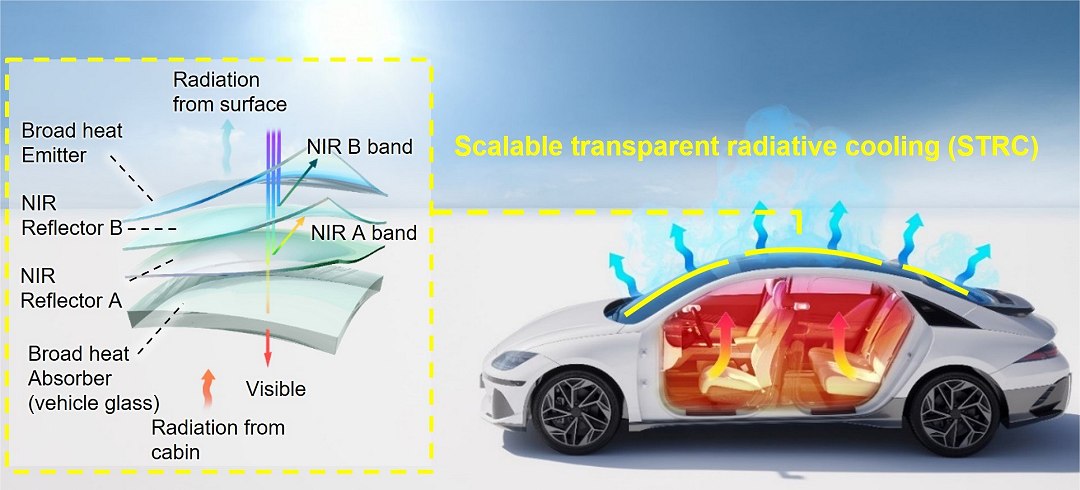
The result is a transparent radiative cooling film that dissipates heat directly to the outside without consuming electricity. The film is designed to be applied directly to cars without interfering with the paint or the vehicle ‘s appearance .
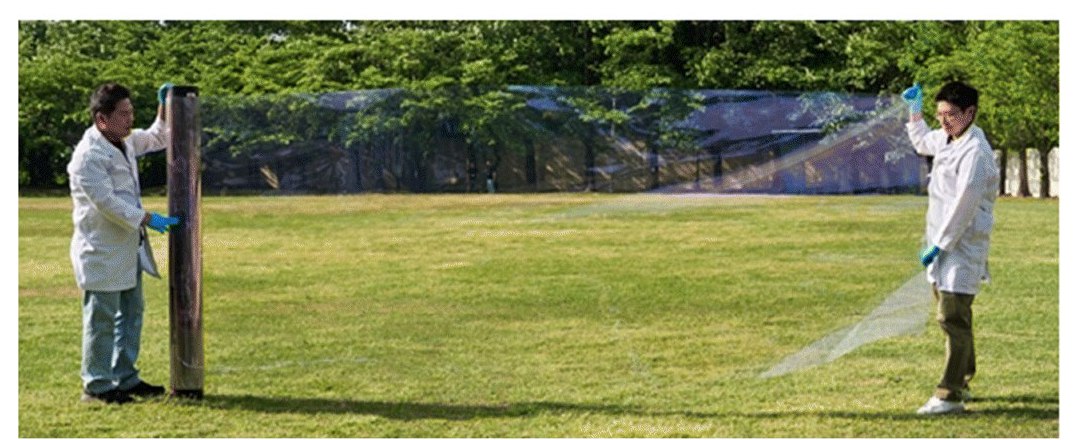
In addition to allowing vehicles to be wrapped, the transparency also allows the technology to be applied to car windows.
[Image: Min Jae Lee et al. – 10.1039/D5EE06609C]
Passive cooling in real cars
The coating was validated through experiments with real vehicles, conducted under diverse conditions, including different countries (Korea, USA, and Pakistan), all seasons, and different parking and driving scenarios. On average, passive cooling reduces the interior temperature of the vehicle by 6.1 °C. As a result, energy consumption for the air conditioning system drops by more than 20%.
“This study is particularly significant because it goes beyond laboratory-scale performance, validating the technology using real-world vehicles under diverse national, seasonal, and operational conditions,” said researcher Min Lee.
Furthermore, the energy savings from cooling achieved in the summer significantly outweighed any increase in heating demand during the winter. And simulations based on real vehicle data showed that the time required to reach a comfortable cabin temperature after activating the air conditioning was reduced by 17 minutes.
According to the team’s analysis, applying this technology to all passenger vehicles in the U.S. could reduce carbon dioxide emissions by approximately 25.4 million tons annually, the equivalent of taking about 5 million vehicles off the road.
[Image: Min Jae Lee et al. – 10.1039/D5EE06609C] Social technology
Transparency is everything.
Radiative cooling technology, which has attracted much attention, especially in the construction industry, simultaneously blocks incident solar energy and emits internal heat to the exterior, enabling passive cooling without consuming electricity. However, most radiative cooling materials developed so far have been opaque, making them unsuitable for application in vehicle windows, which are the main points of heat entry.
To overcome this limitation, the team developed a transparent radiative cooling film that retains over 70% visible light transmittance. At the same time, its multilayer structure reflects solar radiation in the near-infrared range and emits heat from the vehicle’s interior in the mid-infrared range.
Tests confirmed that the film suppresses the temperature increase inside the vehicle without consuming battery power and reduces the time needed to reach thermal comfort, thus minimizing energy consumption, which is especially important in electric vehicles .
“This is the first study to experimentally demonstrate that transparent radiative cooling technology can be effectively applied in real-world vehicular environments,” said Professor Seung Ko.
Source: www.inovacaotecnologica.com.br
Source link