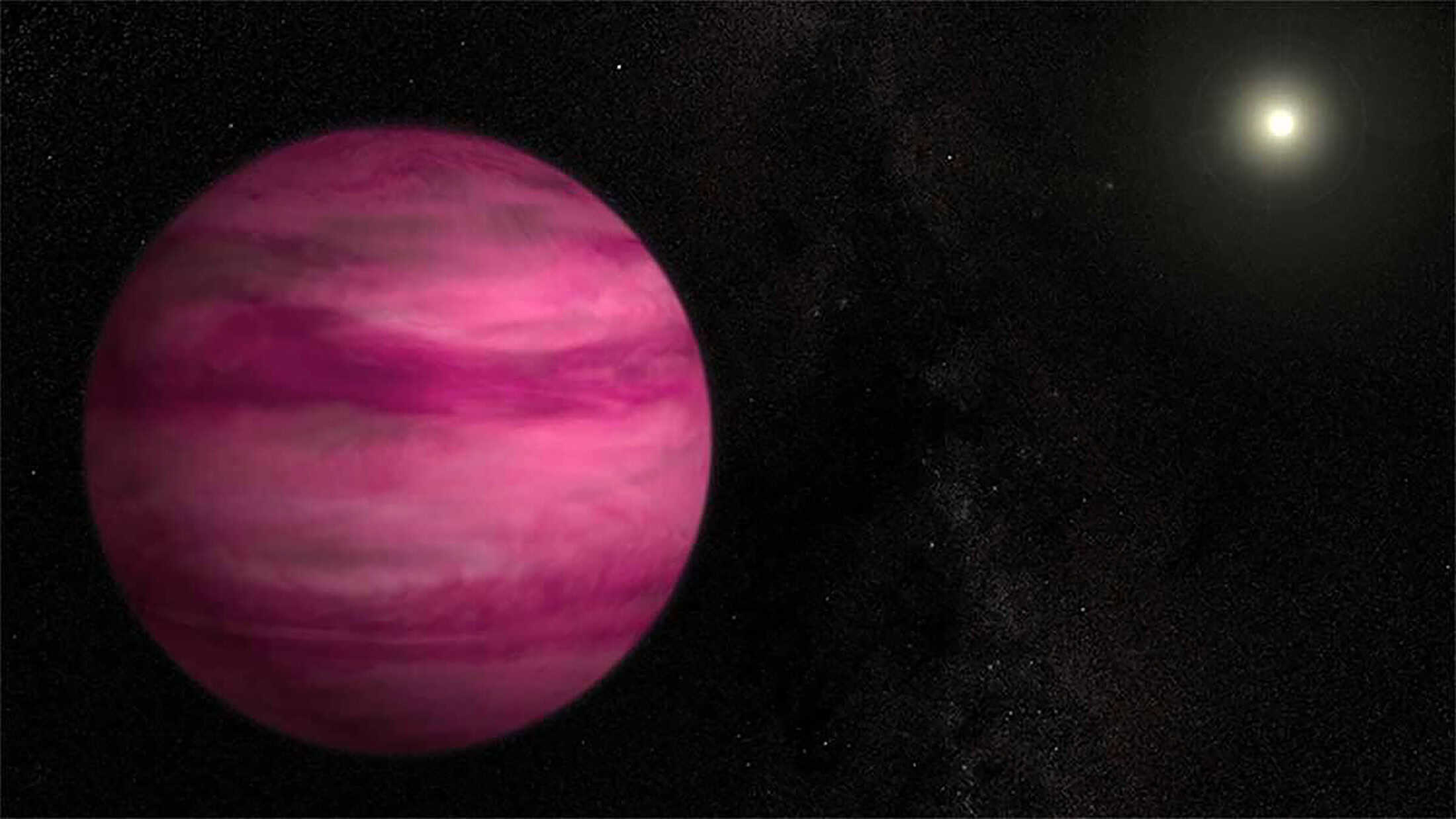
Northwestern University astronomers identified salt clouds in the atmosphere of GJ 504bthe famous “pink planet”, one of the coldest planetary objects ever observed. The discovery, made with the space telescope “James Webb Space Telescope” and published in the magazine The Astronomical Journal, is the first evidence of this type of atmosphere in a cold environment.
Despite the nickname, the astronomers are still not sure if GJ 504b is in fact a planet. With about 25 times the mass of Jupiterthe object is in boundary between gas giants and brown dwarfs. Therefore, researchers classify it as a “planetary mass companion”, a term used for objects similar in size to planets that orbit a star.
For those in a hurry:
- Astronomers have identified salt clouds in the atmosphere of GJ 504b, the famous “pink planet”, using observations from the James Webb Space Telescope;
- The discovery helps explain atmospheric features that have puzzled scientists for more than a decade and represents the first convincing evidence of this type of cloud on such a cold object.
A 15-Year Atmospheric Mystery
Discovered in 2013 through direct observations, the GJ504b caught the attention of astronomers for its unusual features. THE object orbits a sun-like star and became known as “pink planet” due to magenta coloring. At the time, it was considered one of the coldest exoplanets ever directly imaged.
Your temperature atmosphere is approximately 230°Ca value that may appear elevated compared to Earthbut it is relatively low for one gas giant.
Located approximately 57 light years from Earthyour low light made it difficult for years detailed analysis of the atmosphere. According to the study leader, Aneesh Baburaj, the object drew attention precisely because of the difficulty of observation by ground-based observatories.
The Pink Planet is the coldest companion ever discovered using ground-based instruments (…) Many teams around the world performed follow-up observations to study its light, but it was too faint for instruments on the ground. This made him a perfect target for the James Webb Space Telescope (JWST).
Aneesh Baburaj
You data collected by the telescope space revealed a atmosphere rich in water vapor, methane, carbon dioxide and ammonia.
Salt clouds solve an ancient mystery
When comparing the data obtained by James Webb with computer simulations, the researchers realized that an essential ingredient was missing: clouds formed by mineral salts. The existence of salt clouds in cold atmospheres had been theoretically predicted more than 15 years agobut had never been observed in such a convincing way.
“We tested three different types of clouds, and salt clouds were the best fit,” explained Baburaj. “This is the first time we’ve discovered that salt clouds are crucial in explaining the spectrum of an object. It’s a good reminder to consider clouds in our models,” he concluded.
Continues after advertising
Even with the discovery, the formation of planetary mass companion is still open. Observations indicate that the object is richer in heavy elements than expectedbut scientists still do not have sufficient evidence to determine definitely if the body was formed as giant planet or like a brown dwarf.
Source: www.olhardigital.com.br
Source link