The consolidated value of the Seven Magnificents in May corresponds to 21.6 times the total size of the Brazilian stock market. The calls Seven Magnificent returned to the center of attention of the global market after leading a historic recovery in market value in April 2026.
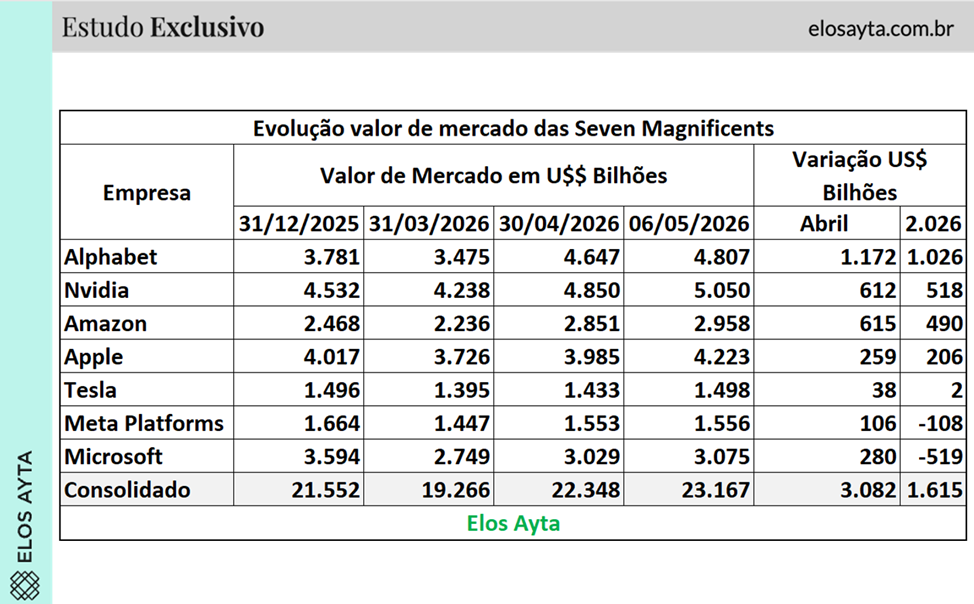
After losing US$2.28 trillion between January and March, US technology giants added US$3.08 trillion in just one month, ending April valued at US$22.34 trillion.
On May 6, the group had already accumulated market value of US$23.16 trillionaccording to a survey by Links Ayta.
The amount is impressive not only because of its absolute size, but because of its comparison with the Brazilian market.
The appreciation recorded by the seven companies in April alone is equivalent to approximately three times the combined market value of all companies listed on B3. The consolidated value of the Seven Magnificents in May corresponds to 21.6 times the total size of the Brazilian stock market.
The movement highlights the growing concentration of capital in the United States and reinforces an increasingly present discussion among academics, managers and economists about the structural difference between the American and Brazilian markets.
While Wall Street concentrates global technology companies with strong cash generation capacity, innovation and dominance of digital markets, The Brazilian stock market remains highly dependent on more traditional sectors, such as commodities, banks and utilities.
At the end of 2025, the Seven Magnificents were worth US$21.55 trillion. The first quarter of 2026 was marked by a strong correction, reducing the consolidated value to US$19.26 trillion by March. The loss of US$2.28 trillion in the period alone represented the equivalent of approximately twice the entire market value of B3.
The recovery, however, was quick and intense. In April, the Alphabet led the movement by adding US$1.17 trillion in market value, an amount greater than the combined value of all Brazilian companies listed on the stock exchange.
The company went from US$3.47 trillion in March to US$4.64 trillion at the end of April, reaching US$4.8 trillion on May 6.
THE Nvidia it also maintained absolute leadership in the global market. The company became the only company in the world above the US$5 trillion mark in market value, reaching US$5.05 trillion in May.
In April alone, the semiconductor manufacturer added US$612 billion in value, reflecting the continuation of the expansion cycle linked to artificial intelligence, data centers and advanced computing infrastructure.
Amazon added US$615 billion in April, while Apple recovered US$259 billion in the period. Tesla showed a more modest appreciation of US$38 billion in the month, but maintained stability in the annual picture.
Despite the group’s significant recovery, not all companies will record a positive balance in 2026. Meta Platforms accumulated a loss of US$108 billion in the year up to May 6, while Microsoft records a decline of US$519 billion. Even so, the group of seven giants accumulated a net appreciation of US$ 1.61 trillion in the year.
The difference in scale between the American giants and the Brazilian market helps explain part of the global capital flow observed in recent years.
In an environment marked by the digitalization of the economy, international investors tend to prioritize companies capable of growing globallymonetize technology on a large scale and operate with high profitability. The result is a cycle in which the largest companies attract more capital, increase investments in innovation and further consolidate their leadership.
Experts also note that the phenomenon reinforces a trend known as extreme market concentration. Today, a relevant portion of the performance of the main American indices depends on a few technology companies.
This generates debates about systemic risks, excessive dependence on artificial intelligence and possible valuation distortions, but it also highlights the ability of these companies to capture value on a global scale.
In the Brazilian case, the comparison reveals historical structural challenges. The local market has low capital depth, a reduced number of listed technology companies and a limited presence of companies with relevant global operations.
Furthermore, structurally high interest rates and a lower capacity to finance growth end up reducing the competitiveness of the domestic stock market in relation to the United States.
At the same time, current photography raises important reflections on the future of emerging markets. Part of the economic academy argues that peripheral countries face increasing difficulty in competing in high-technology sectors due to the concentration of intellectual capital, infrastructure and innovation in central economies.
Other experts point out that markets like Brazil will need accelerate agendas linked to productivity, digitalization and technological development to reduce the distance in relation to the great global corporate powers.
The fact is that the 2026 numbers make clear the magnitude reached by the American giants. In a single month, the Seven Magnificents added a equivalent to multiple times the entire Brazilian stock marketreinforcing how the new global economy is increasingly concentrated in a few companies capable of mastering technology, data and artificial intelligence on a planetary scale.
Source: www.moneytimes.com.br
Source link