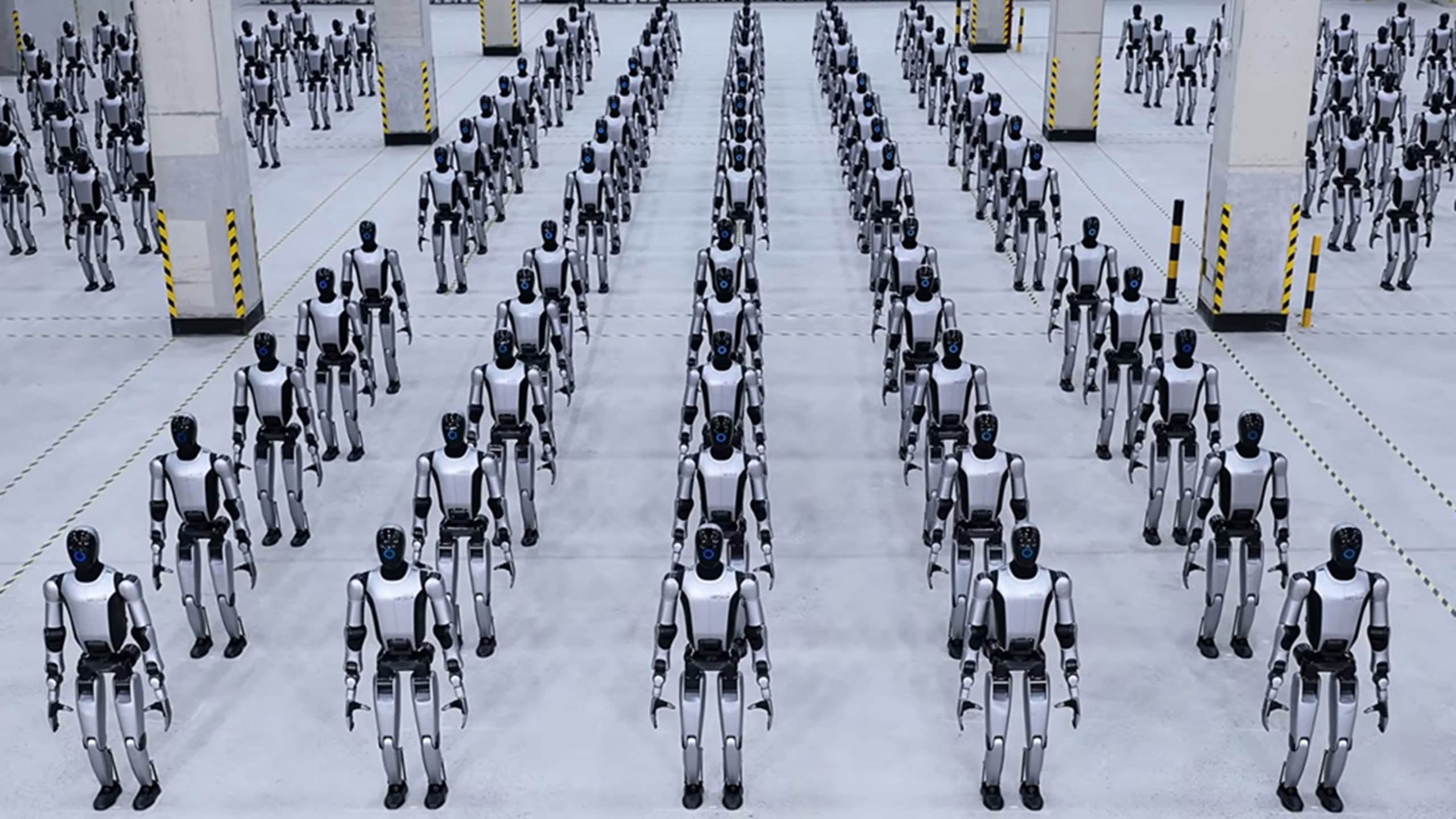
More than 300 humanoid robots are expected to participate in the second edition of the China Robotics Half Marathon. The event, which takes place this Sunday in Beijing, is not just a demonstration of resistance, but a rigorous test of technical advances in a sector that the Chinese government intends to transform into one of the pillars of its economy. According to information from Reuters this year’s competition features more difficult terrain, designed to evaluate the durability and autonomy of the machines.
With more than 70 participating teams, an increase of almost five times compared to the previous year, the 21 km race will run along paved slopes and green areas. The big change, however, lies in machine intelligence: while last year all robots were controlled remotely, in this edition almost 40% of competitors will navigate completely autonomously.
The highlight falls on the model Tiangong Ultradeveloped by the Beijing Humanoid Robotics Innovation Center in partnership with UBTech. Last year, the model won the race with a time of 2 hours and 40 minutes. Although the time is twice that recorded by professional human athletes, Tiangong Ultra will now compete without external assistance, using sensors and large-scale data simulations to mimic human gait and avoid obstacles in real time.
Global Domain
The numbers show that China already leads the sector comfortably. Data from Counterpoint Research indicate that the country was responsible for more than 80% of the 16 thousand units of humanoid robots installed worldwide in 2025. In comparison, American giant Tesla only held 5% of this market. Local businesses like AgiBot and Unitree shipped more than 5,000 units each last year, with Unitree planning to expand its production capacity to 75,000 robots annually.
However, experts warn about the difference between “running” and “working”. Georg Stieler, director of technological consultancy Stieler, points out that the current challenge is to balance the quality of constantly evolving products with the pressure for competitive prices.
Despite the visual spectacle, the industry still faces critical barriers. Tang Wenbin, founder of startup Yuanli Lingji, was emphatic in a recent forum when stating that the sector’s level is still elementary. “Often, what we see today is ‘dance disguised as work,’” Tang said, referring to the fact that although robots can perform coordinated movements, their success rate in complex industrial tasks and their actual perception ability are still low.
To overcome this phase, companies are investing heavily in data collection. UBTech, for example, jumped from fewer than 10 robots in factories in 2024 to more than a thousand last year, with the goal of launching 10 thousand life-sized humanoid robots this year.