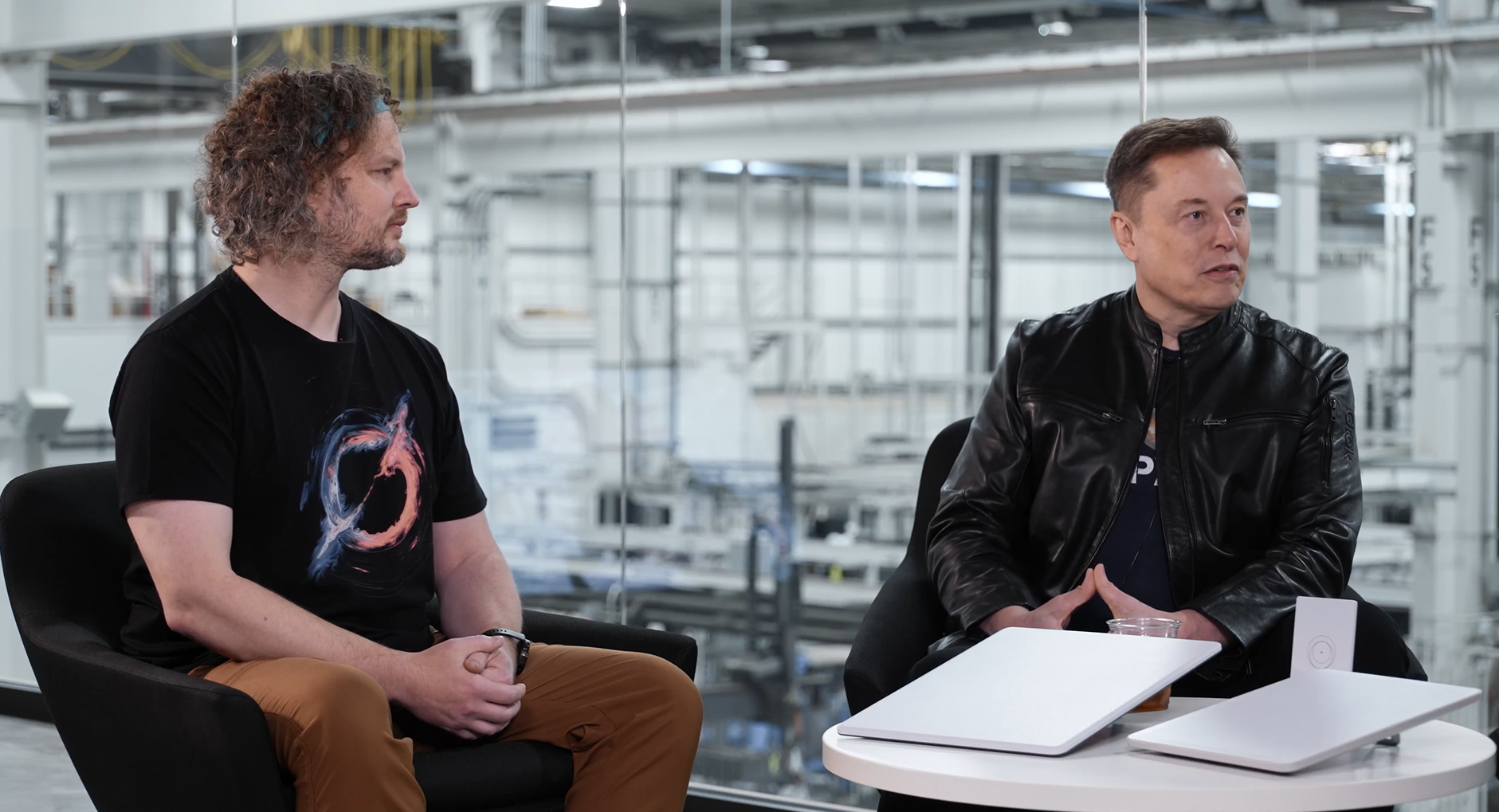
Elon Musk (right) and SpaceX executive in video published on X (Reproduction/X)
Recent advances in artificial intelligence (AI) have demanded the increasing use of data centers – and the energy to power and cool them. If we continue at this pace, the only way out may be to put data centers in space and use much more energy from the Sun.
This is the plan of billionaire businessman Elon Musk, owner of X (formerly Twitter) and SpaceX, which makes its debut on the US stock exchange this Friday (12) and could be valued at US$ 1.75 trillion.
In a 31-minute video published this Tuesday (9) on the social network, Musk and other executives from the rocket manufacturer appear sitting talking inside the company’s factory and trying to explain to the public how they intend to put this grandiose idea into practice.
Musk stated that it is not necessary to resort to “magic” solutions to place data centers in space, arguing that the fundamental components for this already exist or are under development within SpaceX.
Why space?
The plan involves SpaceX’s experience with reusable rockets, satellites and hardware production to build data centers in orbit, powered by solar energy captured directly in space – and releasing heat in a vacuum.
According to Musk, the project is part of a broader vision of increasing humanity’s energy capacity and advancing the so-called Kardashev scale, a classification created by Soviet astrophysicist Nikolai Kardashev to measure the development of a civilization by the amount of energy it can use.
“To harness any significant percentage of the Sun’s energy, you need to go to space,” said the businessman.
Three basic elements
According to the executive, the project essentially depends on three elements: the ability to transport large volumes of cargo into Earth orbit, solar energy generation and artificial intelligence chips.
The main pillar of this strategy is Starship, the company’s new generation rocket. Musk once again defended that the rapid and total reuse of the vehicle will be the decisive factor in drastically reducing the costs of accessing space.
According to him, the Starship V3 version will have more than double the thrust of the Saturn V, used in the Apollo missions, while future versions could further expand this capacity. The company’s objective is to increase the mass transported to orbit from around 2,500 tons per year to millions of tons per year.
The main challenge
The space infrastructure envisioned by the company includes specialized satellites for computing. During the presentation, Ian Doll, a member of the Starlink team, explained that the main challenge is to supply electrical energy and dissipate the heat generated by the processors.
The proposed solution uses solar panels similar to those currently used on Starlink satellites and radiators to release heat directly into the vacuum of space.
According to Musk, the first prototype, called AI1, will have approximately 150 kilowatts of maximum power and 120 kilowatts of sustained power. This would correspond, according to him, to a computing rack equipped with dozens of advanced Nvidia GPUs.
The modules would be connected by laser-optical links and integrated into the Starlink constellation to transmit data to Earth with low latency.
From Texas to space
To enable the expansion of computing capacity, Musk also revealed plans to build a chip factory called Terafab in Bastrop, Texas. The facility would be about 9.3 million square feet, approximately ten times the size of Tesla’s Gigafactory in Texas.
The goal presented by the executive is to reach a capacity equivalent to 1 gigawatt per year of space computing by the end of next year, subsequently advancing to 10 GW, 100 GW and, in the long term, 1 terawatt annually.
Musk also stated that, in a future stage, the expansion of this infrastructure could migrate to the Moon. The idea would be to locally manufacture solar panels and radiators and use electromagnetic accelerators to launch satellites into deep space without the use of conventional rockets.
According to the businessman, this would be the only way to expand the capacity to use solar energy thousands of times and bring humanity closer to a Kardashev type 2 civilization, capable of using a significant portion of the energy produced by the Sun.
Source: www.moneytimes.com.br
Source link