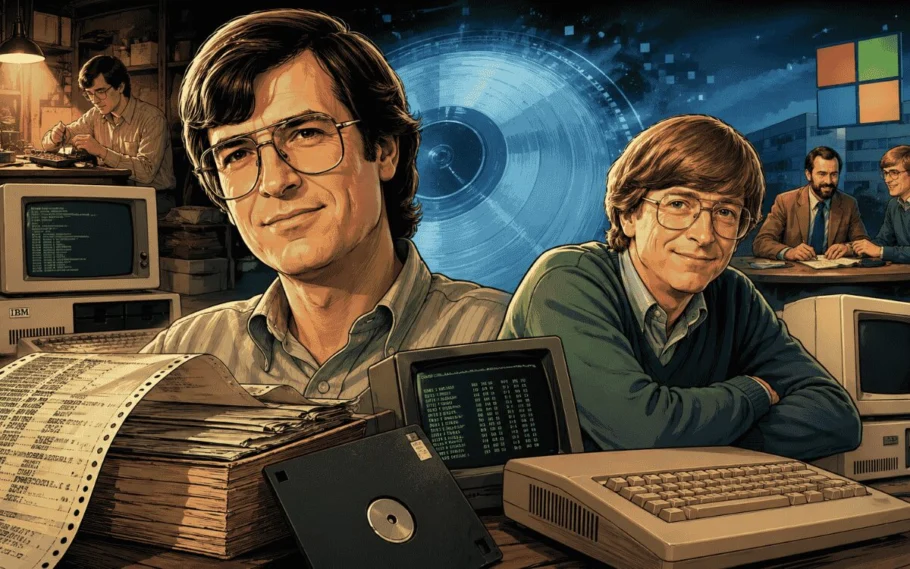
The Microsoft made available the source code of 86-DOS 1.00 as an open source project on GitHub, marking 45 years of software written by Tim Paterson in 1981.
The material, hosted in the public repository DOS-History/Paterson-Listings under MIT license, brings together the original kernel, several pre-release versions of PC-DOS 1.00utilities known as CHKDSK and even the assembler used to compile the system itself. The release was announced on April 28, 2026 on the official Microsoft Open Source blog.
The relevance of the material goes beyond technical curiosity. 86-DOS, originally named QDOS (Quick and Dirty Operating System) at Seattle Computer Products, is the direct ancestor of MS-DOS, the basis on which Microsoft built Windows and its dominance in the personal computer market in the following decades.
From Paterson’s Garage to GitHub
The history of preservation has a curious ingredient. The oldest code listings were recovered from printer paper stored in Tim Paterson’s own garage, as revealed by Scott Hanselman, vice president of Microsoft and GitHub, in a post on Bluesky.
The collection, approximately ten centimeters high in continuous green-and-white sheets, went through a process of location, digitization and transcription led by researchers Yufeng Gao and Rich Cini.
The documents preserve a precise timestamp of the system’s evolution. The 86-DOS 1.00 kernel was dated June 15, 1981, while a beta version of PC-DOS 1.00 was dated July 7 of the same year.
Difference files, such as 86DOS.DIFshow exactly what changes were made between versions, including bug fixes and feature additions.
“We are excited to present newly available source code materials that offer an even earlier look at the development of PC-DOS 1.00, the first release of DOS for the IBM PC”
Stacey Haffnerdirector of Microsoft’s open source office
What is included in the repository
The collection available on GitHub is organized into three levels of access, from raw material to compilable code.
| Folder | Content |
|---|---|
| 1_transcription | Transcription of listings, basically the raw output from the printer |
| 2_printed_files | Original files that were printed, extracted from the transcription |
| 3_source_code | Compilable and assembly-ready source code |
In addition to the 86-DOS 1.00 kernel and PC-DOS 1.00 snapshots, the repository contains the compiler runtime library Microsoft BASIC-86 and the Seattle Computer Products assembler used in building the system itself.
The physical collection of printed papers, donated by Paterson, will be displayed at the Interim Computer Museum.
The 75 thousand dollars that changed the industry
86-DOS’s trajectory within Microsoft involved one of the most profitable deals in the history of technology. In December 1980, Bill Gates’ company licensed the software for a fixed fee of $25,000.
The following summer, realizing the importance of having full ownership of the code to license it to other clone makers of the IBM PCthe company bought all the rights for another 50 thousand dollars, totaling 75 thousand dollars (around R$ 374 thousand at the current commercial price, without considering Brazilian taxes or import fees).
The move was possible because IBM had approached Microsoft in 1980 to develop a BASIC language interpreter and an operating system for its new PC.
Without having its own system, the Microsoft proposed licensing 86-DOS, which Paterson had written at Seattle Computer Products because the 16-bit version of CP/M was late. Paterson left SCP in 1981 to work directly at Microsoft.
A rare window into pre-Git era development
The point that differentiates this release from previous ones is the level of pre-versioning detail.
The listings function as a kind of printed commit history, with handwritten notes from Paterson himself recording which features were implemented, which errors appeared along the way and how each one was fixed.
In an era before modern version control systems like Git, this type of recording was the only way to track the technical evolution of software.
It is worth remembering that the Microsoft had already released source code for later versions on two occasions. In 2018, the company republished the MS-DOS 1.25 and the 2.11 under open license. In 2024, it was the turn of MS-DOS 4.0 join the public collection.
The current release turns the clock back a few more months, achieving the initial spark that would lead to the first IBM PC, released in August 1981.
The controversy that never slept
86-DOS has always carried a shadow of controversy. At the time of launch, the system was widely accused of being heavily inspired by Digital Research’s CP/M, created by Gary Kildall.
Paterson always denied direct copying, claiming to have only used CP/M’s printed documentation to build something that fulfilled equivalent functions. In 2012, a forensic analysis conducted by software intellectual property expert Bob Zeidman concluded that QDOS was not copied from CP/M and that MS-DOS also showed no signs of copying.
Making the code publicly available now allows any researcher, historian or enthusiast to draw their own conclusions from the source material.
Software also ages on paper
Liberation attacks a concrete problem: part of the history of computing It only survived because a specific programmer kept his own prints in casesfor more than four decades.
Without the collection from Paterson’s garage, there would be no way to reconstruct how the kernel left his machine in June 1981 and became the system embedded in the first IBM PC two months later.
When publishing code under the MIT license, the Microsoft transfers this preservation responsibility to anyone with access to GitHub, which makes it more difficult for this same material to disappear in the next 45 years.
For those who develop today, a rare record is available of how a single person, without version control, without automated testing and without peer review, wrote the software that paved the way for fortune of one of the largest companies in the world.
Sources): Microsoft

Microsoft’s K2 project promises lighter, more gaming-optimized Windows 11.
Source: www.adrenaline.com.br
Source link