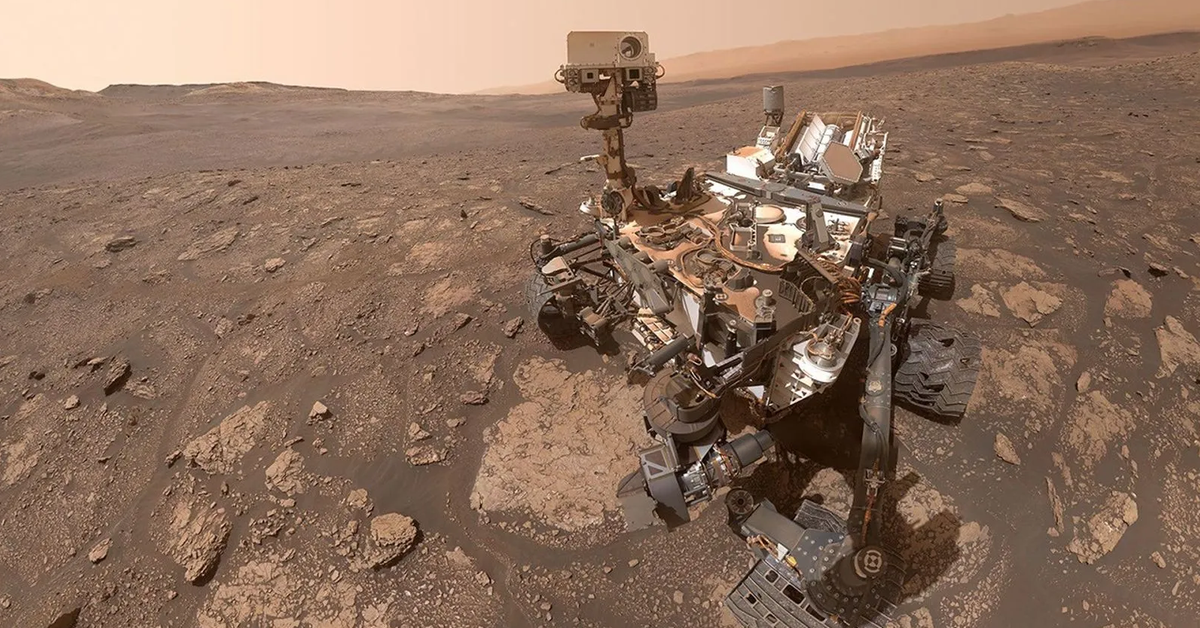
After years of work in the laboratory, the results: a rock drilled and analyzed in Mars in 2020 by the Curiosity rover, from NASA contains the most diverse collection of organic molecules ever identified on the planet. Das 21 molecules containing carbon found in the sample, seven were detected for the first time on Mars.
Scientists still cannot determine whether these organic molecules were formed by biological or geological processes, both are possible. The discovery, however, reinforces that the Ancient Mars had adequate chemical composition to support life.
Furthermore, the compounds add to a growing list of molecules capable of preserving themselves in rocks even after billions of years of exposure to Martian radiation, which tends to degrade them over time.
The results were detailed in an article published on Tuesday in the journal Nature Communications.
The sample, nicknamed “Mary Anning 3”, in honor of the English paleontologist, was collected in a region of Mount Sharp that, billions of years ago, was home to lakes and streams.
This environment arose and dried up several times in the planet’s remote past, enriching the area with clay minerals — especially effective in preserving organic compounds, molecules that contain carbon and are basic components of life, in addition to being present throughout the Solar System.
Among the newly identified molecules is a nitrogenous heterocycle, a ring of carbon atoms that includes nitrogen. This type of structure is considered a precursor to RNA and DNA, essential nucleic acids for genetic information.
“This detection is quite significant because these structures may be chemical precursors to more complex nitrogenous molecules,” said study lead author Amy Williams of the University of Florida. “Nitrogen heterocycles have never been found before on the surface of Mars nor confirmed in Martian meteorites.”
Another discovery was benzothiophene, a molecule containing carbon and sulfur present in many meteorites. Part of the scientific community considers that these meteorites, together with their organic molecules, contributed to prebiotic chemistry at the beginning of the Solar System.
See also
Larger image shows the three holes that NASA’s Curiosity rover drilled into Martian rocks at a site nicknamed “Mary Anning” in October 2020
| Photo: Disclosure/Nasa
Martian chemistry
The new study complements the previous discovery of the largest organic molecules ever found on Mars: long-chain hydrocarbons such as decane, undecane and dodecane.
“This is Curiosity and our team at their best. It took dozens of scientists and engineers to locate this site, drill the sample and make these discoveries with our robot,” said project scientist Ashwin Vasavada of NASA’s Jet Propulsion Laboratory. “This collection of organic molecules increases the likelihood that Mars harbored life in the remote past.”
The discoveries were made with the SAM (Sample Analysis on Mars) instrument, a mini laboratory on board Curiosity. A drill at the end of the robotic arm pulverizes the selected rock, turning it into powder, which is then heated in a high-temperature oven. The gases released are analyzed to reveal the composition of the material.
SAM also performs “wet chemistry,” adding samples to a container of solvent. The reactions can break down larger molecules, making them easier to detect. Among the available containers, only two contain tetramethylammonium hydroxide (TMAH), a solution reserved for higher value samples. “Mary Anning 3” was the first to be exposed to the compound.
To validate the method, the researchers tested the technique on Earth with a fragment of the Murchison meteorite, which is more than 4 billion years old.
The experiment demonstrated that TMAH can break down larger molecules into compounds similar to those found on Mars, including benzothiophene — indicating that the identified molecules may have originated from the breakdown of even more complex structures.
Recently, Curiosity used its second and final container of TMAH while exploring rock formations associated with ancient groundwater. The data will be analyzed in a future peer-reviewed study.
Path to future missions
Developed by the Goddard Space Flight Center, SAM is based on larger laboratory instruments. To integrate it into the rover, engineers needed to miniaturize the equipment and adapt its operation to limited energy conditions.
“It was a challenge to figure out how to carry out this type of chemical reaction for the first time on Mars,” said Charles Malespin, the instrument’s principal investigator. “Now, with this experience, we are prepared to conduct similar experiments on future missions.”
Curiosity was built by the Jet Propulsion Laboratory (JPL), managed by the California Institute of Technology (Caltech), which leads the mission as part of NASA’s Mars exploration program.
Source: www.bing.com
Source link