Probabilistic computer
It seems that quantum computers truly have a worthy rival – if not in computing power, at least in terms of technological readiness.
After Japanese researchers developed a probabilistic computer using silicon technology, it was now the turn of Shuhan Yang and colleagues from the National University of Singapore, who not only presented their probabilistic hardware but also put on a show in terms of implementing practical applications.
A probabilistic computer, or p-computer, uses naturally random building blocks called probabilistic bits, or p-bits . Unlike the bits in traditional computers, which must have defined values (0 or 1), p-bits do not have a specific value; they oscillate between values, closely mimicking qubits. This is why probabilistic computing is considered a bridge to quantum computing —with the major advantage that it operates at room temperature.
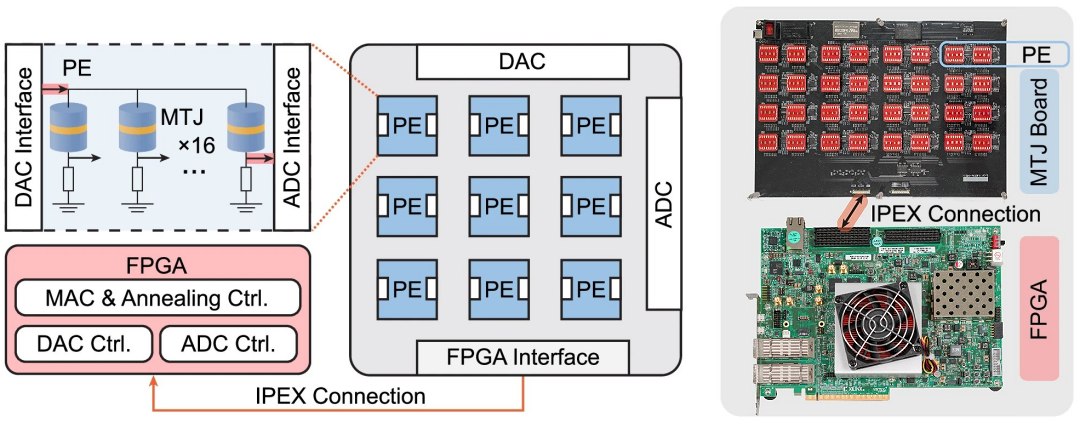
Yang and his colleagues built a probabilistic computer based on magnetic tunnel junctions, nanoscale components that can generate randomness in a natural and adjustable way. It’s a step forward from spintronics, which in itself is a promising path to running combinatorial optimization applications faster and more energy- efficiently .

Winning against quantum computing

The second prototype is a larger probabilistic Ising machine , consisting of 250 magnetic tunneling junctions for spin transfer torque.
The implementations showed that a clustered parallel update method allows for a 10-fold speedup for sparsely connected graphs without altering the hardware. The researchers also experimentally demonstrated that simulated quantum annealing improved solution quality by 20 times compared to conventional simulated annealing, in addition to increasing robustness to device variability.
“By combining stochastic magnetic devices with parallel architectures and advanced annealing algorithms, we can accelerate optimization while reducing power consumption,” said Yang. “Instead of treating randomness as a source of error, we utilize it as a computational resource.”
Together, the two demonstrations cover crucial challenges in probabilistic computing: performance, scalability, energy efficiency, and the quality of the solutions generated.
The team now aims to further expand its hardware capabilities and explore integrated architectures for large-scale probabilistic computing. These chips could enable energy-efficient computing platforms for AI, logistics, planning, financial modeling, communications, and electronic project automation, the team says.
Source: www.inovacaotecnologica.com.br
Source link