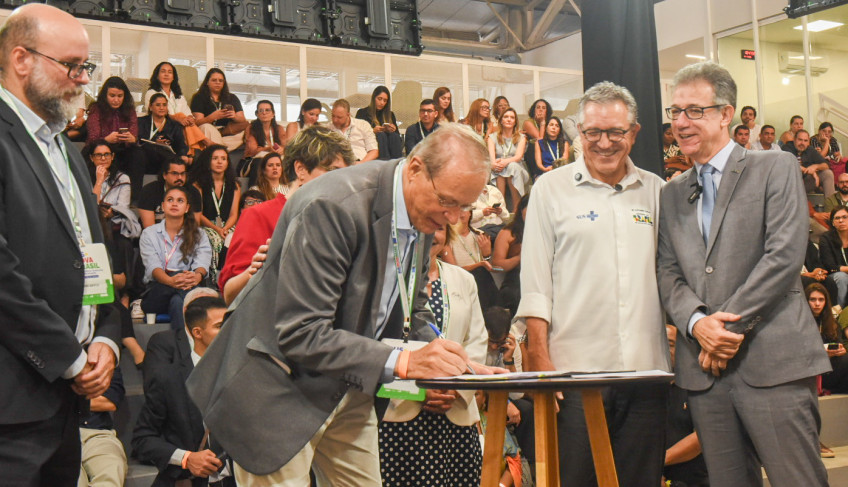
Technology-based startups that develop innovations focused on the area of oncology applicable to the Unified Health System (SUS) may receive financial support of up to R$100,000. Sebrae and the Ministry of Health launched, this Friday (17), during the opening of the SUS Inova Brasil Fair, in Rio de Janeiro, the Inova SUS Notice, which is part of the Technological Challenge for the Unified Health System – SUS Hackathon.
The initiative is the result of the Technical Cooperation Agreement (ACT) signed between Sebrae, the ministries of Health and Development, Industry and Commerce (MDIC), the National Health Surveillance Agency (Anvisa), the Brazilian Hospital Services Company (Ebserh), which coordinates the network of University Hospitals, and the Pan American Health Organization (OPAS).
The objective is to support technology-based companies in health and university hospitals through training actions, qualification in health regulation and incentives for innovation. According to Sebrae’s technical director, Bruno Quick, ACT plays a fundamental role in accelerating the entire ecosystem for the country and ensuring that science and innovation reach Brazilian patients.
Today, we see other countries pushing innovation through the defense system, but in Brazil it is different. It’s great to see our healthcare system driving innovation in our country. And this partnership that we are signing today shows that Sebrae is at the side of health innovation in the country. Proof of this is that one of every four startups served by Sebrae’s Catalisa program is in the area of health.
Bruno Quick, technical director of Sebrae
Scheduled to run until April 2027, the notice will select, accelerate and reward Brazilian startups in the health sector capable of developing medical devices and technological solutions that face real challenges in oncology, with potential for social impact, scalability and economic sustainability.
Sebrae will support 15 selected startups, three per region of the countrythrough acceleration actions for six months. Participating startups will face two challenges. The first will be to create a medical device for diagnosis and clinical monitoring in oncology. The second is to develop instruments and devices (active or non-active) to expand oncological surgical capacity.
At the end of the process, the best solutions will be awarded with resources from the Ministry of Health, being R$100,000 for first place; R$50 thousand for the second and R$30 thousand for the third. In addition to financial recognition, participating startups will have access to mentoring, training and experimentation environments, increasing the chances of validating and incorporating the solutions developed into the SUS.
The partnership also provides for the training of small innovative companies in regulatory aspects, both in relation to Anvisa’s requirements and the requirements necessary for incorporating technologies into the SUS. Another highlight is the structuring of the Regulatory Sandbox, which will allow controlled experimentation of health innovations developed by deeptechs.
The proposal is to promote safe innovation, generate evidence to improve regulatory standards and accelerate solutions capable of expanding access to healthcare, especially in priority regions and populations.

Catalisa ICT
One of the highlights of the partnership is the potential for mobilizing Catalisa ICT, a Sebrae initiative that has already promoted around 300 deeptechs, approximately 25% of which are in the health sector, creating a highly qualified audience to participate in the call for proposals.
Source: www.agenciasebrae.com.br
Source link